Wednesday, 23 September 2026
The rapid expansion of artificial intelligence is turning computing capacity, semiconductor production and electricity supply into increasingly important constraints on economic growth, according to a discussion between former Intel chief executive Pat Gelsinger and OpenAI Head of Compute Sachin Katti at AI4 2026 in Las Vegas.
The discussion focused on the physical infrastructure required to support increasingly powerful AI models and the scale of investment needed across semiconductor manufacturing, data centres, electricity generation and communications networks.
AI4 2026 was held at The Venetian in Las Vegas from 4–6 August, bringing together technology companies, investors and corporate executives focused on the commercial development of artificial intelligence. The conference programme identifies Katti as OpenAI’s Head of Compute and Gelsinger as a general partner at Playground Global and former CEO of Intel.
Gelsinger argued that virtually every major development in AI ultimately depends on semiconductor capacity. While software models attract much of the public attention, the computing infrastructure underneath them is becoming one of the industry’s most significant economic and physical requirements.
He described semiconductors as the underlying fuel of an increasingly token-driven digital economy, pointing to the extraordinary technical complexity and capital requirements involved in producing advanced chips.
The challenge is no longer simply designing faster processors. New semiconductor fabrication plants can require investments running into tens of billions of dollars and take years to develop, while the most advanced manufacturing processes depend on highly specialised equipment, materials and supply chains concentrated among a relatively small number of global companies.
Companies such as TSMC and semiconductor-equipment manufacturer ASML have consequently become critical participants in the expansion of AI infrastructure.
Gelsinger argued that semiconductor companies have so far captured a substantial share of the economic value generated by the current AI investment cycle as demand for processors, advanced memory and manufacturing equipment continues to rise.
However, the next stage of the market could increasingly depend on improving efficiency rather than simply adding more computing power.
Current AI systems consume significant amounts of electricity and require enormous quantities of high-bandwidth memory and supporting infrastructure. Gelsinger said today’s generation of graphics processors remains relatively inefficient when measured against the amount of energy required to generate AI workloads.
Future chip designs are therefore likely to focus increasingly on reducing energy consumption, bringing memory physically closer to processing units and improving the amount of useful computing delivered for every watt of electricity consumed.
Katti similarly emphasised that the challenge facing AI companies extends well beyond semiconductor availability.
Building large-scale AI infrastructure requires simultaneous development of data centres, electricity connections, communications networks, cooling systems and computing equipment. Constraints at any one of these points can delay the deployment of new AI capacity.
The availability of power is becoming particularly important.
Gelsinger argued that the potential scale of AI infrastructure investment will ultimately be limited by how much electricity economies can produce and deliver to locations where new computing facilities are being constructed.
“You are fundamentally an energy entity,” he said of the emerging AI economy, arguing that companies cannot install billions of dollars of processors unless sufficient electricity is available to operate them.
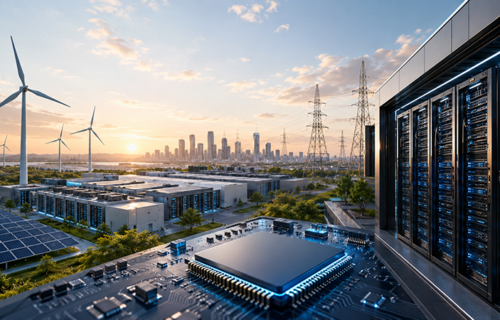
That connection between AI and electricity generation is already beginning to reshape investment strategies across the global data-centre market.
Technology companies and data-centre developers are increasingly examining long-term electricity contracts, renewable energy projects, nuclear generation and on-site power solutions as they seek more reliable access to electricity.
For the property industry, this is changing the criteria used when selecting locations for large computing campuses. Land availability remains important, but access to high-capacity electricity networks, fibre infrastructure and cooling resources is increasingly determining where projects can realistically be developed.
Katti also highlighted the time required to bring new infrastructure into operation. Semiconductor development cycles can stretch across several years, while obtaining land, planning approvals and grid connections for large data centres can create additional delays.
Accelerating these development cycles will therefore become an important part of expanding global computing capacity.
At the semiconductor level, Gelsinger expects improvements in architecture and memory integration to significantly reduce the cost of AI inference over time.
Today’s processors frequently face limitations caused not by computing capability itself but by the speed at which information can be transferred between processors and memory. Bringing larger amounts of memory closer to computing units could substantially improve performance while reducing the infrastructure required for individual workloads.
Specialised processors may also become increasingly important, although both speakers cautioned against designing chips too narrowly around today’s AI architectures.
AI models are changing rapidly and semiconductor development cycles remain comparatively long. A processor optimised for a particular generation of models could potentially reach commercial production after the underlying algorithms have already changed.
This creates an unusual investment challenge for both semiconductor manufacturers and data-centre operators: infrastructure with multi-decade investment horizons is being developed for a technology whose underlying architecture can change within months.
The discussion also highlighted the growing strategic importance of semiconductor manufacturing.
Advanced chip production remains concentrated among a small number of companies and locations, creating concerns among governments and technology groups about supply-chain resilience. The complexity of rebuilding semiconductor manufacturing ecosystems means that simply investing additional capital cannot immediately create new production capacity.
Companies such as TSMC and ASML developed their technological positions over several decades, supported by networks of specialised suppliers, engineers and manufacturing expertise.
Nevertheless, the scale of investment now flowing into AI is creating incentives to expand production, develop alternative semiconductor architectures and improve manufacturing techniques.
Gelsinger said the economics of AI infrastructure will ultimately have to improve substantially if the technology is to expand to the scale currently anticipated by the industry.
The amount of capital flowing into processors, data centres and energy infrastructure is already enormous, and he suggested that future AI infrastructure investment could eventually become significant enough to be measured as a share of global economic output.
For real estate and infrastructure investors, the implications extend well beyond the technology industry.
The AI boom is increasingly linking the future of data centres with electricity generation, semiconductor manufacturing, industrial development and communications infrastructure. Markets capable of providing land, power, connectivity and predictable permitting processes are therefore likely to become increasingly competitive locations for new computing investment.
The next phase of AI development may consequently depend as much on factories, electricity networks and real estate as on advances in software.
As Gelsinger and Katti argued in Las Vegas, the race to develop more powerful artificial intelligence is rapidly becoming a race to build the physical infrastructure capable of running it.
© 2026 cij.world