Saturday, 19 September 2026
Tokyo’s office market has undergone a significant transformation since the pandemic, but not in the way many initially expected. Rather than triggering a widespread decline in office demand, hybrid working has accelerated a shift in occupier preferences, creating a clear divide between premium Grade A buildings and older secondary office stock.
As companies reassess the role of the workplace, demand has increasingly concentrated in high-quality assets that offer modern amenities, sustainability credentials, disaster resilience and excellent transport connectivity. This flight-to-quality trend has become one of the defining features of Tokyo’s office market and has helped support leasing activity despite broader changes in workplace behaviour.
The strongest demand remains concentrated in central Tokyo, where newly developed Grade A buildings continue to attract occupiers seeking to upgrade their office environments. Pre-leasing activity has remained robust across several major developments, reflecting sustained demand from both domestic and international companies. Many occupiers are using lease expirations and corporate restructuring initiatives as opportunities to relocate into higher-quality space.
Several major corporate relocations illustrate this trend. Companies across manufacturing, technology and business services sectors have announced moves to newly developed office towers in districts such as Yaesu, Takanawa Gateway and Akasaka. In many cases, the decision is driven not simply by location but by the ability to provide employees with more collaborative, flexible and attractive working environments.
A key factor behind this shift is the growing importance of environmental, social and governance (ESG) considerations. Sustainability has become an increasingly important criterion in leasing decisions as occupiers seek to align real estate strategies with broader corporate objectives. Buildings with strong environmental performance, energy efficiency and sustainability certifications are increasingly preferred by large occupiers.
Japan’s evolving sustainability framework is reinforcing this trend. New disclosure requirements and growing investor focus on ESG performance are encouraging both landlords and tenants to prioritise more sustainable buildings. As a result, modern office developments that incorporate energy-efficient systems, lower carbon footprints and enhanced operational performance are gaining a competitive advantage.
Employee wellbeing has also emerged as a major consideration. Japan’s tight labour market and demographic challenges have increased competition for talent, making workplace quality an important recruitment and retention tool. Many companies now view office design as an extension of corporate culture and employee engagement strategies.
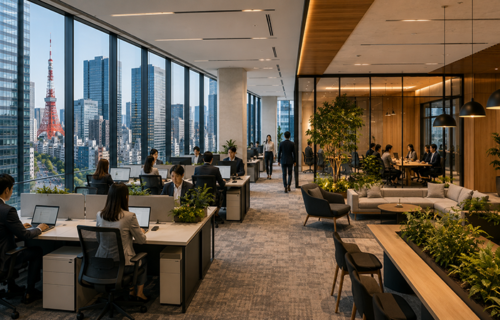
Modern developments increasingly incorporate wellness-focused amenities such as lounges, collaborative workspaces, fitness facilities, cafés and outdoor areas. These features are intended to improve employee experience while encouraging greater in-person interaction and collaboration.
Hybrid work has further strengthened demand for flexible office solutions. While Japan has generally maintained higher office attendance levels than many Western markets, companies are increasingly seeking workplace strategies that combine flexibility with collaboration. This has supported demand for flexible workspace operators and adaptable office layouts capable of accommodating changing work patterns.
At the same time, older office buildings face growing challenges. Assets that lack modern specifications, sustainability features or convenient access to transportation are finding it increasingly difficult to compete with new developments. This divergence has created a two-tier market in which premium assets continue to attract strong demand while secondary stock experiences greater leasing pressure.
Tokyo’s office market is therefore not experiencing a decline in demand but a redistribution of demand toward higher-quality buildings. The workplace remains important, but occupiers now expect more from office space than before the pandemic. Sustainability, employee wellbeing, flexibility and resilience have become core requirements rather than optional features.
As redevelopment activity continues across central Tokyo and occupier expectations evolve further, the flight-to-quality trend is likely to remain one of the defining characteristics of Japan’s office market for the remainder of the decade.
Copyright: CIJ.World Japan Research & Analysis Team