Sunday, 4 October 2026
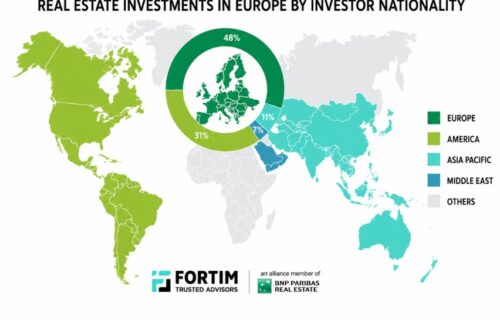
In Europe, most investors in commercial real estate still come from within Europe, accounting for 48%. They are followed by American investors, with 31%, while investors from Asia Pacific rank third, at a significant distance, with 7%, and those from the Middle East rank fourth, with 2%, in the first quarter of 2026, according to BNP Paribas Real Estate data.
According to BNP Paribas Real Estate, cross-border investment in Europe reached EUR 15.1 billion in the first quarter of 2026, while domestic investment, carried out by European investors in their own markets, totalled EUR 21.1 billion.
“Europe is strengthening its position as the main driver of real estate investment on the continent, in a context where European capital remains active and focused on markets with solid fundamentals. The volume of approximately EUR 7.3 billion directed toward cross-border transactions confirms investors’ confidence in European assets, while the significant growth recorded in markets such as the United Kingdom, Germany, and Italy shows that investment appetite is gradually returning, especially where there is liquidity, stability, and clear yield prospects,” said Nicolae Ciobanu, Managing Partner – Head of Advisory, Fortim Trusted Advisors, an alliance member of the BNP Paribas Real Estate.
By contrast, American investors, although representing almost one third of foreign capital, have adopted a more selective approach. Their activity was mainly driven by specific opportunities, particularly in Sweden, Spain, and Poland.
European capital dominates the analysed real estate transactions, accounting for more than two thirds of the investment volume and indicating significantly stronger interest compared with other buyer origin regions. At the same time, non-European capital continues to be present, but remains more attentive to financing costs, asset quality, and the predictability of local markets.
In Romania, investors from the region prevail
In Central and Eastern Europe, including Romania, investors are assessing opportunities more carefully than in previous years. While in mature markets the return of capital is supported by higher liquidity and a larger volume of available institutional products, Romania is in a different position: yields remain attractive, but the macroeconomic context requires greater caution.
Forecasts regarding the evolution of the local economy are being examined more carefully, while growth scenarios are assessed more conservatively.
Romania remains a relevant market in the region, but investment decisions will be more selective. Capital is available, but it is being directed primarily toward well-positioned assets, with stable income and low operational risk.
The origin of capital is changing, local and regional investors are becoming more visible
One of the most important trends for the coming period is the change in the structure of active capital in the market. While in previous years large transactions were dominated mainly by Western European institutional funds, there is now greater activity from local, regional, and entrepreneurial capital.
CEE investors, wealthy families diversifying their portfolios, private capital, and opportunistic funds are more actively analysing markets where they can achieve higher returns than in Western Europe. In Romania, this may lead to an increase in medium-sized transactions, especially in the industrial-logistics sector, retail parks, hotels, and assets with repositioning potential.
At the same time, institutional investors remain interested but are waiting for greater predictability regarding financing costs and yield evolution.
“Romania remains on investors’ radar, but we are no longer talking about broad-based investment appetite. Capital is present, but it is more disciplined, more risk-aware, and more focused on assets that can deliver stable long-term income. Over the next 12–24 months, we will likely see a market dominated by selective transactions, more active local and regional capital, and investors looking for well-founded opportunities, not just high yields,” said Ștefan Oană, Head of Capital Markets, Fortim Trusted Advisors, an alliance member of the BNP Paribas Real Estate.