Wednesday, 30 September 2026
India’s aggressive infrastructure spending is rapidly becoming the defining feature of its economic strategy, but whether it can deliver a lasting boost to competitiveness and logistics efficiency remains a question of execution rather than ambition.
Capex Surge Signals Structural Shift
Public investment has more than doubled in just four years, rising from under ₹6 lakh crore in FY2021–22 to over ₹11 lakh crore in FY2025–26, according to the Ministry of Finance India. This marks a clear pivot toward capital-led growth, with policymakers prioritising infrastructure over consumption-driven expansion.
The scale is significant by emerging market standards, although headline projections for long-term infrastructure pipelines often combine both public and private investment, making direct comparisons less straightforward.
Connectivity Gains Begin to Show
India’s transport backbone has expanded steadily over the past decade. National highways have grown materially, improving freight movement between industrial and consumption centres and reducing transit times.
The impact is increasingly visible. The World Bank ranked India 38th in its 2023 Logistics Performance Index, reflecting progress in infrastructure, customs and shipment reliability.
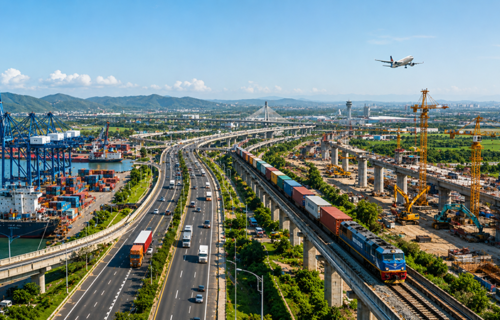
Ports and rail systems are also undergoing upgrades, while dedicated freight corridors and multimodal logistics hubs are expected to further streamline long-distance cargo movement.
Logistics Reform Still a Work in Progress
Despite improvements, India’s logistics system remains cost-heavy and fragmented. Historically estimated at 12–16 percent of GDP, logistics costs have been a long-standing constraint on competitiveness.
Government initiatives such as the National Logistics Policy and the PM Gati Shakti platform aim to address these inefficiencies through integrated planning and digital coordination. However, independent estimates suggest costs remain above 10 percent of GDP, indicating that meaningful efficiency gains are still evolving rather than fully realised.
Competitiveness Gains Depend on Execution
Improved infrastructure has the potential to reshape India’s economic geography by linking hinterland regions more effectively to ports and industrial corridors. This could lower costs, support manufacturing growth and enhance export competitiveness.
Yet structural challenges persist. Land acquisition, regulatory complexity and uneven execution across states continue to slow project delivery and dilute impact.
A Long-Term Play, Not an Immediate Leap
India’s infrastructure drive represents a genuine structural shift toward investment-led growth. The direction is clear, and early gains are visible, particularly in connectivity and logistics performance.
However, the transformation into a globally competitive logistics and manufacturing platform will be gradual. The real test lies not in the scale of announced spending, but in the consistency and efficiency of delivery over the next decade.
Source: CIJ.World India Research & Analysis Team