Sunday, 4 October 2026
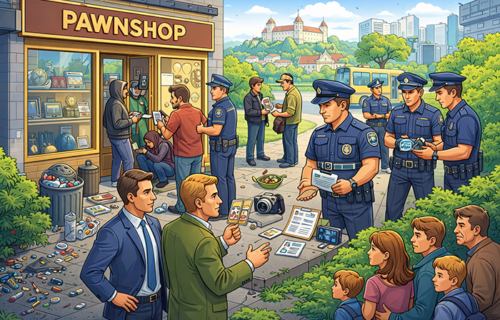
Municipal representatives in Slovakia are calling for stricter regulation of pawnshops, citing concerns over their impact on public safety and quality of life in urban areas.
At a press briefing in Bratislava, city officials outlined proposals aimed at addressing what they describe as a lack of clear rules governing pawnshop operations. According to local authorities, these businesses can contribute to criminal activity, including the circulation of stolen goods and associated social issues in surrounding neighbourhoods.
Bratislava Mayor Matúš Vallo said: “We have a number of concrete solutions for the operation of the pawnshops. However, their implementation also requires legislative changes, so we are calling again to the state to proceed as soon as possible. For if this state does not, the communities living around the lien will continue to suffer.”
The proposed measures include stricter requirements on ownership transparency, mandatory identification and recording of goods and sellers, and increased oversight. Municipalities are also seeking greater authority to regulate the location and operating conditions of pawnshops.
Martin Chren, Mayor of Bratislava’s Ružinov district, said: “Therefore, to be able to regulate where the pawnshop may be and where not, what opening hours it can have, and if it is evident that there is a public order violation in connection with its operation, then also be able to cancel the operation of such a lien.”
Local residents have also raised concerns about the day-to-day impact of pawnshop activity. Ján Sabo, a resident of the affected area, said: “Every day we see the same scenario. People come with different goods, which often still contains anti-theft security features. After the monetization, a drug dealer is waiting a few meters further. And after a quick exchange, drugs are applied, often directly at our homes. There is a hazardous waste and people under the influence of drugs right in the space where we live. This doesn’t happen once in a while. This happens daily, in front of the eyes of the inhabitants, in a locality full of families with young children. People are often afraid to walk past their own home. It has a very specific impact on the quality of our lives.”
City authorities said they have already taken steps to improve safety in affected areas, including increased police patrols, infrastructure upgrades and traffic adjustments. However, they argue that these measures are undermined by the continued operation of pawnshops without tighter regulation.
Vallo added: “Over the past year, we have invested enormous efforts in this area to improve security. We radically intensified the patrol of the police here, people reported problematic behaviors, followed by prompt police exits. Last year, the number of interventions by the city police in this neighborhood has quadrupled. We have improved the lighting here, have made changes in transport, we are checking the places reserved for taxis, as it was those abused by dealers for drug sales. And it must be said that the state also reacted to our call for deteriorating security, and some of the things we have pointed out have moved forward. For example, repeated petty thefts are already a criminal offence again.”
Officials noted that similar issues have been identified in other parts of the city and argued that existing local measures are insufficient without changes at the national level.
Chren added: “If we look at companies providing, for example, fast loans or on a gaming room, this type of business is regulated in Slovakia. It’s a perfectly normal and common thing that such a business is regulated. Anyone who goes to the playroom must show an ID card. Similarly, in reserving, if someone takes over the goods, they should be responsible for their legal origin.”
Vallo concluded: “This is an acute problem that needs to be addressed. The problem of safety is one of the most important for residents and does not have a party T-shirt. I therefore ask all political parties to face this challenge and adopt a rapid legislative change that will return the lives of residents around troubled pawnshops to normal. We invest a lot of time, money and energy in solving the problem of security, and we don’t want it all to go out.”