Thursday, 22 October 2026
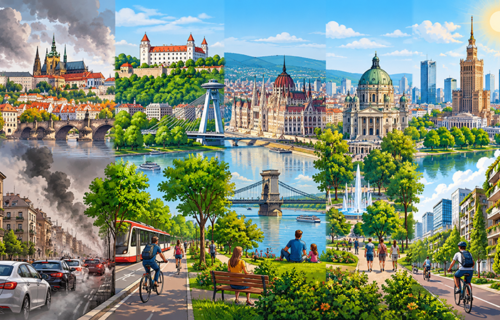
Environmental conditions are becoming an increasingly important factor in determining the attractiveness of Europe’s capital cities as places to live, work and invest. While economic opportunities, housing costs and infrastructure have traditionally dominated comparisons between urban centres, greater attention is now being paid to the quality of the air residents breathe, the water they consume, the availability of natural surroundings and the ability of cities to protect their populations from rising temperatures and pollution. An examination by CIJ.World of Prague, Bratislava, Budapest, Bucharest and Warsaw in 2026 reveals different approaches to environmental management, alongside challenges that continue to affect the health and everyday comfort of millions of residents.
Air pollution remains one of the most significant concerns across the five capitals. Although European cities have made progress in reducing emissions from transport, industry and domestic heating, concentrations of harmful particles and gases continue to present health risks. European environmental monitoring published in 2026 indicates that fine particulate pollution remains widespread, with many monitoring locations exceeding internationally recommended health thresholds. The consequences extend beyond respiratory illnesses, with prolonged exposure also associated with cardiovascular disease and other serious medical conditions. For residents considering where to live, the difference between a property beside a heavily trafficked road and one situated in a quieter, greener neighbourhood can therefore be substantial.
Prague has several environmental advantages, particularly its established public transport system and extensive network of parks, woodland and other vegetated areas. Trams, metro services and buses provide alternatives to private vehicles, while green corridors and recreational areas contribute to the city’s residential appeal. Municipal planning information identifies approximately 834 hectares of established parks and hundreds of kilometres of streets containing trees. Nevertheless, these environmental benefits are not distributed evenly. Densely developed central districts and locations experiencing substantial redevelopment face challenges involving traffic, limited vegetation and the accumulation of heat during summer. As former industrial and railway properties are transformed into residential and commercial districts, the integration of public greenery, shaded streets and environmentally responsible building design is becoming increasingly important.
Bratislava benefits from a distinctive geographical setting, with the Danube, surrounding forests and the Little Carpathians providing access to natural environments close to the urban area. These features offer recreational opportunities and contribute to the city’s environmental character. However, proximity to nature does not automatically guarantee favourable living conditions throughout the capital. Heavily developed neighbourhoods experience different levels of traffic exposure, summer temperatures and access to vegetation. Municipal assessments have identified parts of Staré Mesto, Ružinov and Petržalka as particularly vulnerable to excessive heat. During 2026, the city introduced a network of more than 30 publicly accessible locations where residents could find relief during hot weather, demonstrating the growing importance of practical measures designed to protect people from extreme temperatures.
Budapest faces a more complex combination of environmental pressures associated with its transport network, residential heating systems and densely developed urban districts. Pollution generated by vehicles and heating remains a concern, particularly where traffic is concentrated and buildings have limited energy efficiency. During October 2026, municipal authorities presented proposals for a revised programme intended to improve air conditions across Budapest and neighbouring settlements. The initiative recognises that environmental problems extend beyond administrative boundaries, with commuting patterns, heating emissions and regional activities influencing conditions throughout the metropolitan area. Budapest’s residential environment also varies considerably between its busy central streets, riverside districts and greener neighbourhoods extending towards the surrounding hills.
Bucharest continues to face challenges involving traffic emissions, summer heat and the condition of its urban vegetation. The Romanian capital’s dense road network and extensive built environment contribute to environmental pressures that can be particularly noticeable during periods of high temperatures. Authorities have sought to improve their understanding of local pollution through the introduction of additional monitoring equipment, including sensors positioned near schools and medical facilities. The expansion of environmental observation is important because pollution levels can differ considerably between neighbourhoods and even individual streets. Meanwhile, proposals to develop a wider network of protected and connected green areas around Bucharest could improve access to nature and strengthen the city’s ability to cope with climate-related pressures, although the eventual benefits will depend on implementation.
Warsaw has adopted a more direct approach to reducing pollution associated with older vehicles. The city’s designated low-emission traffic area, introduced in 2024, entered a further stage of implementation at the beginning of 2026, tightening access requirements for certain petrol and diesel vehicles. The programme is intended to reduce harmful emissions in areas experiencing substantial traffic activity. Official environmental assessments have also recorded improvements in some air quality measurements, including compliance with applicable annual limits for particulate pollution and nitrogen dioxide during 2024. However, meeting existing regulatory requirements does not necessarily mean that pollution has fallen to levels considered optimal for long-term human health. Continued monitoring will be necessary to determine whether transport restrictions produce lasting improvements.
Access to safe drinking water represents another essential consideration when comparing the environmental quality of these capitals. Modern treatment facilities, reliable distribution networks and regular testing are fundamental to protecting public health. Warsaw’s municipal water provider published monitoring results during 2026, while sanitary assessments confirmed compliance with relevant requirements for the samples and parameters examined. Across the wider region, however, comparisons must also consider the age and condition of residential plumbing. Water that meets official standards when entering a distribution system may encounter additional risks within older buildings, particularly where internal pipework has not been modernised. Consequently, the environmental quality of individual residential properties cannot always be determined from municipal infrastructure performance alone.
Urban greenery is another area where appearances can be misleading. A capital surrounded by forests may appear environmentally attractive, yet residents living in densely populated neighbourhoods might have limited access to parks within walking distance. Equally, a city with smaller natural areas distributed throughout residential districts may provide more frequent opportunities for outdoor activity and relief from urban temperatures. The quality, accessibility and maintenance of green spaces are therefore as important as their total area. Trees along streets, vegetation within residential developments and connections between parks can also improve the experience of moving through a city without relying on private transport.
Noise pollution deserves greater attention in assessments of urban living conditions. Road traffic, aircraft movements, railway operations and construction activity can create persistent disturbances, particularly in residential areas situated close to major transport infrastructure. Long-term exposure to excessive noise is associated with disrupted sleep, stress and increased risks to cardiovascular health. The five capitals contain neighbourhoods with substantially different acoustic environments, making it difficult to establish meaningful comparisons using general citywide descriptions. For prospective residents and property investors, understanding the immediate surroundings of a building may be more informative than relying on a city’s overall environmental reputation.
Climate conditions are also changing the requirements for healthy urban development. Extended periods of high temperatures can make densely constructed neighbourhoods uncomfortable, especially where buildings retain heat overnight and public spaces provide little shade. Older residents, young children and people with existing medical conditions may be particularly vulnerable. Across Central and Eastern Europe, local authorities are increasingly considering the role of vegetation, water management, building materials and public cooling facilities in reducing these risks. The issue is especially relevant to residential development, where decisions about insulation, ventilation, landscaping and building orientation can influence living conditions for decades.
The environmental performance of housing itself represents a further consideration. Poor ventilation, dampness, mould, inadequate insulation and excessive indoor temperatures can affect residents even in cities with relatively favourable outdoor conditions. Older apartment buildings may require substantial investment to improve energy performance and internal comfort, while newly constructed properties are increasingly expected to incorporate measures addressing overheating, energy consumption and water efficiency. For the property sector, this creates a closer relationship between environmental standards, building quality and long-term residential attractiveness.
Waste collection, energy infrastructure and the management of natural resources also contribute to the wider environmental picture. Reliable municipal services, effective recycling systems and cleaner energy production can reduce pollution and improve urban cleanliness. Nevertheless, these factors should be distinguished from conditions that directly affect residents in their immediate surroundings. A city may have ambitious environmental targets and extensive investment programmes while still experiencing substantial traffic emissions, inadequate greenery or uncomfortable residential environments. The effectiveness of environmental policy ultimately depends on measurable improvements rather than the scale of announced commitments.
The comparison of Prague, Bratislava, Budapest, Bucharest and Warsaw illustrates why identifying the healthiest capital requires more than examining individual environmental achievements. Prague benefits from an extensive public transport network and established green infrastructure. Bratislava offers access to substantial natural surroundings while developing measures to address heat exposure. Budapest is pursuing wider cooperation to reduce pollution across its metropolitan area. Bucharest is expanding environmental monitoring and considering additional green infrastructure, while Warsaw is implementing restrictions intended to reduce emissions from older vehicles. Each city has identifiable strengths, but none can be declared the healthiest on the basis of these measures alone.
For real estate investors, developers and occupiers, environmental quality is becoming an increasingly relevant component of location assessment. Residential demand may be influenced not only by access to employment, schools and transport, but also by pollution exposure, neighbourhood greenery, noise levels and the ability of buildings to remain comfortable during extreme weather. These characteristics can vary significantly within the same city, meaning that environmental assessments conducted at district or street level may provide greater practical value than broad comparisons between capitals.
The findings also demonstrate the importance of distinguishing environmental commitments from actual living conditions. New parks, cleaner transport systems and climate adaptation programmes can improve urban environments, but their effects must be measured over time. Similarly, a city’s proximity to forests or rivers does not necessarily compensate for pollution, traffic congestion or inadequate public space within its residential neighbourhoods. Reliable comparisons require consistent information on air quality, drinking water, vegetation, noise, temperature exposure and housing conditions.
As Central and Eastern European capitals continue to develop, the relationship between environmental quality and urban competitiveness is likely to strengthen. Cities that succeed in reducing pollution, improving access to nature and protecting residents from increasingly difficult climatic conditions may become more attractive places to live and invest. The central question is no longer simply which capital has the largest parks or the most ambitious environmental programme, but which can consistently provide the healthiest everyday environment for the people who call it home.
Source: CIJ.World Research & Analysis Team