Saturday, 31 October 2026
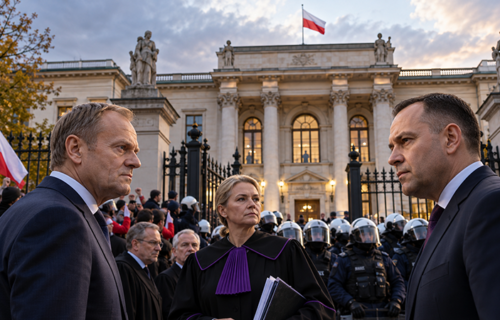
Poland has entered a new phase of political and constitutional confrontation following an attempt to remove the leadership of the country’s Constitutional Tribunal on 30 October 2026. The dispute brought police to the court’s headquarters in Warsaw, prompted demonstrations and led President Karol Nawrocki to abandon an official journey abroad. What began as a disagreement over judicial appointments has developed into a wider conflict over the authority of Poland’s constitutional institutions and the legal boundaries of government intervention.
The confrontation centred on Bogdan Święczkowski, president of the Constitutional Tribunal, and vice-president Bartłomiej Sochański, after orders were issued temporarily preventing them from carrying out their official duties. Anna Korwin-Piotrowska, a judge elected by parliament earlier this year, asserted that she was entitled to assume responsibility for the institution. The orders were intended to apply for one month, although their legal validity and the authority under which they were issued have been challenged.
The attempted leadership change followed months of disagreement over the appointment of new Constitutional Tribunal judges. President Nawrocki had refused to administer the required oaths to several candidates selected by parliament, raising questions about whether they could formally take up their positions. The judges subsequently participated in alternative oath-taking arrangements, while the Tribunal’s existing leadership continued to challenge their status. The dispute created competing interpretations of who was entitled to serve on the court and exercise its constitutional responsibilities.
Events escalated when police were deployed around the Tribunal building as protesters gathered to oppose the attempted suspensions. Some demonstrators breached the perimeter fence, while others confronted officers outside the premises. Three people were detained following disturbances. Warsaw police maintained that their presence was intended to protect public safety following warnings about possible threats to judges and employees. Opposition representatives questioned the circumstances of the deployment and accused the government of interfering with the independence of the judiciary.
President Nawrocki interrupted his journey to Senegal and returned to Warsaw as the confrontation intensified. He subsequently visited the Constitutional Tribunal and called for urgent discussions with parliamentary leaders. The president rejected the attempted removal of the Tribunal’s leadership and maintained that the measures undermined Poland’s constitutional arrangements. His intervention brought the dispute directly into the relationship between the presidency and Prime Minister Donald Tusk’s government.
Tusk defended the need for action to address problems within the judicial system, arguing that institutions affected by earlier political decisions must be brought back into compliance with constitutional principles. His government has repeatedly criticised the judicial changes introduced during the period when Law and Justice governed Poland between 2015 and 2023. Opposition politicians, including senior figures from Law and Justice, rejected the latest intervention and accused the government of attempting to gain control of a constitutional institution through procedures they consider unlawful.
The legal basis for the attempted suspensions has attracted criticism beyond the political opposition. Constitutional lawyer Dr Mateusz Radajewski has questioned whether the legislation invoked permits the Tribunal’s president and vice-president to be removed from their duties in this manner. Professor Marcin Matczak, who has previously criticised judicial changes introduced under Law and Justice, has also challenged the legality of the intervention. Their objections demonstrate that concerns about the procedure are not confined to one political camp, although the legal questions have not been conclusively resolved.
The disputed orders reportedly relied on provisions governing temporary interruptions to judicial duties, together with legislation addressing the administration of the Constitutional Tribunal. However, the Tribunal occupies a distinct position within Poland’s constitutional system, and the application of rules intended for other courts remains a central issue. The existence of suspension orders does not establish that they were lawfully issued, while objections to their validity do not independently resolve the separate dispute over the appointment of new judges.
Justice Minister Waldemar Żurek has also reportedly sought the removal of judicial immunity from Święczkowski and Sochański in connection with allegations concerning the obstruction of newly elected judges. Any removal of immunity would be a preliminary procedural step rather than a determination of criminal responsibility. The proposed proceedings add another dimension to a confrontation already involving disagreements over judicial appointments, institutional leadership and the interpretation of constitutional law.
The crisis has its origins in changes introduced to Poland’s judiciary more than a decade ago. Following the Law and Justice election victory in 2015, disputes emerged over appointments to the Constitutional Tribunal and the recognition of its decisions. European institutions subsequently raised concerns about judicial independence and the relationship between political authorities and the courts. When Tusk’s coalition assumed office in December 2023, it promised to address those concerns, but its proposed reforms encountered resistance from political opponents and successive presidents.
The Council of Europe’s Venice Commission has also examined questions surrounding the appointment of Constitutional Tribunal judges. Its position on the recognition of judges elected by parliament has become relevant to the present disagreement, although that issue is separate from the legality of the October suspension orders. The distinction illustrates the complexity of Poland’s constitutional dispute: an argument that one institution has acted improperly does not automatically establish that the measures taken against it are lawful.
The confrontation has exposed a deeper institutional problem. Poland’s government, presidency and competing groups within the judiciary no longer agree on the legitimacy of certain appointments or the authority of individuals exercising constitutional responsibilities. Such disagreements are particularly difficult to resolve when they concern the institution responsible for determining whether legislation complies with the constitution.
Further developments are expected as the disputed leadership arrangements, possible criminal proceedings and outstanding judicial appointments are examined. President Nawrocki’s intervention and the government’s determination to continue its judicial reforms suggest that the confrontation will remain a central issue in Polish politics. The immediate challenge is whether the institutions involved can establish a legally recognised procedure for resolving their differences without further undermining confidence in the constitutional system.
The events of 30 and 31 October represent more than a disagreement over two senior judicial positions. They reflect an unresolved struggle over the constitutional changes introduced during the previous decade and the methods being used to address them. Until the competing interpretations of judicial authority are resolved, Poland faces continued uncertainty over the leadership and functioning of one of its most important constitutional institutions.