Tuesday, 22 September 2026
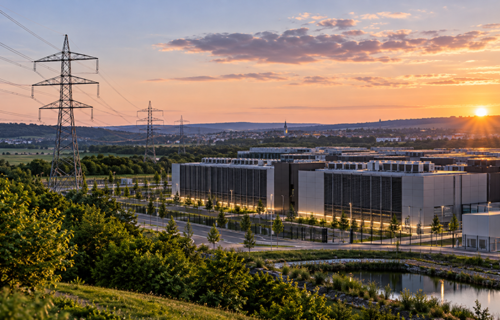
Luxembourg’s push to strengthen its position in artificial intelligence, cloud services and digital infrastructure is creating a new challenge for the country’s property and energy sectors. Large data centres require far more than suitable development sites: access to substantial and reliable electricity capacity is increasingly determining where projects can proceed. For Luxembourg, where several major facilities are being considered while the wider economy is also electrifying, the relationship between digital investment and the power network is becoming increasingly important.
The scale of potential demand illustrates the issue. Luxembourg grid operator Creos has been notified of five major proposed data-centre projects with combined electricity requirements of around 365 MW, while two additional projects representing approximately 70 MW have made preliminary enquiries. These figures do not mean all of the projects will be developed, but they show how significantly the sector could alter future electricity requirements if even part of the pipeline is delivered.
Google’s long-running proposal at Bissen provides the most visible example. The technology company acquired around 33.7 hectares there in 2017 for a potential data-centre campus. After years of uncertainty, the project returned to the planning process in 2026, including a public consultation earlier in the year. Its potential electricity consumption and impact on network costs have also been raised formally in Luxembourg’s parliament, demonstrating that the project has become as much an infrastructure question as a real-estate development.
The timing is significant because Luxembourg is already preparing a substantial upgrade of its electricity network. Creos is developing a new 380-kV connection with Germany as part of a wider programme intended to accommodate increasing demand from economic growth and electrification. Long-term scenarios indicate that peak electricity imports could reach around 1,600 MW by 2040, with additional large industrial or data-centre projects capable of pushing requirements higher. Further reinforcement is therefore being considered to provide greater capacity and resilience.
Data centres are only one component of this increase. Electric vehicles, heating systems, industrial decarbonisation and population growth will also require more electricity. The challenge for policymakers and grid operators is consequently not simply whether enough power can be supplied to individual computing facilities, but how very large new connections fit within an electricity system undergoing broader transformation. Facilities requiring more than 100 MW can also need direct access to Luxembourg’s highest-voltage network, making their location closely connected to electricity infrastructure.
At the same time, the government wants to increase Luxembourg’s computing capabilities. National strategies place artificial intelligence, data infrastructure and digital sovereignty among the country’s priorities, creating an incentive to attract investment in cloud services, computing capacity and related technology. Across Europe, rapidly increasing AI workloads are already intensifying competition for suitable data-centre locations, with grid access becoming one of the most important factors determining where new capacity can be built.
Luxembourg therefore faces a strategic balancing act. Digital infrastructure could reinforce its position as a European financial and technology centre, but large computing facilities must compete for future network capacity alongside other parts of the economy while satisfying increasingly demanding environmental and planning requirements. The Bissen project may become the first major test of that balance, but the wider issue extends well beyond Google. As AI increases the physical infrastructure required behind the digital economy, Luxembourg will have to decide how much data-centre growth its electricity system should accommodate and what investment will be necessary to make that expansion possible.
Source: CIJ.World Research & Analysis Team