Tuesday, 15 September 2026
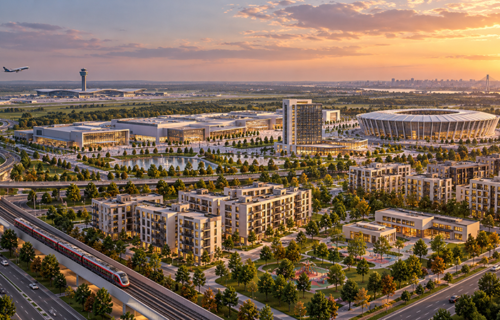
The construction programme surrounding Expo 2027 is transforming Surčin on a scale rarely seen on Belgrade’s western edge. Thousands of homes, exhibition facilities, a national stadium, hotel accommodation and major transport infrastructure are being developed within the same area, raising a question that will become increasingly important for Serbia’s property market: what happens when the Expo visitors leave? For the real estate industry, the significance of the project extends well beyond the exhibition itself. Serbia is effectively creating the physical foundations of a new urban district, supported by infrastructure intended to remain in use long after 2027.
The residential component alone is substantial. The Expo Village in Surčin is being developed with 1,500 apartments ranging from approximately 37 to 102 sqm. Unlike accommodation designed exclusively for a temporary international event, these homes are intended to enter civilian use after Expo. Schools, a kindergarten and supporting amenities are also planned, giving the development the potential to become a permanent residential neighbourhood. Adding 1,500 apartments to one location is significant, but their long-term impact will depend on how quickly households absorb them, how they are priced and whether sufficient employment, retail, services and transport connections develop around the new community.
Transport investment could ultimately prove more important to Surčin’s property prospects than the Expo itself. New infrastructure is intended to improve connections with central Belgrade, Prokop railway station, Belgrade Nikola Tesla Airport and Obrenovac, alongside upgrades to roads and other utilities serving the development area. Improved accessibility changes the property equation. Surčin has traditionally sat outside Belgrade’s principal commercial and residential districts, but its position close to the airport gives it strategic advantages. Better transport links could increase its attractiveness for residents while opening opportunities for hotels, logistics, business services and other airport-related activities.
The National Stadium provides another potential anchor. Large sporting venues can attract restaurants, entertainment, hospitality and leisure investment, particularly when combined with strong transport infrastructure. But stadium-led districts also carry risks. Without regular activity beyond major events, surrounding commercial areas can struggle to generate consistent footfall. The same question applies to the Expo exhibition facilities. Their economic value after 2027 will depend on whether Belgrade can maintain a programme of exhibitions, conferences and other events capable of keeping the complex active. Successful reuse could strengthen the city’s business tourism and events market, while underuse would leave substantial infrastructure without the level of commercial activity originally anticipated.
Hospitality development is therefore another area to watch. A hotel with around 400 rooms forms part of the wider programme, creating considerable accommodation capacity close to both the Expo site and airport. During the exhibition, demand should be supported by visitors, participants and organisers. Afterwards, performance will depend on whether the district can attract conferences, sporting events, airport travellers and other sources of year-round demand.
For property investors, surrounding land may ultimately be one of the most interesting parts of the story. Public investment in transport, utilities and major facilities can change the economics of previously peripheral development sites. Land that once lacked sufficient infrastructure can become viable for residential, commercial, hospitality or industrial projects once those connections are established. However, rising development potential should not automatically be interpreted as evidence of sustainable private-sector demand. Government spending can create roads, railways, utilities and public buildings, but it cannot guarantee that companies will lease offices, residents will purchase apartments or retailers will open stores.
That distinction will become increasingly important as Expo approaches. Official descriptions understandably emphasise the long-term benefits of the programme and its potential to create a new development area for Belgrade. The property market will eventually provide a more objective measure of whether those ambitions have been achieved. Evidence of private investment independent of the Expo programme would be particularly significant. New residential schemes, hotels, commercial developments or other projects launched because developers see permanent demand in Surčin would suggest that public investment is beginning to generate a wider property market.
The district’s proximity to the airport could also give it an economic identity that extends beyond Expo. Logistics, aviation-related services, hotels and businesses requiring rapid access to international transport could potentially reinforce residential and leisure development around the new infrastructure. The biggest question is whether all these components can develop into a functioning district rather than remaining a collection of individual projects. Successful urban areas require residents, employment, services and activity throughout the week, not simply crowds arriving for exhibitions, football matches or other major events.
Expo 2027 is therefore only the first deadline for Surčin. Construction must be completed and infrastructure needs to function before the exhibition opens, but the more important property-market test will begin after the event closes. By then Serbia will have created a large concentration of housing, transport infrastructure, hospitality, sports and exhibition facilities on Belgrade’s western edge. Whether private capital, businesses and residents continue building around them will determine if Surčin becomes one of Belgrade’s permanent growth districts or remains primarily the physical legacy of a major international event.
Source: CIJ.World Research & Analysis Team