Monday, 26 October 2026
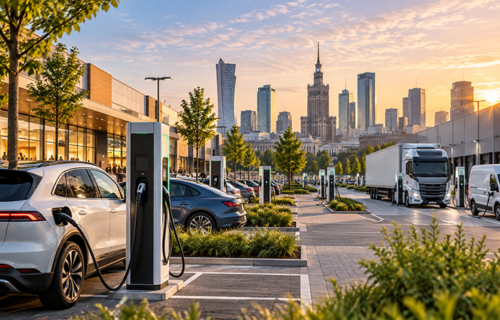
Poland continues to expand its electric vehicle charging infrastructure despite a decline in purchases of new battery-powered passenger cars. Figures published on 26 October 2026 in the latest Polish EV Outlook Index show that the country had 13,936 publicly accessible charging points at the end of September, representing an annual increase of 27%. The continued expansion of charging facilities is becoming increasingly relevant to commercial property development, particularly for shopping centres, retail parks, office complexes and industrial properties where access to electricity and vehicle charging may influence future investment requirements.
Higher-powered charging facilities are accounting for a growing proportion of the network. Poland had 7,113 direct-current charging points in September, an increase of 49% compared with the previous year, while the number of alternating-current connections rose by 11% to 6,823. Faster charging facilities now represent approximately 51% of publicly accessible charging points. A further 1,946 points are situated along European transport corridors, supporting electric vehicle travel across longer distances. For commercial property owners, these developments raise questions about the availability of suitable electrical connections, installation costs and the potential commercial benefits of providing charging services at locations used by customers, employees and delivery operators.
Charging infrastructure remains concentrated in Poland’s larger cities, with Warsaw recording 955 public charging points, followed by Gdańsk with 461, Poznań with 438, Kraków with 390 and Szczecin with 369. The geographical differences may influence where property developers consider additional charging capacity, particularly in areas where existing facilities are limited. Retail destinations and mixed-use developments could provide opportunities for further installations, although the commercial viability of individual projects will depend on local vehicle ownership, charging demand and electricity costs rather than the overall expansion of the national network.
The number of electric vehicles on Polish roads continues to increase, although new registrations indicate a less consistent market. By the end of September, the country had 152,768 fully electric passenger cars, 49% more than a year earlier, alongside 13,811 electric vans and trucks, representing annual growth of 68%. However, registrations of new electric passenger cars declined by 23% to 3,406 during September, reducing their share of the new passenger car market to 6.1%, compared with 8.9% in September 2025. Commercial electric vehicle registrations followed a different pattern, increasing by 72% to 328 vehicles during the month.
The increase in electric vans and trucks has potential implications for Poland’s warehouse and distribution property market. Logistics operators introducing electric vehicles may require dedicated charging areas, additional electrical capacity and changes to parking and vehicle circulation arrangements. Such requirements could become part of the design process for new industrial facilities or influence investment in existing buildings. Nevertheless, the available statistics do not establish how extensively electric commercial vehicles are being used by individual logistics operators or whether their adoption is already affecting warehouse leasing decisions.
The latest figures point to a transport market in which charging infrastructure is expanding more consistently than new electric passenger car sales. For Poland’s commercial property sector, the development creates opportunities to incorporate charging facilities into existing and planned buildings, but also introduces questions about investment costs, electricity supply and future utilisation. The Polish EV Outlook Index, compiled using information from F5A, PSNM and OTOMOTO, indicates that the country’s charging network is continuing to develop, while the financial and operational implications for individual property owners will depend on local conditions and the pace of electric vehicle adoption.