Wednesday, 14 October 2026
A series of violent incidents involving educational institutions in Poland has intensified public concern about school safety and prompted renewed debate over the responsibilities of government, families and educational authorities. Reports of attacks involving dangerous weapons, together with alleged plans for further violence, have led to increased police activity around schools. The events have also generated political disagreement over whether additional regulation of online activity would improve public safety or whether greater attention should be directed towards prevention, education and individual accountability.
The reported incidents occurred over several days in early October. On 7 October, a 19-year-old allegedly attacked people at a vocational school in Ostrołęka, injuring several individuals. Authorities were also reported to have intervened in connection with a suspected planned attack in Sierpc. A further serious incident was reported on 8 October at a school near Wyszków, where a former student allegedly attacked members of staff. Another incident involving injuries at a Warsaw educational institution was reported later that week. The precise circumstances, casualty figures and possible connections between these cases require confirmation through official investigations.
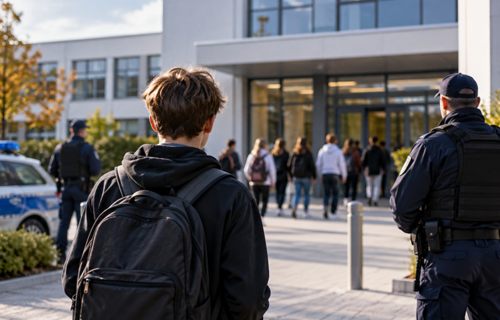
Polish authorities responded by increasing security measures at educational facilities, with police officers conducting inspections, maintaining a visible presence near schools and investigating potential threats. Reports indicated that thousands of officers had been deployed nationwide and that numerous educational buildings had undergone security checks. Investigators have also examined whether publicity surrounding individual attacks could encourage similar behaviour elsewhere. However, the existence of coordinated activity linking the incidents has not been established, and each case requires separate examination before broader conclusions can be drawn.
The incidents have also reopened disagreements between the government and the presidency over the regulation of harmful online material. Prime Minister Donald Tusk has linked concerns about the circulation of violent content to legislation intended to strengthen enforcement of European digital regulations. President Karol Nawrocki has opposed aspects of the proposed framework, raising concerns about freedom of expression and the powers available to administrative authorities. Although online platforms can contribute to the circulation of threatening material, the extent to which additional regulatory powers could have prevented the reported attacks remains uncertain. Establishing such a connection would require evidence about the perpetrators’ activities, warning signs and opportunities for intervention.
Beyond the political disagreement, the incidents raise broader questions about how schools identify and respond to potentially dangerous behaviour. Effective prevention depends on cooperation between teachers, parents, school psychologists, social services and law enforcement. Clear reporting procedures, appropriate access to mental health support and timely intervention when credible threats emerge can all contribute to safer educational environments. Families also play an important role in recognising behavioural changes, encouraging responsible conduct and maintaining communication with schools. These responsibilities are complementary rather than interchangeable, and no single institution can reasonably be expected to address every risk independently.
The physical security of educational buildings is another important consideration. Schools must balance their obligation to provide welcoming learning environments with the need to control unauthorised access and respond effectively to emergencies. This can involve reviewing entry procedures, visitor management, staff training, communication systems and cooperation with local police. However, increased security infrastructure should be proportionate to identified risks and supported by clear operational procedures. Additional equipment or surveillance alone cannot replace effective supervision, early intervention and the development of trust between students and school staff.
For public authorities, the immediate challenge is to determine which measures genuinely reduce the likelihood and consequences of violence without unnecessarily restricting civil liberties or disrupting education. The recent incidents have exposed the difficulty of responding to public anxiety while investigations remain ongoing and political disagreements intensify. A credible response requires verified information, careful examination of institutional responsibilities and practical measures supported by evidence. Protecting students and educators ultimately depends on more than legislation or police deployments; it requires sustained cooperation between families, schools, communities and the institutions responsible for public safety.
Source: WEI