Friday, 9 October 2026
International real estate capital in Africa has traditionally concentrated on a handful of established markets, leaving much of Francophone West Africa outside the mainstream institutional investment landscape. That gap is beginning to narrow. Economic expansion, infrastructure investment and growing demand for modern buildings are putting markets such as Côte d’Ivoire and Senegal under greater scrutiny, although significant differences in risk remain across the region.
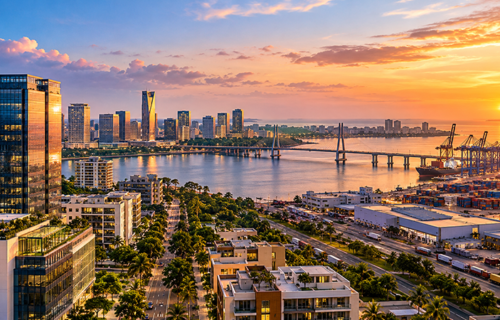
Côte d’Ivoire stands out as the clearest example. Its economy is expected to expand by around 6% in 2026, maintaining a long period of relatively strong growth. Abidjan has developed into an increasingly important regional business centre, supported by the country’s position within the West African Economic and Monetary Union and investment in transport, industrial capacity and urban infrastructure.
Commercial property supply has not always kept pace. Abidjan still has a relatively limited stock of offices meeting the requirements of multinational and large domestic occupiers. Prime office rents are around US$35 per sqm per month, while yields are approximately 9%. New business locations are also developing outside the traditional Plateau district as occupiers consider modern properties in Cocody, Marcory and other parts of the city.
Industrial and logistics property could become equally significant. Investment around the PK24 corridor north of Abidjan, together with industrial development and improved connections to the country’s port infrastructure, is creating new locations for manufacturing, processing and distribution. Prime industrial yields of around 11.5% illustrate both the returns available and the higher level of risk investors continue to price into the market.
Dakar offers a different proposition. Senegal’s current fiscal and debt pressures mean its economic environment is more challenging in 2026, but institutional-quality property remains scarce. Modern offices suitable for multinational businesses, international organisations and regional companies are limited, helping support prime rents of approximately US$26 per sqm per month and yields around 9.5%.
The shortage extends into parts of Dakar’s residential market, where rents for high-quality homes in established locations can be substantial. This reflects demand from expatriates and international organisations as well as constrained supply. For developers, the opportunity is therefore less about broad residential expansion and more about identifying specific groups of occupiers whose requirements are not being met by existing stock.
The monetary and legal environment provides another reason these markets deserve attention. Côte d’Ivoire and Senegal use the West African CFA franc, which maintains a fixed relationship with the euro. This provides greater exchange-rate predictability for euro-based investors than in many African markets. Both countries also operate within the OHADA business-law system, giving investors a more consistent legal framework across participating African economies.
The regional economic backdrop remains favourable. The West African Economic and Monetary Union is expected to grow by approximately 6% in 2026. Expanding cities, infrastructure programmes and private-sector activity should generate additional requirements for logistics facilities, offices, housing, hospitality and retail over the longer term.
Yet these advantages should not be confused with a fully developed institutional property market. Transaction volumes remain relatively small, market information can be limited and international investors may face difficulties deploying capital at sufficient scale. Financing, professional management, valuation transparency and the ability to sell assets efficiently remain important considerations. Conditions also vary sharply across Francophone West Africa, making country and city selection essential.
This is why the next phase of development is likely to be selective rather than regional. Abidjan currently offers the clearest combination of economic growth, infrastructure investment and commercial-property demand, while Dakar demonstrates how shortages of quality stock can create opportunities even against a more difficult economic background. Other markets will develop at different speeds depending on political stability, infrastructure and access to capital.
Francophone West Africa may therefore remain a frontier for institutional real estate rather than a mature investment destination. But that distinction is becoming increasingly important. The opportunity is no longer simply theoretical: modern assets are being developed, regional business centres are expanding and infrastructure is opening new investment corridors. For capital prepared to look beyond Africa’s traditional property hubs, parts of the region are starting to warrant much closer attention.
Source: © CIJ.World Africa Research & Analysis Team