Saturday, 19 September 2026
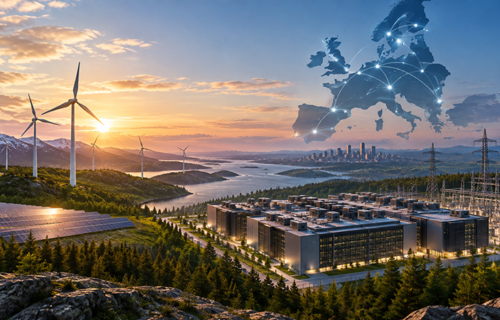
The rapid expansion of artificial intelligence is forcing data centre developers across Europe to reconsider where future computing capacity can be built. Electricity is emerging as one of the most important location criteria, creating opportunities in regions with available generation and grid capacity while making development increasingly difficult in some established markets.
Europe’s data centre industry has traditionally been concentrated around London, Frankfurt, Amsterdam, Paris and Dublin. These cities offered the connectivity, corporate demand and digital infrastructure required by operators. AI is changing the equation because the largest new computing facilities can require several hundred megawatts of electricity, alongside much larger development sites.
Developers are consequently searching further from established metropolitan locations. Large projects planned for the next several years are increasingly appearing in regional markets where land is more readily available and access to the electricity network may be easier to secure. For some AI applications, particularly model training, proximity to the end user is less important than access to dependable power.
Northern Europe is well positioned for this change. Finland, Sweden and Norway combine substantial low-carbon electricity generation with cooler climates and comparatively large areas available for development. Finland has attracted growing technology investment supported by nuclear generation and an expanding renewable sector, although rising demand from large electricity users is also beginning to place additional requirements on the country’s network.
France has a different advantage. Its extensive nuclear generating fleet provides a substantial source of low-carbon electricity while Paris remains one of Europe’s largest digital infrastructure markets. Paris added 72.5 MW of data centre capacity during the first half of 2026, demonstrating that France can continue expanding within an established European market while benefiting from its domestic electricity base.
Spain and Portugal could also gain from the changing market. Both countries have strong solar and wind resources and substantial areas where new energy and data centre projects could potentially be developed. This makes the Iberian Peninsula increasingly relevant for large computing operations that do not need to be immediately adjacent to Europe’s largest cities.
However, national electricity production tells only part of the story. A country can produce large quantities of renewable or nuclear electricity while individual locations remain unable to accommodate a 100 MW or 300 MW development. Transmission lines, substations, available network capacity and the timetable for securing a connection are becoming just as important as the amount of electricity generated nationally.
This problem is becoming increasingly visible across Europe. Electricity connection queues are now present in numerous EU markets as renewable projects, industrial facilities, transport electrification and data centres compete for network capacity. Grid investment has not always kept pace with the rapid increase in demand for new connections.
Central and Eastern Europe illustrates both sides of the opportunity. Poland has a rapidly developing digital economy and an expanding data centre market, particularly around Warsaw, but its electricity system is simultaneously undergoing a major transition. Renewable generation is growing while the country prepares for future nuclear capacity and extensive investment in transmission infrastructure.
The limitations of the existing Polish network are already evident. Around 42 GW of renewable connection applications were rejected during 2025 because sufficient network capacity was unavailable. This does not mean Poland lacks future electricity potential, but it demonstrates that additional generation cannot support new developments unless the grid can transport that electricity to where it is required.
For the property market, this could make sites with secured electricity increasingly valuable. A large industrial plot with an existing high-capacity connection, or credible access to a nearby transmission node, may offer a significant advantage over land in a more established location where additional electricity cannot be obtained for several years.
Romania could emerge as another important market. Its electricity system includes nuclear, hydro, wind and solar generation, while its data centre sector remains relatively small compared with Western Europe. The country therefore has potential for further development, although its competitiveness will depend on the ability of the transmission network to provide large and reliable connections at suitable locations.
Czechia, Slovakia and Hungary also merit closer examination. Slovakia and Hungary have significant nuclear generation, while Czechia combines an established industrial economy with a central European location and growing demand for digital infrastructure. Planned nuclear investment across the region could strengthen future electricity supply, but individual project connections will remain the decisive issue for large data centres.
The situation contrasts with some of Europe’s most mature data centre markets, where strong demand is increasingly encountering infrastructure limits.
Frankfurt remains a major European hub, but electricity availability is influencing how quickly new capacity can reach the market. Around 311 MW was under development during the first half of 2026, with a further 687 MW planned. At the same time, developers faced grid connection periods extending to two years or more, while available data centre space remained extremely limited.
Ireland provides an even clearer example of how rapid data centre expansion can affect a national electricity system. Data centres have become a major source of electricity demand, leading regulators to impose tighter requirements on new connections and encourage development towards locations where additional generation can be supported.
Ireland also demonstrates why renewable generation and grid capacity should not be treated as the same thing. During the first half of 2026, part of the country’s available wind and solar production had to be reduced because the electricity system could not absorb all of the power being generated. The electricity existed, but the network could not always use it where and when it was available.
The UK faces similar pressure. Applications from large electricity consumers have increased sharply, with proposed data centres accounting for a significant share of new demand. Regulators are attempting to remove speculative projects from the connection pipeline so that limited capacity is not reserved indefinitely by developments that may never proceed.
This is encouraging operators to consider locations beyond established London data centre clusters. Areas with transmission infrastructure, fibre connectivity and available development land could attract projects that previously would have been concentrated much closer to the capital.
The emerging European picture is therefore not simply one of countries with sufficient electricity and countries without it. The more important distinction is between locations where large amounts of electricity can be delivered within a realistic development timetable and those where the network cannot accommodate additional demand.
That difference could have significant consequences for commercial real estate. Data centre land is increasingly being valued not only according to location, planning and connectivity, but also according to the amount of electricity that can be secured and when it will become available.
This creates a potential opportunity for CEE and SEE. Poland, Romania, Czechia, Slovakia, Hungary, Bulgaria, Serbia, Croatia and Slovenia have considerably smaller data centre markets than Europe’s traditional hubs, but selected locations could become more competitive if they combine large sites with dependable electricity, transmission infrastructure and international fibre connections.
The growth of AI could therefore redistribute part of Europe’s future data centre investment away from the locations that dominated the previous development cycle. The next major centres of computing capacity may emerge where energy infrastructure and property development can be expanded together.
For investors, this changes the definition of a prime data centre location. Land close to a major European city may be of limited use if sufficient electricity cannot be secured, while a regional site with a strong grid connection could become strategically important.
As AI increases the amount of electricity required by Europe’s digital economy, the competition for computing capacity is increasingly becoming a competition for power-connected land.
Source: CIJ.World Research & Analysis Team