Friday, 18 September 2026
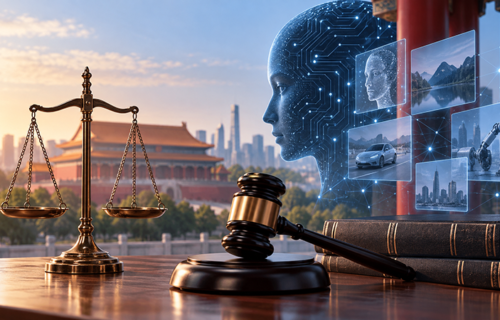
China’s Supreme People’s Court has issued national guidance for handling disputes involving artificial intelligence, giving businesses, technology developers and users greater clarity over how existing Chinese law will be applied to issues ranging from copyright and personal data to deepfakes, consumer protection and autonomous vehicles.
Published on 7 September 2026, the guidance contains 24 provisions divided into five sections. It does not create a separate AI statute. Instead, it directs courts on how existing legislation, including China’s Civil Code, Copyright Law, Personal Information Protection Law, Cybersecurity Law, Data Security Law and consumer protection rules, should be applied when AI is involved in a dispute.
One of the central principles concerns responsibility when AI causes harm. Unless another law establishes a different standard, courts are instructed to examine whether the party involved was at fault. Judges can consider how an AI system was being used, its degree of autonomy and transparency, the potential scale of harm, safeguards introduced by developers or service providers and the extent to which users could anticipate or control the consequences.
The approach is particularly relevant to generative AI businesses because responsibility will not automatically fall on one participant in the technology chain. Developers, providers and users can each face scrutiny depending on their role and conduct. Service providers that become aware of content infringing personal rights may also face consequences if they fail to take appropriate action.
Intellectual property is another major part of the framework. In copyright disputes involving AI-generated material, courts are instructed to consider factors including the type of service, the origins of training material, the involvement of different parties, preventative measures and any financial benefit obtained. Developers arguing that their systems have not infringed copyright may be required to provide evidence concerning training-data sources, training records, how the model operates and the technical reasoning supporting their position.
Users can also be held responsible. Where someone knew or should have known about an existing protected work and uses AI to produce substantially similar material without an adequate legal justification, a court may find in favour of the rights holder. The framework therefore places potential responsibility on both the companies building AI systems and the people using them.
However, the Supreme People’s Court has deliberately avoided resolving some of the most contested questions surrounding generative AI. The guidance does not provide a comprehensive answer to every issue concerning copyright protection for AI output or the use of copyrighted material in model training. Areas where sufficient agreement has not yet developed remain open to further interpretation through future cases.
Personal identity and privacy receive substantial attention. Creating and distributing an identifiable digital representation of an individual without permission can infringe personal rights. Similar considerations apply to synthetic voices, while AI-generated material that damages the reputation of an identifiable individual can also create potential liability.
The court has also addressed the use of information that is already publicly available. Public accessibility does not automatically make personal information unrestricted material for AI development. Whether information can be used for model training can depend on the purpose, necessity and scale of the processing, the sensitivity of the information and its potential effect on the individual concerned.
Consumer-facing applications are another focus. The guidance addresses the use of algorithms to impose unjustified differences in prices or other transaction conditions on consumers. It also covers fraudulent AI impersonation, including situations where synthetic identities or representations of well-known individuals are used to deceive consumers.
For companies developing AI-enabled physical products, courts can consider factors such as intended use, self-learning capabilities, software updates, the degree of control available to users, relevant technical standards and whether manufacturers adequately disclosed foreseeable limitations and risks when assessing potential product defects.
Automotive businesses are specifically covered. In disputes involving automated or driver-assistance systems, courts may require parties controlling relevant information to provide authentic and complete event records where these are necessary to determine the circumstances surrounding an accident.
Open-source development is also addressed. Courts considering disputes involving open-source AI components can examine licence conditions, restrictions on use, security precautions and information supplied by developers. This provides a basis for distinguishing the responsibilities of original developers from businesses that subsequently incorporate, distribute or modify open-source components.
The guidance also deals with AI-related inventions. Technical innovations capable of patent protection remain subject to existing intellectual-property rules, while recognition as an inventor depends on a natural person having made a creative contribution to the substantive features of the invention.
AI use in legal proceedings is subject to additional safeguards. Parties using AI to prepare pleadings, legal research or other materials submitted to courts are expected to verify their accuracy, disclose the use of AI assistance and remain responsible for the information submitted. Courts can also examine the authenticity and integrity of electronic and AI-generated evidence.
For international companies operating AI systems in China, the practical consequences extend beyond legal interpretation. The framework increases the importance of maintaining records concerning training-data sources, model development, technical safeguards, open-source licences and other decisions affecting how AI systems operate. Such information could become important evidence if a dispute reaches a Chinese court.
Rather than introducing a separate layer of AI legislation, the Supreme People’s Court has established a common judicial approach for applying China’s existing laws to rapidly developing technology. For developers, technology providers and multinational businesses, the guidance provides a clearer indication of how responsibility may be assessed, while several of the most difficult questions surrounding generative AI and intellectual property remain open for future court decisions.
Source: CMS