Wednesday, 16 September 2026
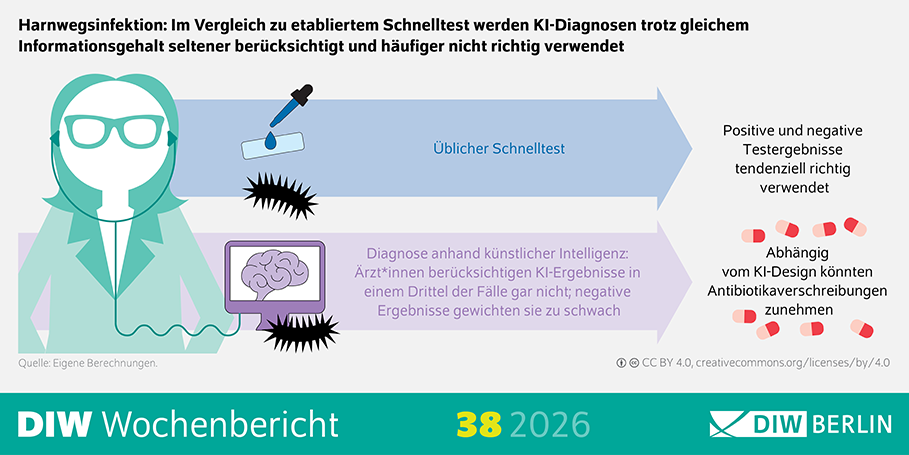
Doctors may interpret diagnostic information differently when it comes from artificial intelligence rather than an established medical test, even when both provide equivalent levels of accuracy, according to new research involving Danish primary-care physicians. The study examined responses from 372 doctors using hypothetical cases involving suspected urinary tract infections. Participants were provided with additional diagnostic evidence presented either as the result of an AI system or as information from a conventional urine test, with the two sources designed to offer equivalent diagnostic performance.
Despite receiving information with comparable accuracy, doctors changed their assessment of whether a patient had an infection considerably less when the evidence was attributed to AI. The researchers calculated that the adjustment in doctors’ probability estimates was 41% smaller in the AI scenario than when they received information from the established diagnostic method. The experiment also identified substantial differences between individual doctors, with around one third of participants placing very little weight on the AI information when making their assessments.
Previous experience with technology appeared to be relevant. Doctors who were more receptive to AI were more likely to work in practices already using digital services such as video consultations and electronic communication with patients. This suggests that familiarity with digital healthcare systems may influence how readily clinicians incorporate new forms of algorithmic assistance into their work.
Another difference emerged in the treatment of negative results. Doctors responded to conventional diagnostic evidence in a way that reflected the significance of a negative result but did not consistently make the same adjustment when equivalent information was presented as coming from AI. This affected subsequent treatment choices in the experiment, with the way some doctors processed AI-generated information resulting in higher antibiotic prescribing.
The finding is particularly relevant to efforts to reduce unnecessary antibiotic use as antimicrobial resistance increases the importance of distinguishing infections requiring treatment from cases where antibiotics provide little or no benefit. However, the research does not demonstrate that AI generally increases antibiotic prescribing or produces worse healthcare outcomes. The experiment involved hypothetical patient scenarios rather than the treatment of real patients in clinical practice.
Instead, the study identifies a potential problem in the interaction between medical professionals and algorithmic decision-support systems. An AI system can produce statistically useful information while having less influence on clinical decisions if doctors give its conclusions less weight than equivalent information from established diagnostic methods.
The findings also suggest that evaluating medical AI solely by comparing algorithmic accuracy with that of doctors or conventional tests provides an incomplete picture. A system can perform well technically while producing less benefit in practice if clinicians do not incorporate its recommendations appropriately into their decisions.
This distinction is becoming increasingly important as healthcare organisations introduce AI into diagnosis, clinical documentation and treatment planning. Practical factors such as integration with existing systems, familiarity with digital tools and confidence in algorithmic recommendations can influence how extensively new technology is used.
The Danish researchers argue that training and the design of AI interfaces should therefore form part of implementation. Clinicians need sufficient information to understand what an AI result represents, including the reliability and limitations of the underlying prediction.
Evidence from other research also suggests that the relationship between doctors and algorithms does not necessarily need to be viewed as competition between human and machine decision-making. Previous studies of antibiotic prescribing have identified potential benefits when algorithmic predictions supplement rather than replace clinical expertise.
The wider challenge for healthcare providers is therefore moving from demonstrating that AI can produce accurate predictions to establishing whether those predictions improve decisions under everyday working conditions. This requires examining how clinicians respond to recommendations, whether the technology fits existing workflows and what happens to treatment decisions after systems are introduced.
As investment in healthcare AI accelerates, the Danish experiment provides evidence that technical performance represents only one part of successful adoption. The eventual impact of medical AI will also depend on whether doctors understand, accept and appropriately incorporate algorithmic information into their own clinical judgement.
Source: DIW Berlin