Tuesday, 15 September 2026
Montenegro’s economy gained momentum during the first half of 2026, with growth accelerating during the second quarter as the country approached its most important tourism period. Household demand, investment and higher activity in parts of the economy supported expansion, while inflation, the large goods-trade imbalance and dependence on international tourism remained important vulnerabilities. Real GDP increased by 2.6% year-on-year during the first quarter before growth accelerated to 3.8% in Q2. Economic output at current prices reached approximately €1.65 billion during Q1 and €2.15 billion in Q2. The stronger second-quarter performance meant Montenegro entered the summer season with better economic momentum than it displayed at the beginning of the year.
Domestic demand continued to provide support. Higher household incomes, employment, tourism expenditure and investment have helped sustain consumption despite relatively weak economic conditions across parts of Europe. Recent reforms affecting wages and labour taxation have also increased disposable income, although rising consumer prices are absorbing some of the benefit. Industrial production recorded a strong increase during the second quarter, standing 20.0% above the corresponding period of 2025. The figure should be viewed in the context of Montenegro’s relatively small industrial base, where changes in electricity generation and individual industries can have a substantial effect on the overall index. The result nevertheless provided an additional source of activity beyond tourism and household consumption during Q2.
Inflation remained elevated throughout the first half. Consumer prices were 3.6% higher in June than a year earlier and increased by 0.4% compared with May. Across January to June, average prices were 3.3% above the corresponding period of 2025, with food, hospitality and several service categories contributing to higher household costs. Average gross earnings reached €1,237 in June, while net earnings stood at €1,036. Net wages were 2.6% higher than in June 2025. At that particular point, annual consumer-price inflation of 3.6% was therefore running ahead of nominal net-wage growth, although the comparison does not necessarily describe household purchasing-power trends across the whole first half.
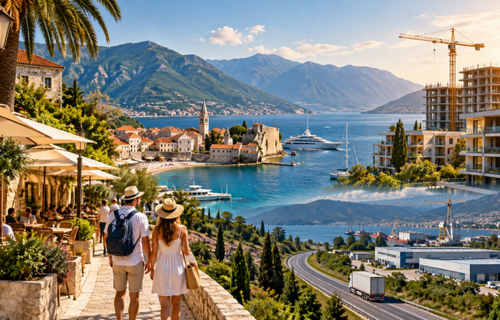
Tourism remained central to economic performance. Collective accommodation establishments recorded almost 207,000 arrivals and approximately 794,000 overnight stays during June. In May, there had been around 170,000 arrivals and 506,000 overnight stays, illustrating the rapid seasonal increase in activity as Montenegro moved towards its busiest tourism months. The economic importance of tourism extends well beyond hotels. International visitors support restaurants, retail, transport, entertainment and property-related services, while continued investment in hotels, resorts and holiday accommodation contributes to construction and development. This dependence also leaves Montenegro sensitive to changes in European household spending, transport connectivity and international travel demand.
Foreign trade remains one of the economy’s main structural weaknesses. Total merchandise trade reached approximately €2.44 billion during the first six months of 2026, 2.1% higher than during the corresponding period of 2025. Montenegro continues to purchase substantially more goods internationally than it exports, reflecting its reliance on imported consumer products, vehicles, machinery, construction materials and other goods. Tourism and other service exports compensate for part of the merchandise imbalance, making the summer season important to Montenegro’s external financial position as well as domestic businesses and employment. The country nevertheless remains reliant on foreign investment and international capital to finance parts of its economy.
Construction and real estate continue to play a significant role, particularly in Podgorica and along the Adriatic coast. Residential, hospitality and mixed-use projects are supported by domestic demand, tourism and international buyers, while infrastructure investment provides another source of construction activity. Residential demand remains concentrated in Podgorica and the principal coastal markets. Foreign buyers, tourism-related purchases and domestic households continue to support development, although construction costs and affordability increasingly influence project economics. The ability to deliver housing accessible to local households is becoming an important issue alongside continued demand for higher-priced coastal property.
Hospitality remains particularly important for commercial real estate. Montenegro’s dependence on tourism supports demand for hotels, resorts, serviced accommodation and leisure facilities. Much of this activity remains concentrated along the coast, while developers and tourism operators increasingly seek to attract higher-spending visitors and extend activity beyond the traditional summer season. Retail property also benefits from the combination of domestic consumption and tourism. Higher household incomes provide support throughout the year, while coastal locations experience substantial additional spending during the summer. Persistent inflation remains a risk, particularly if consumer prices continue to increase faster than household incomes.
Industrial and logistics property represents a smaller segment of Montenegro’s property market but has scope to develop. The country’s large volume of imported goods, infrastructure investment and requirements for modern distribution create demand for warehousing and logistics facilities. Podgorica, the Port of Bar and locations connected with the main transport corridors are particularly relevant to this longer-term opportunity. Infrastructure investment will be important to Montenegro’s ability to broaden economic activity. Improvements to roads, energy networks and regional transport links can reduce some of the physical constraints that have historically limited development outside the principal urban and coastal markets. Better connections between Podgorica, the coast and neighbouring countries could improve conditions for logistics, manufacturing and distribution investment.
Progress towards European Union membership is another important influence on the economic outlook. The accession process is driving reforms affecting regulation, public administration, infrastructure and the business environment. Further progress could strengthen investor confidence and improve access to European funding, although the economic benefits depend on the successful implementation of reforms. Public finances present a more complicated challenge. Policies that increased wages and household incomes have supported domestic consumption but have also contributed to fiscal pressure. Montenegro simultaneously faces substantial infrastructure and public-investment requirements, making the balance between economic support and sustainable government finances increasingly important.
External risks remain significant because Montenegro is a small economy heavily dependent on tourism, imported goods, foreign investment and international financing. Weaker European growth, geopolitical disruption, changes in energy prices or declining international travel demand can therefore affect economic performance relatively quickly. International forecasts suggest that full-year growth may be more moderate than the strong second-quarter figure implies. The IMF expects Montenegro’s economy to expand by approximately 2.8% during 2026, with average inflation around 3.2%. The World Bank’s June forecast puts growth at approximately 2.9% this year, followed by 3.1% in both 2027 and 2028.
These forecasts remain below the 3.8% annual growth recorded during Q2, highlighting uncertainty surrounding the second half. Montenegro’s busiest tourism months fall during the third quarter and can provide substantial economic support, but the outcome will depend on visitor numbers, spending and conditions in the country’s principal tourism markets. For commercial property, the first-half economic picture is broadly supportive but varies significantly between sectors. Tourism continues to favour hospitality and coastal development, while domestic consumption provides support for retail. Infrastructure investment and the country’s dependence on imported goods provide longer-term opportunities for logistics and selected industrial development. Development risks remain linked to construction costs, housing affordability, infrastructure capacity and dependence on foreign capital.
Montenegro entered the second half of 2026 with stronger momentum than it had at the beginning of the year. GDP growth accelerated from 2.6% in Q1 to 3.8% in Q2, industrial production recorded a strong quarterly increase and tourism activity was moving towards its seasonal peak. At the same time, inflation remained elevated and the large merchandise-trade imbalance continued to demonstrate the economy’s dependence on tourism receipts and international capital. The longer-term challenge is to turn current growth, infrastructure investment and progress towards EU membership into a more diversified economic base. Tourism will remain central to Montenegro, but greater investment in transport, logistics, productive industries and infrastructure could reduce some of the economy’s dependence on seasonal activity and create a broader foundation for property development and economic growth.
Source: CIJ.World Research & Analysis Team