Tuesday, 15 September 2026
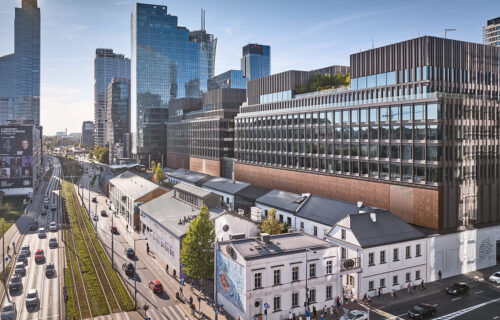
Five years after reopening, Norblin Factory has developed into a fully occupied mixed-use destination in Warsaw, combining offices with restaurants, retail, services, entertainment and cultural facilities. The Capital Park development now attracts around 500,000 visitors each month, while more than 3,000 people work at the complex.
Capital Park acquired the former industrial site on Żelazna Street in 2008. The following years were devoted to design, planning procedures and conservation arrangements before construction started in November 2017. After 46 months of redevelopment, Norblin Factory reopened in September 2021, completing a 13-year process from acquisition to operation.
The complex provides more than 41,000 sqm of office space alongside almost 24,000 sqm devoted to other commercial and cultural uses. Its offices were fully leased before construction was completed, with occupiers including Allegro, Japan Tobacco International, ISS and SEB Bank. Puzzle Office and Beyond Office provide flexible workspace within the development.
Leasing the remaining areas took longer, particularly as the final stage of construction coincided with the Covid-19 pandemic and disruption across the retail and hospitality markets. Capital Park subsequently continued developing the tenant mix, and the non-office component has now also reached full occupancy.
Food and beverage has become one of the property’s largest uses outside the offices, occupying almost 10,000 sqm across 38 concepts. Food Town covers approximately 3,200 sqm in five historic halls and accommodates 24 food operators and five bars. The wider offer includes Piano Bar and the 1,400 sqm MOXO restaurant and music venue.
Entertainment and leisure uses have further broadened the property’s role. KinoGram and its event facilities occupy around 3,500 sqm, while BioBazar covers approximately 2,000 sqm. Smart Kids Planet operates across 1,600 sqm and Art Box Experience has around 800 sqm. More than 2,000 sqm is also occupied by health and beauty businesses.
The industrial history of the site remains integrated into the development. The Norblin Factory Museum incorporates 10 historic buildings and almost 50 pieces of former manufacturing machinery and equipment, together with a collection of more than 400 silver-plated objects connected with production at the former factory.
Cultural programming has also become a regular part of the property’s operation. Since 2021, 240 Wednesday Jam Sessions have been organised, while the Summer Stage has hosted more than 470 music and DJ performances since its introduction in 2022. Other activities include theatre, concerts, dance events and programmes for families.
Five years of operation have demonstrated the management challenges associated with combining offices, restaurants, retail, entertainment and cultural facilities within a single development. Each use has different operating hours, servicing requirements and visitor patterns, requiring more active coordination than a conventional single-use commercial property.
With both its office and non-office components now fully occupied, Norblin Factory has moved beyond the initial redevelopment and leasing stages. Its next phase will depend increasingly on the management of its different functions, tenant performance and its ability to maintain visitor activity throughout the working week and weekends.