Monday, 14 September 2026
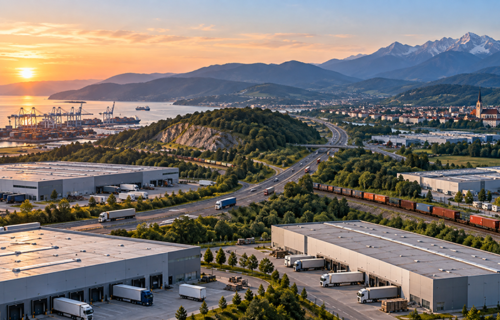
Slovenia’s warehouse market is becoming less dependent on Ljubljana as developers and occupiers increasingly consider locations positioned along the country’s international transport routes. Sežana, Maribor and the corridor between the capital and the Port of Koper are attracting development that could gradually change the geography of Slovenia’s industrial property sector.
Ljubljana remains the country’s principal logistics centre. Its central location, motorway connections and proximity to Slovenia’s largest concentration of consumers and businesses continue to make it the natural choice for national distribution. However, limited opportunities in established locations and the requirements of companies serving international markets are creating a stronger case for development elsewhere.
CBRE’s figures for the second quarter of 2026 identify more than 112,000 sqm of speculative warehouse space planned in Slovenia. The significance is not simply the amount of space under consideration, but where developers are looking to build it.
Sežana is emerging as one of the most important alternatives. Located close to Italy and connected to the route towards the Port of Koper, the town offers access to both Slovenian and cross-border markets. A logistics development of around 50,000 sqm planned by BHM Group would significantly increase the amount of modern warehouse space available in the area, while other projects progressing through the planning and permitting system point to further expansion.
The attraction of Sežana is closely connected with the changing role of the northern Adriatic. Koper handled approximately 1.27 million TEU in 2025, while further investment in port and rail infrastructure is intended to increase its ability to serve markets deeper inside Central Europe. Greater freight volumes through Koper could generate additional demand for warehousing, consolidation and distribution facilities along the routes leading inland.
Maribor represents another emerging centre, but with a different economic profile. Its location in northeastern Slovenia provides convenient access towards Austria, Hungary and Croatia and places the city close to several important regional manufacturing markets. Modern logistics development is already establishing a larger presence there. Log Center Maribor provides around 30,000 sqm of space, with plans for approximately another 20,000 sqm. At the same time, new manufacturing investment in the wider region could generate demand from suppliers, transport companies and businesses requiring warehouse space close to production facilities.
Development is also appearing southwest of Ljubljana. Logatec benefits from its position on the motorway towards Koper while remaining close enough to the capital to serve the Ljubljana market. The completion of a warehouse of more than 26,000 sqm there demonstrates that sizeable modern facilities can be viable outside the capital while retaining access to Slovenia’s main population and business centre.
These locations are unlikely to compete for exactly the same occupiers. Ljubljana should remain dominant for domestic distribution. Sežana has stronger potential for companies connected with Italy, Koper and northern Adriatic trade. Maribor offers a combination of logistics and manufacturing demand, particularly for businesses operating across Central and Southeast Europe, while Logatec occupies an increasingly attractive position between the capital and the coast.
Kranj and other locations along Slovenia’s motorway network could eventually add another layer to this market. For the moment, however, the evidence of major logistics expansion is clearer in Sežana, Maribor and the Ljubljana–Koper corridor.
Slovenia’s relatively small size makes this geographical change particularly interesting. Distances between the country’s main industrial centres are short, yet their connections to neighbouring markets differ considerably. That allows developers to target facilities towards particular trade routes and occupier groups rather than treating Slovenia as a single warehouse market centred on Ljubljana.
Continued investment in Koper, rail capacity and motorway infrastructure could accelerate the process. As Slovenia strengthens its connections between the Adriatic and Central Europe, industrial property development is likely to follow the movement of goods and manufacturing investment.
The result may not be the displacement of Ljubljana as Slovenia’s dominant logistics centre, but the creation of several complementary warehouse markets around it. Sežana, Maribor and locations on the route to Koper are already providing the clearest signs that Slovenia’s next phase of logistics development will increasingly take place beyond the capital.
Source: CIJ.World Research & Analysis Team