Friday, 23 October 2026
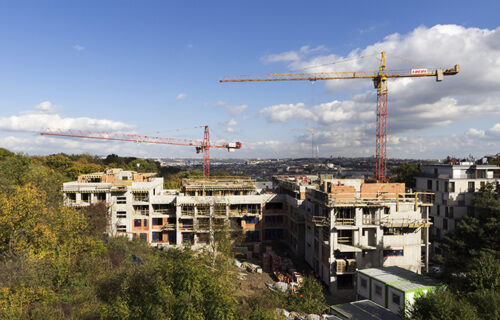
Central Group is preparing to start construction of more than 2,000 apartments across Prague over the coming months, reviving projects that were postponed last year as the developer sought to avoid exceptionally high building costs. The new homes have an estimated market value of around CZK 17 billion and will be financed entirely from the company’s own resources.
The programme covers nine projects in seven parts of Prague and represents a significant return to development activity after Central Group decided at the end of 2025 to delay new construction starts. The company says conditions in the contracting market have since become more sustainable, allowing previously postponed schemes to move forward.
“Construction prices are no longer as hysterically high as before and are returning to a more sustainable normal. Due to the tense international situation, there is still considerable uncertainty in the market. In recent months, I personally met with the heads of the ten largest construction companies. We discussed the market situation and prices in detail and found a common way forward. So now we can restart new construction on a large scale,” said Dušan Kunovský, founder and CEO of Central Group.
The largest concentration of new development will be at Parková čtvrť in Nový Žižkov, Prague 3. Central Group has already completed two urban blocks in the area and plans to begin another three containing approximately 900 apartments. Additional developments are planned in Hloubětín, Vysočany, Uhříněves, Černý Most, Hlubočepy and Břevnov.
Projects in Malešice and Horní Měcholupy are already under construction and are scheduled to enter the market this autumn.
Central Group is also changing the way it structures contracts with construction companies. New projects may be divided into additional phases, while contractors will benefit from faster approval and payment for completed work, greater scheduling flexibility and, on multi-stage developments, the possibility of inflation-linked adjustments. The developer also intends to work more closely with contractors on technical solutions to reduce construction costs.
“We as investors must provide greater certainty for construction contractors in this specific environment. If we enable them to plan capacity better, accept and pay for completed work more quickly, and jointly optimise the technical solutions as much as possible, we can achieve better prices. This allows us to restart construction on a large scale and keep our prices 5–10% below the Prague market average,” Kunovský said.
Central Group says it has more than 3,200 apartments under construction during 2025 and 2026 and controls land across approximately 60 locations in Prague with capacity for more than 40,000 additional homes. During almost 33 years of activity, the company says it has completed more than 20,000 apartments.
The developer also operates without bank financing, according to Kunovský, giving it greater flexibility over when projects move into construction.
“We finance all our acquisitions, construction and operations from our own resources without the need for loans. For more than 30 years, we have reinvested all the money we have earned back into the company. Thanks to this, we are not under pressure from banks or financial markets and can decide when construction makes economic sense,” Kunovský said.
The restart comes against the backdrop of a long-running shortage of new housing in Prague. Central Group argues that increasing supply will also depend on improvements to planning and permitting, pointing to changes to Czech construction legislation and Prague’s new metropolitan planning framework as potentially important steps.
“Only more predictable, simpler and faster permitting of new construction can increase the supply of new apartments on the market and slow their price growth. While apartment prices are currently rising by around 10% annually, with higher supply their growth could slow significantly, perhaps by half. We could then reach a situation where wage growth begins to exceed apartment price growth and housing affordability gradually starts to improve,” Kunovský concluded.