Friday, 23 October 2026
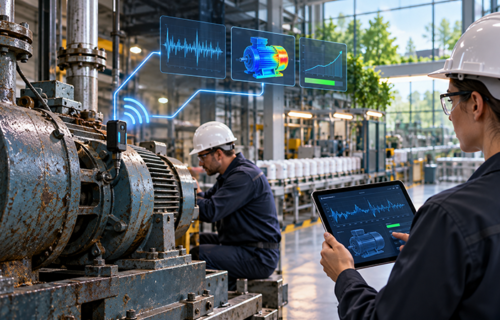
Artificial intelligence is beginning to change how manufacturers think about one of their largest capital commitments: the machinery already installed inside their factories. Rather than replacing ageing production equipment with entirely new automated plants, manufacturers are increasingly using sensors, machine data and AI-assisted monitoring to understand when equipment is deteriorating and intervene before a failure interrupts production. The potential financial impact can be substantial. Unplanned equipment failure can stop an entire production line, disrupt deliveries, increase labour costs and create problems elsewhere in the supply chain.
At AI4 2026 in Las Vegas, manufacturing executives from Kimberly-Clark, BlueScope and commercial food-equipment producer Henny Penny discussed how predictive maintenance is moving from isolated technology experiments towards a broader strategy for managing industrial assets. The discussion, moderated by Woven Capital, Toyota’s growth-stage investment arm, highlighted an important shift in industrial AI. Predictive maintenance itself is not new. Manufacturers have monitored vibration, temperature, electrical current and other machine characteristics for decades. What has changed is the ability to collect information more cheaply, combine it with historical maintenance records and use machine-learning systems to identify patterns that employees may not recognise until equipment is much closer to failure.
Traditional industrial maintenance generally follows three approaches. Equipment can be repaired after it fails, serviced according to a predetermined schedule whether it requires intervention or not, or monitored continuously so maintenance can be performed when the data indicates that deterioration is developing. The third approach has become considerably more practical as sensors have become cheaper and AI has improved the ability to interpret large quantities of operational information. For manufacturers, the objective is not necessarily to eliminate equipment failure. It is to convert unexpected downtime into planned downtime. Knowing several weeks in advance that a bearing, motor, pump or other critical component is deteriorating gives plant managers the opportunity to schedule repairs, secure spare parts and reorganise production rather than dealing with an emergency shutdown.
Kimberly-Clark described how vibration and electrical-current monitoring is already being used across parts of its industrial asset base. Equipment including bearings, valves and rotating machinery generates signatures that can indicate changes in operating condition. In chemical processes, similar monitoring can identify problems such as leaking valves or changes that could affect the production process. One particularly expensive problem is an unexpected break during continuous manufacturing. According to the company’s presentation, an emergency interruption on some production lines can carry costs reaching approximately $250,000 per hour. Predictive monitoring can potentially identify deteriorating conditions weeks beforehand, allowing the company to move maintenance into a controlled production window.
That distinction is economically important. A machine may still require exactly the same repair, but the financial consequences can be dramatically different depending on when the work takes place. Planned maintenance allows managers to adjust production schedules, prepare replacement components and coordinate employees before the line is stopped. An unexpected breakdown can simultaneously create lost production, overtime, emergency repair costs and missed customer commitments.
The panel also challenged the assumption that manufacturers need to replace old equipment before they can benefit from AI. Industrial facilities frequently contain machinery that has operated successfully for decades. In capital-intensive sectors such as steel, replacing functioning equipment simply because it lacks modern digital controls can be difficult to justify. BlueScope described machinery that may have been installed 20 or 30 years ago but remains capable of safely producing the required product. Historically, connecting such assets to modern monitoring infrastructure could require substantial investment in controllers, wiring and plant systems. In some cases, the cost of digitally upgrading an individual motor or component could reach well into six figures, effectively preventing the investment.
Wireless monitoring and lower-cost sensing technologies are changing those economics. Instead of rebuilding the underlying machine, manufacturers can increasingly add external monitoring equipment and connect operational information to newer analytical platforms. That can allow a decades-old asset to participate in a modern predictive-maintenance programme without requiring a complete equipment replacement. For industrial property owners and manufacturing companies, this creates an important capital-allocation question. Older machinery is not necessarily obsolete simply because it predates connected manufacturing. If equipment remains safe, reliable and capable of producing the required quality, digital monitoring may extend its useful economic life considerably.
The same logic can apply to entire industrial facilities. The future of manufacturing may therefore involve fewer completely automated greenfield factories than some technology forecasts suggest. A substantial portion of industrial AI investment could instead flow into retrofitting and digitally enhancing existing plants. However, the panel repeatedly warned against adding sensors simply because the technology is available. Collecting additional information creates cost, complexity and cybersecurity exposure. Every connected industrial device represents another potential access point into operational technology infrastructure, while the resulting data still needs to be stored, analysed and converted into action.
A factory does not necessarily benefit from receiving dozens of different signals from a machine when one reliable indicator would provide enough information to make the maintenance decision. The value comes from identifying which measurement matters and what employees should do when it changes. Kimberly-Clark illustrated the issue through its large manufacturing operation at Beech Island, South Carolina, where parts of the industrial infrastructure are many decades old. Some equipment continues to contain analogue components because converting every element to digital technology would create substantial cost and potentially require production downtime that cannot be economically justified.
This is where the economics of industrial AI become more complicated than simply comparing the price of sensors with the cost of a machine. Manufacturers need to consider the total cost of ownership created by additional connected equipment, software licences, cybersecurity, data infrastructure and long-term maintenance. The panel provided an example of a predictive-maintenance project that successfully detected a pump problem but still failed economically. The technology could identify the condition, but doing so required sufficiently sophisticated equipment that the monitoring system cost too much relative to the value of the pump and the consequences of its failure. The technically successful project was therefore discontinued.
That example captures one of the most important lessons from the discussion. Not every failure needs to be predicted. Sometimes the most rational maintenance strategy is to keep a replacement component nearby and allow the existing one to run until it fails. The decision depends on criticality. A relatively inexpensive component with redundancy and little effect on production may not justify continuous monitoring. A single component capable of shutting down an entire production process can justify considerably greater investment.
Henny Penny illustrated this through commercial restaurant equipment. A restaurant fryer can contain multiple heating elements, meaning failure of one may still allow the kitchen to continue operating. A critical pump, however, may have no equivalent redundancy. If that component fails, the restaurant can lose its ability to produce an important part of its menu. Predictive maintenance therefore needs to begin with the economic consequence of failure rather than with the technology capable of detecting it. Manufacturers need to understand what happens when the asset stops, how quickly it can be repaired, whether another machine can take over and how much the disruption costs.
The required warning period also varies significantly. Technology companies frequently market predictive systems around their ability to identify failures weeks in advance, but such long forecasts may provide little additional value. Henny Penny found that equipment problems in restaurants can already take several days to progress from initial failure to technician arrival because employees first need to report the problem and service teams then need to dispatch someone. For certain critical equipment, knowing four or five days before failure may therefore provide sufficient time to intervene. This illustrates why predictive maintenance cannot be standardised purely around technical performance. A model predicting a failure 30 days ahead is not automatically more valuable than one providing five days of warning. The relevant measure is whether the prediction gives the organisation enough time to take the economically appropriate action.
The return on investment can also appear in areas beyond conventional calculations of production uptime. Henny Penny reported feedback from a major restaurant customer that equipment failures increase employee stress because workers must suddenly adapt service around unavailable machinery. Avoiding unexpected breakdowns can therefore improve working conditions as well as operational performance. For large manufacturers, the consequences can extend through inventory and retail distribution. Kimberly-Clark explained that production interruptions can affect commitments to major retailers and alter the timing of product flows through warehouses and stores. A failure at the factory can consequently create costs well beyond the machine where the problem originated.
Environmental performance provides another potentially significant benefit. In chemical-intensive manufacturing, deteriorating equipment can increase the consumption or leakage of process materials before the problem becomes severe enough to stop production. Monitoring those changes can identify inefficiency earlier and potentially reduce waste, energy consumption and environmental exposure. Predictive maintenance therefore intersects increasingly with corporate sustainability strategies. Equipment that operates outside its optimal range can consume more electricity, water or raw materials. A deteriorating bearing, for example, can require more energy before the change becomes obvious to an operator. Detecting that deterioration earlier can produce both maintenance and energy savings.
However, the business case needs to capture these benefits explicitly. BlueScope argued that condition-monitoring programmes should be able to demonstrate financial payback. Manufacturers need systems for tracking not only the cost of deploying technology but the value of failures prevented, production preserved and other operational improvements. Demonstrating successful returns also helps organisations expand programmes. Once employees and management can see that a particular monitoring application has paid for itself, gaining support for deployment on additional assets becomes easier.
Scaling remains one of the industry’s largest difficulties. A predictive-maintenance model that works in one factory cannot necessarily be copied directly into another. Kimberly-Clark operates a large global manufacturing network in which plants contain equipment from different generations and vendors, integrated through different systems and maintained by employees with different operating histories. The panel summarised the problem by noting that manufacturing patterns may repeat while the underlying implementation rarely does. Similar machines can experience comparable failure modes, but the code, integrations and operational environment are seldom identical.
This complicates the economics of scaling industrial AI. A company may successfully demonstrate a predictive model on one production line only to discover that deploying it across dozens of plants requires substantial additional integration and calibration. Industrial AI therefore differs from many corporate software applications where one system can be rolled out relatively uniformly across an organisation. Individual machines can also develop their own operating signatures. Henny Penny described establishing baseline characteristics when equipment leaves the production line. Once that machine is operating at a customer location, its subsequent behaviour can be compared with its own original condition as well as with broader fleet data.
At sufficient scale, this creates potentially valuable information. A manufacturer with tens of thousands of connected machines in customer locations can identify patterns across the installed base while still recognising differences between individual units. But the risks of model errors also increase dramatically. A false maintenance alert affecting one machine is inconvenient; the same error replicated across tens of thousands of connected units can create widespread operational disruption.
Human operators therefore remain central to predictive maintenance. Experienced maintenance employees often know individual machines intimately and can recognise changes through sound, vibration or behaviour. AI needs to earn their trust rather than simply override their judgement. False alarms are particularly damaging. If a monitoring system repeatedly warns about failures that never occur, operators can quickly stop paying attention. Once that happens, even a correct warning may be ignored.
Successful implementation therefore requires collaboration between data specialists, reliability engineers, maintenance teams and machine operators. AI can identify abnormal patterns and recommend action, but employees need to understand what the warning means and what should happen next. Visualisation and notification are also critical. A sophisticated predictive model creates little value if its warning is buried inside a dashboard that nobody checks. Information needs to reach the right employee at the moment when action is still possible.
This reinforces the idea that predictive maintenance is ultimately an operational system rather than simply an AI model. Sensors, data infrastructure, analytics, notifications, maintenance processes, spare-parts availability and human decision-making all need to work together. The same complexity affects decisions over whether manufacturers should build AI capabilities internally, purchase commercial platforms or work with external partners.
The panel suggested that commodity capabilities are often better purchased. Common equipment signatures, such as bearing vibration, are not necessarily sources of competitive advantage and may already be addressed effectively by specialised vendors. Manufacturing processes that are unique to a company’s products or intellectual property can justify custom development. Kimberly-Clark pointed to manufacturing characteristics involving absorbency, chemical balances and specialised production techniques as examples where internal knowledge becomes strategically important.
The emerging model is therefore likely to combine buying, building and partnering. Manufacturers can purchase standard monitoring technologies while developing proprietary models around processes that differentiate their products. AI itself is also making internal development easier. BlueScope noted that modern AI tools allow operational and engineering teams to perform analytical and development work that previously required external consultants. This could reduce the cost of creating specialised applications and make smaller industrial AI projects economically viable.
The more important opportunity may ultimately come from combining information that already exists across the factory. Sensor readings represent only one part of the picture. Maintenance-management systems contain years of work orders, repair histories and technician comments that have historically been difficult to analyse at scale. Bringing those records together with real-time machine data can give managers a much richer understanding of asset condition. This suggests that some of the most valuable industrial AI applications may not require additional sensors at all. Existing error codes, maintenance records, production data and service histories can already contain enough information to identify useful patterns.
Manufacturers also need to consider ownership of this information when selecting technology vendors. Industrial operating data can reveal production volumes, equipment performance, proprietary processes and weaknesses within a manufacturing system. Moving that information entirely into a vendor-controlled platform can create long-term dependence. The panel warned that companies need to understand where their production data resides, who controls it and how easily it can be moved. A manufacturer that places its operational history inside a proprietary external platform can eventually find itself effectively paying ongoing rent to access information generated by its own equipment.
The issue is becoming more significant as technology vendors add AI capabilities and increase software costs. Manufacturers therefore need to consider the long-term total cost of ownership rather than simply the initial subscription price. For industrial companies and investors, the larger implication is that AI may change the economics of existing manufacturing assets before it transforms factories into fully autonomous facilities. The ability to monitor older machinery cheaply, extract information from maintenance histories and schedule interventions before failure can extend asset life and improve the productivity of capital already invested.
That could influence future industrial CAPEX strategies. Companies may find that retrofitting selected high-value assets produces better returns than replacing entire production lines. Older factories with strong physical infrastructure could remain economically competitive for longer if digital monitoring compensates for some of their technological limitations. The investment case for industrial modernisation therefore becomes more selective. Rather than spending capital uniformly across a plant, manufacturers can identify the machines whose failure carries the greatest economic consequences and concentrate technology investment there.
Predictive maintenance is consequently becoming as much a capital-allocation discipline as a technology programme. The most sophisticated model does not automatically produce the best result, and the most connected factory is not necessarily the most efficient. The real advantage comes from understanding which assets matter, which failures need to be predicted, how much warning is actually required and what action employees should take when the warning arrives.
AI is making those decisions easier by allowing manufacturers to extract more value from data that machines have been producing for years. But the factories likely to benefit most will not necessarily be those installing the greatest number of sensors or deploying the most AI. They will be the ones that use the technology selectively to keep critical equipment running, reduce unplanned downtime and extract more productive life from billions of dollars already invested in industrial assets.
Source: CIJ.World Research & Analysis Team