Sunday, 4 October 2026
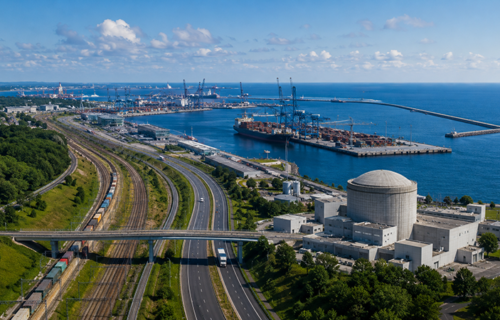
Poland is preparing to accelerate a series of major transport, port and energy projects under new legislation intended to shorten the lengthy administrative process surrounding strategically important infrastructure. The programme places the Baltic coast at the centre of Poland’s economic, energy and defence strategy, with investment planned across ports, railways, roads and nuclear infrastructure.
The Council of Ministers approved the proposed legislation on 18 August 2026. The measures are intended to simplify procedures for projects considered particularly important to national security and the economy, addressing a development process in which major infrastructure schemes can currently spend years progressing through approvals and administrative decisions.
Prime Minister Donald Tusk presented the programme as part of a wider effort to strengthen Poland’s position on the Baltic Sea. The government wants improved ports and their surrounding transport networks to support commercial growth while simultaneously increasing the country’s ability to move military equipment and maintain resilient supply routes.
Among the projects identified for faster implementation is the extension of national road No. 7 towards the Port of Gdynia. The government also intends to accelerate the planned external port in Gdynia, expansion of Świnoujście’s external harbour and the development referred to by the government as Cape Pomerania.
The programme extends beyond individual port developments. Railway infrastructure connecting Poland’s industrial and population centres with the Baltic coast is also included, reflecting the importance of inland connections to the competitiveness of maritime terminals.
Routes identified by the government include Szczecin-Świnoujście, Wrocław-Szczecin, Chorzów Batory-Tczew, Warsaw-Gdańsk and Nowa Wieś Wielka-Gdynia. Infrastructure associated with a transhipment facility on Port Island, including new road and railway access across the Dead Vistula, is also among the projects intended to benefit from faster procedures.
This makes the initiative relevant well beyond Poland’s maritime sector. Improved north-south freight corridors could strengthen connections between Baltic terminals and manufacturing, logistics and distribution markets across Poland and Central Europe. Faster and more reliable access to ports can also influence decisions concerning warehouses, intermodal terminals and industrial developments along the principal transport corridors.
Poland’s ports have already expanded significantly as the country’s role in European trade has increased. Gdańsk has emerged as the largest Baltic port by cargo volumes and has been moving higher in the European port rankings. According to figures cited by the government, the port handled a record 7.9 million tonnes of cargo during July.
Further port investment is therefore increasingly concerned with maintaining capacity ahead of future demand rather than simply catching up with Western European infrastructure. Larger terminals, improved rail access and stronger road connections could allow Polish ports to handle a greater proportion of trade serving Central and Eastern Europe.
The geopolitical environment has added another dimension to these investments. Since Russia’s invasion of Ukraine, Baltic transport infrastructure has acquired greater strategic importance for NATO’s eastern members. Ports and railway corridors capable of handling heavy equipment can serve both commercial supply chains and military mobility requirements.
That overlap between civilian and defence infrastructure is becoming increasingly important across Europe. Investment in bridges, railways, roads and ports can generate conventional economic returns while simultaneously increasing the ability of governments and armed forces to move equipment rapidly across national territory.
Poland’s recent naval investment reinforces the maritime element of the strategy. The government’s announcement followed the naming ceremony for Wicher, the first frigate being constructed under the Miecznik programme, as Poland simultaneously invests in naval capabilities and the land-based infrastructure supporting its Baltic coastline.
Energy security forms another part of the programme. Infrastructure connected with Poland’s first nuclear power station in Pomerania is expected to benefit from accelerated procedures, including developments in the Choczewo and Krokowa municipalities and associated maritime infrastructure.
The nuclear project requires considerably more than construction of the generating units themselves. Roads, power connections, marine facilities and supporting infrastructure will be needed to build and subsequently operate a power station of this scale. Accelerating associated infrastructure could therefore become important to maintaining the wider project schedule.
The combination of nuclear energy, ports and transport corridors illustrates the broader direction of Polish infrastructure policy. Rather than treating energy, logistics and defence as separate investment categories, the government is increasingly approaching them as interconnected elements of national resilience.
For the property and investment markets, this could have significant consequences. Major transport investment can alter the attractiveness of industrial land, particularly around Gdańsk, Gdynia, Szczecin and Świnoujście and along the corridors connecting the coast with Warsaw, Silesia and western Poland.
Improved rail capacity could also strengthen Poland’s position as a logistics gateway for neighbouring landlocked markets. Czechia and Slovakia, as well as parts of Germany and other Central European economies, represent potential hinterlands for Polish Baltic ports, making infrastructure capacity an important component of competition between northern European maritime gateways.
However, faster administrative procedures will not by themselves guarantee faster construction. Large infrastructure projects still face potential constraints including financing, procurement, environmental requirements, construction capacity and coordination between national and local authorities. The practical impact of the legislation will therefore depend on how effectively shortened procedures translate into investment decisions and work on the ground.
There is also a balance to be maintained between speed and scrutiny. Strategic projects frequently involve substantial land, environmental and community impacts, particularly major ports, railway corridors and nuclear infrastructure. Accelerating decisions will therefore need to preserve sufficient assessment while eliminating unnecessary duplication and administrative delays.
Tusk has framed the programme in ambitious terms, arguing that completion of the investment package could establish Poland as a leading Baltic power. While that description reflects the government’s political ambition, the underlying economic strategy is more tangible: increase port capacity, strengthen connections to Poland’s interior, secure additional energy infrastructure and improve the country’s ability to respond to security challenges.
The programme also illustrates how geopolitical change is influencing infrastructure investment across Central and Eastern Europe. Projects once assessed principally according to transport demand or commercial returns are increasingly being evaluated according to their contribution to energy independence, supply-chain resilience and defence mobility.
For Poland, the Baltic coast sits at the intersection of all three. If the planned investments progress as intended, the country’s ports could become more important not only as gateways for Polish trade but as strategic infrastructure serving a wider Central European market.
The government’s challenge will now be turning faster legislation into faster delivery. Poland already has an extensive pipeline of infrastructure ambitions. The significance of the new approach will ultimately be measured by whether projects that previously required years of administrative preparation can move more rapidly from government plans into operating ports, railways, roads and energy infrastructure.