Monday, 16 November 2026
Poland’s retail property market recorded €667 million in investment transactions involving retail parks and similar properties during the first nine months of 2026, an increase of 172% compared with the same period in 2025. Research published by Savills indicates that investment was also 257% above the five-year average, while construction activity continued at a considerably faster pace than in most established European markets.
Transactions worth €374 million were completed during the third quarter alone, accounting for more than half of the nine-month total. The figures reflect increased investor activity in a sector that has undergone substantial expansion in Poland over recent years.
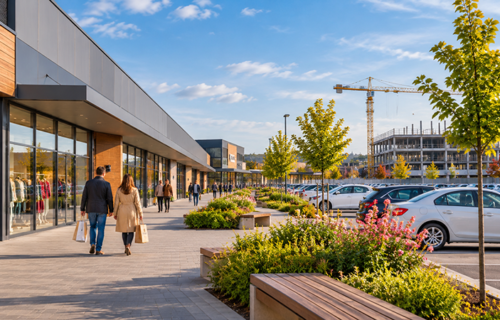
Since 2020, the amount of retail park accommodation in Poland has increased by 116.5%, the largest percentage increase among the European countries examined by Savills. Further development is underway, with space currently under construction equivalent to 17.8% of the country’s existing stock.
The scale of this construction activity contrasts with several Western European markets. In Germany, the development pipeline represents approximately 2% of existing retail warehouse accommodation, compared with 1.2% in France and 0.8% in the United Kingdom. The figures indicate that Poland remains at a different stage of retail property development, with substantially more new space being added relative to its current market size.
Despite the increase in construction, Poland has approximately 104 sqm of retail park accommodation per 1,000 inhabitants, slightly below the European average of 109 sqm. However, these national figures conceal differences between individual cities and regions, where the availability of retail space and local purchasing power can vary considerably.
Much of the country’s recent development has taken place in smaller towns and suburban locations. Retailers including Action, Pepco, TEDi and Sinsay have continued opening stores in these areas, supporting demand for relatively small retail units. According to Savills, vacancy levels in some smaller retail parks remain limited, although this does not necessarily apply across the wider market.
Changes in residential development patterns are also affecting the location of new retail schemes. The report identifies Warsaw among European metropolitan areas where population growth in suburban and commuter districts exceeded that of the central city between 2015 and 2025. Such changes can create demand for shopping facilities closer to expanding residential communities.
Investment activity has also shifted geographically across Europe. Central, Eastern and Southern European countries accounted for 46% of European retail warehouse investment during the first nine months of 2026, compared with 14% in 2021. Poland, Spain, Romania and Italy were among the markets receiving a greater share of capital.
Across Europe, investment in retail parks and warehouse-style retail properties reached €5.3 billion between January and September 2026. Third-quarter transactions exceeded €2 billion, representing a 91% annual increase. Savills estimates that full-year investment could reach between €8 billion and €8.3 billion, although this remains dependent on transactions completing before the end of December.
For Poland, the combination of increasing investment and a substantial development pipeline presents both opportunities and risks. Additional retail accommodation may support expansion by national and international chains, but continued construction could also increase competition between properties in locations where consumer demand is insufficient to absorb new supply.
The market’s longer-term performance will depend less on national development totals than on conditions within individual catchment areas, including population growth, household spending, retailer demand and the amount of competing retail space. With construction equivalent to almost one-fifth of existing stock, the absorption of new accommodation will be an important measure of the sector’s development over the coming years.