Sunday, 25 October 2026
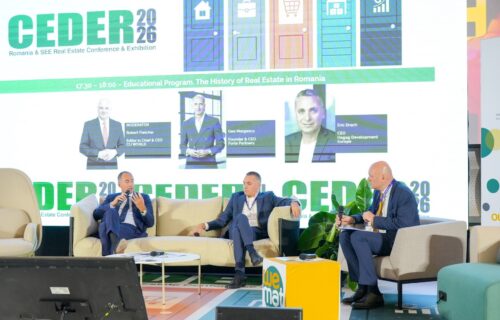
During the Educational Program panel held at the end of CEDER 2026, the experts invited to participate discussed how in modern Bucharest, the office development landscape is undergoing a profound shift, moving away from “isolated projects” toward integrated developments that actively “influence districts, communities and urban life”. This evolution marks a significant departure from the “chaotic” expansion seen before 2008, as reputable developers now prioritize urbanistic rules and the specific needs of the end-user.
A central theme in this new era is the transition of the office from a functional “box” to a vibrant community. Geo Mărgescu, Founder and CEO of Forte Partners, explains that office buildings have become “communities rather than simply boxes where employees are called to deliver”. In a post-pandemic world where repetitive work can often be done from home, the physical office has been reimagined as a space for collaboration, innovation, and creation. Tenants today demand unique environments that align with their corporate identity—spaces where “employees are feeling at home while working”.
The impact of these modern developments extends far beyond their own walls, often acting as catalysts for wider urban regeneration. A prime example is The Bridge project. Before its inception, the surrounding area was “completely dead,” dominated by old railway lines. Today, it anchors a thriving district with approximately 600,000 to 700,000 square meters of office and residential space. Similarly, the Sector Zero initiative—comprising the Millo and Tandem buildings—has revitalised downtown Bucharest by creating new pedestrian links and public squares.
International developers are also bringing a focus on efficiency and smart planning. Eric Drach, CEO of Hagag Development Europe, emphasizes that modern offices must be “planned smart, efficient, [and] green” to ensure long-term value for tenants. Location is also very important for office developments, as well as flexibility. This includes adaptable solutions like H Private, which offers flexible, short-term office leases along with the traditional long-term leases.