Sunday, 4 October 2026
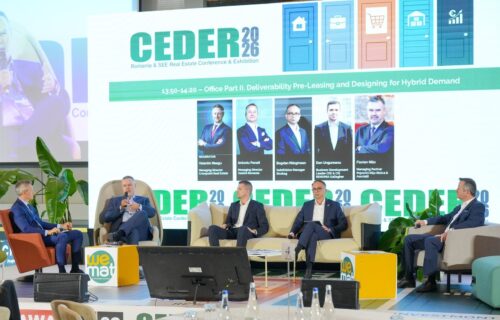
One of the conclusions of the second Office panel held at CEDER 2026 was that the office development landscape is undergoing a fundamental shift, moving away from simple space-leasing models towards complex, service-oriented environments. This transition introduces significant legal and practical frictions.
According to Florian Nițu, Managing Partner at Popovici, Nițu, Stoica & Asociații, the success of mixed-use projects has made legal iterations far more intricate. He notes that the traditional “triple net” lease is a concept of the past, replaced by complex partnerships. Nițu explains: “In legal terms, successful as mixed means complex from a legal standpoint, because the benefits of a mixed-use project translate into complex obligations and complex legal iterations in the contracts that are signed. Office space means a lease agreement that is doubled by a service agreement”. Furthermore, permitting remains a primary friction point, particularly in markets like Bucharest. Nițu advocates for a “strong, firm” stance toward authorities, including using judicial instruments when necessary to push developments forward.
On the practical side, the industry faces a “structural problem” regarding project delivery. Bogdan Mărginean, Technical Subdivision Manager at Strabag, argues that developers often focus too much on optimistic renderings and not enough on the viability of execution. He highlights the friction caused by treating construction as a “downstream activity” rather than an integrated part of the design process from the start: “The biggest risk is not if we are able to design attractive buildings, office buildings. The biggest risk is if this project is really deliverable, it is financially deliverable, technically, operationally and within the expected time… Too often projects are designed in isolation, are optimized only on paper, from theoretical point of view and only afterwards tested if the market is taking them on. On execution capacity, procurement constraints… this will create by default (…) loops in redesign, additional cost, additional time”.
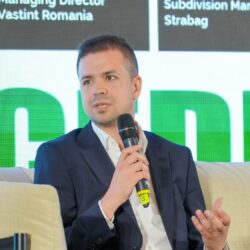
Adding to these frictions is a lack of economic visibility. Antoniu Panait, Managing Director of Vastint Romania, emphasizes that developers must be prudent because they cannot “foresee what will happen in the next few weeks, not next few years” regarding interest rates or taxes.
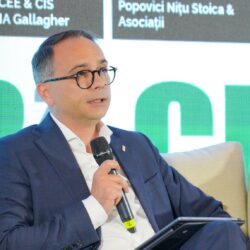
As highlighted by Dan Ungureanu, Business Development Leader CEE & CIS at RENOMIA Gallagher, this uncertainty is mirrored in the insurance sector, where lenders now demand more rigorous due diligence to ensure projects remain bankable, and developers have become more open to insuring their projects: “It’s about the global environment we’re living in. So, on one hand you have the lenders which are being more careful in what they put their money in, and of course they’re forcing somehow the market to get to upper level. But on the other hand, you have also the developers, and we are living in a mature market in which you have very powerful developers in the market. And of course, they’re coming with a lot of know-how brought by their group level, by their past experience, by their key people within the companies, which saw a lot of aspects happening.”
Ultimately, the projects that overcome these frictions will be those that prioritize integrated delivery models and a partnership-driven approach to both legal and construction challenges.