Sunday, 4 October 2026
As occupiers across Central and Eastern Europe reassess the role of the office in the hybrid work era, workplace design is entering a more psychologically driven phase. Mihai Olaru, Director General of OMIFA, argues that the next generation of workplaces will be judged less by how many desks they contain and more by how effectively they support human connection, well-being, trust and a sense of belonging. In a recent discussion with CIJ EUROPE, he outlined why psychological comfort is becoming a core design driver and how companies should rethink workplace environments accordingly.
Workplace design in Central and Eastern Europe is entering a more psychologically driven phase, according to Mihai Olaru, Director General of OMIFA. In a recent discussion with CIJ EUROPE, Mihai Olaru argued that the future of office environments will be defined less by efficiency metrics and more by their ability to support human connection, well-being and identity.
OMIFA, a Romanian company specialising in office fit-out solutions, partitions, furniture and integrated workspace systems, positions itself as both a distributor and producer of workplace components and design solutions across multiple European partnerships. The company collaborates with international manufacturers while also developing in-house products and local production capabilities, according to information published on its official website.
Speaking about the psychological dimension of design, Mihai Olaru said the industry must move beyond purely functional thinking. “Beyond ergonomics and aesthetics, I approach workplace design as an emotional ecosystem rather than just a functional environment,” he explained. In his view, modern offices must simultaneously support physical safety, autonomy and personal identity.
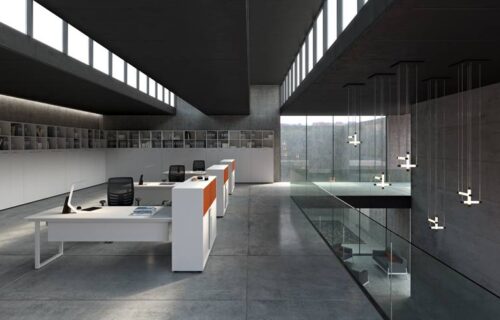
He noted that this requires creating a diversity of spatial experiences within the same workplace. Areas for focus, collaboration, recovery and informal interaction should coexist and allow employees to move fluidly between them. Environmental factors such as natural light, visual transparency balanced with privacy, material warmth and acoustic comfort all play a role in reducing cognitive fatigue and workplace stress.
A central theme in Mihai Olaru’s thinking is belonging. He believes employees connect more deeply with workplaces that reflect shared values and organisational culture. “The goal is not only productivity, but emotional comfort in the long term,” he said.
As hybrid work models reduce the amount of time employees spend in the office, Mihai Olaru expects the purpose of the workplace to fundamentally shift. “The office should move from a place of obligation to a place of intention,” he said. Rather than coming in to perform individual tasks, employees increasingly come to collaborate, build trust and maintain social cohesion.
This transition has direct spatial implications. Traditional rows of desks are giving way to collaboration hubs, project rooms and informal lounges designed to enable interactions that cannot be replicated remotely. At the same time, Mihai Olaru stresses the importance of choice within the workplace. Quiet rooms, phone booths and focused work zones remain essential, particularly for employees who require acoustic privacy.
Balancing standardised office concepts with individual psychological preferences remains one of the sector’s biggest challenges. Mihai Olaru believes the answer lies in adaptable frameworks rather than fixed typologies. “Human psychology is not uniform,” he said. “The objective is to design for choice.”
In practice, this means offering multiple environmental conditions within the same workplace. Introverted employees benefit from quieter, visually protected environments, while more extroverted workers gravitate toward open and dynamic areas. Flexible modular systems should enable users to self-select spaces that match their working style throughout the day.
Sustainability, in Mihai Olaru’s view, must also be reframed. He argues that the industry still focuses too heavily on materials and certifications, while underestimating the human dimension. “Sustainability should be understood not only as environmental responsibility, but as human sustainability,” he said.
He highlighted biophilic design, air quality monitoring, adaptive ventilation, thermal comfort and lighting aligned with circadian rhythms as critical factors that directly influence cognitive performance and emotional health. Achieving the right environmental balance is particularly complex in open-plan offices, where employee preferences for temperature, lighting and acoustics often vary significantly.
Looking ahead to the next decade, Mihai Olaru believes the dominant workplace need will be what he calls “meaningful belonging” — a combination of social connection, purpose and identity. As remote work becomes normalised, physical workplaces will need to justify their existence through experiences that foster community.
“The office will evolve into a cultural platform rather than a pure operational space,” he said. Future environments will need to be more adaptive, emotionally engaging and supportive of both creativity and focus while reinforcing collective identity.
He compares the emerging workplace model to a hotel lobby, a space where people naturally gather, interact and exchange ideas. In his view, hybrid hospitality principles will increasingly influence office design, particularly after the social disruption caused by the pandemic.
Mihai Olaru also acknowledged that budget constraints remain a practical barrier. Many companies are encouraging employees to return to the office while simultaneously limiting fit-out investment, creating tension between ambition and delivery. Still, he expects the direction of travel to remain clear as organisations compete for talent and engagement.
For OMIFA, the strategy combines international partnerships with local manufacturing and integration capabilities, allowing the company to deliver both standardised systems and customised solutions across office, retail and hospitality environments.
Ultimately, Mihai Olaru believes the winners in the next cycle will be those who understand the human dimension of space. “The future office will succeed not by maximising efficiency,” he said, “but by strengthening human connections.”
While cost pressures and uncertain macro conditions continue to influence corporate decisions, Mihai Olaru believes the long-term direction of workplace design is already clear. Offices that function merely as efficient containers risk losing relevance, particularly as hybrid work becomes embedded across the region. In contrast, environments that successfully combine flexibility, environmental quality and emotional engagement are more likely to retain their strategic value. For developers, occupiers and fit-out specialists alike, the challenge now is not simply to deliver space, but to create workplaces where people genuinely want to return.
© 2026 cij.world