Sunday, 4 October 2026
The impact of generative artificial intelligence on the labour market is unlikely to follow traditional gender lines, according to new research by German Institute for Economic Research and Indeed Hiring Lab, which finds that exposure to AI-driven change is shaped more by job tasks than by workforce gender composition.
A recent study by DIW Berlin in collaboration with Indeed Hiring Lab suggests that the ongoing integration of generative artificial intelligence into the workplace will affect both women and men across a broad range of professions, without a clearly identifiable gender-based pattern. The findings are based on an analysis of millions of job advertisements and nearly 3,000 individual skills and activities, combined with labour market data.
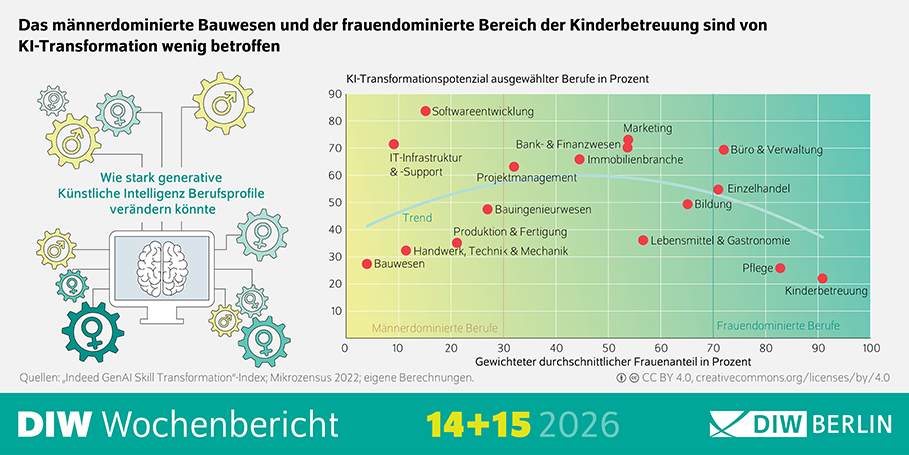
The research indicates that occupations traditionally associated with either gender do not uniformly face higher or lower levels of AI-driven transformation. Roles in care and childcare, which are typically female-dominated, as well as construction and manual trades, which are more often male-dominated, are expected to see comparatively limited direct impact from AI. In contrast, occupations involving a mix of cognitive and digital tasks, including project management, finance, marketing and parts of the real estate sector, are more likely to experience moderate changes in required skills and workflows.
The study identifies technology-related roles, particularly software development, as having among the highest exposure to AI transformation. However, these fields remain characterised by a relatively low share of female employees, highlighting a structural imbalance in workforce participation rather than a direct gender-based impact of AI itself.
According to the authors, the extent to which AI reshapes specific roles depends primarily on the nature of tasks performed and how organisations choose to implement the technology. In many cases, AI is expected to support efficiency and automate routine elements of work rather than replace entire occupations.
The findings also point to differences in the use of AI tools, with evidence suggesting that women currently adopt such technologies less frequently than men. As a result, the study emphasises the importance of expanding access to training and ensuring that upskilling initiatives are designed to address existing gaps in digital competencies.
The authors conclude that while AI is set to influence most professions to varying degrees, its effects will be determined less by gender distribution and more by how effectively workers and employers adapt to new technological capabilities.