Sunday, 4 October 2026
With public access to the Property Price Register now providing insight into actual transaction prices, questions arise over whether this data is shaping developers’ pricing strategies and whether buyers of newly built flats are actively using such information when assessing the market.
Tomasz Kaleta, Managing Director for Sales and Marketing at Develia: The introduction of free access to the Property Price Register is a step towards greater market transparency, but for the time being its interpretative potential is limited. The system does not yet contain complete data, and the scope and availability of the data vary depending on location. Furthermore, the register publishes prices taken from notarial deeds. In the case of the primary market, this means transactions that are often finalised a year or two after the signing of the development contract, which is why the data presented does not always reflect the current price situation on the market.
From the customer’s perspective, up-to-date information on specific developments is more important – primarily transparent flat prices, unit availability and the pace of sales, which allow for a realistic assessment of an offer’s attractiveness.
Agnieszka Majkusiak, General Director of Sales and Marketing at Atal: Prices of developer-built flats are shaped by objective factors, primarily the costs of land acquisition and construction, rather than by the availability of information about offers and historical transactions. The standard of the development is also a key factor.
We have long presented our property listings and prices transparently, even before regulations required us to do so. This change therefore has little significance for us; it simply makes it easier for customers to gain an overview of the market, which is a positive standard.
Under the current RCN reporting requirements, many important parameters of a purchased property are not visible, which may lead to erroneous conclusions. Two flats in the same development—one purchased with two parking spaces and a storage unit, and the other without any additional features, can show very different prices per square metre. Individual features such as orientation, floor level, view and technical solutions used in the building also play a role.
Another issue is the delay, as many purchases made a year or even two years ago do not yet appear in the registers, since title deeds are only now being transferred or are still pending transfer.
As was the case with the introduction of transparency in offer prices last year, there is currently no indication that the new RCN regulations will have a significant impact on developers’ pricing strategies. Many other variables influence market conditions, pricing policies and the overall balance of supply and demand. As the regulation is new, it is still difficult to assess to what extent prospective buyers are using transaction data.
Mariusz Gajżewski, Head of Sales, Marketing and Communication at BPI Real Estate Poland: Greater transparency in the property market is a natural direction for its development. Access to actual transaction prices can help clients better understand how prices are formed and make more informed purchasing decisions. From a developer’s perspective, pricing policy is always based on multiple factors, such as location, standard, development costs and demand.
Public access to transaction data can serve as an additional point of reference, but it does not change the fact that every development has its own specific characteristics and unique value. We are also seeing that customers are becoming increasingly informed and are more likely to analyse market data before making a purchase decision. This is a positive trend that supports greater transparency and professionalism in the market.
Renata McCabe-Kudla, Country Manager at Grupo Lar Polska: The Property Price Register is an interesting tool, but it only shows flat prices and provides no information on the quality of the property. There is no data on layout or standard. It helps to give an idea of average prices in a given location, but it has no influence on our company’s pricing policy. We set prices based on land costs, construction costs and associated expenses, assessing each flat and parking space individually. I am not sure whether customers are interested in monitoring transaction rates, but I do not believe the register will influence market prices, as these are cost-driven.
Joanna Chojecka, Sales and Marketing Director for Warsaw, Wrocław and Łódź at Robyg Group: The launch of the free Property Price Register is a step towards greater market transparency. From our perspective, however, this does not represent a revolution in pricing policy. We set flat prices based on detailed market analyses, including actual transactions, demand levels, competitive offerings, development costs and the pace of sales. Public access to transaction data may streamline and standardise this process for all market participants.
Greater transparency will certainly influence customer expectations. Buyers are better prepared for negotiations, analyse asking prices and compare developments within a given location. Access to actual transaction prices may reinforce this trend. At the same time, price is only one element of the purchasing decision. Customers also consider the standard of the development, location, quality of communal areas and the developer’s reputation. We therefore see data transparency as part of broader market professionalisation rather than a factor that would significantly limit pricing flexibility.
Kamil Rutkowski, CEO of Rutkowski Group: From our perspective, the disclosure of actual sales price data has not significantly affected our pricing policy or sales dynamics. From the outset, we have based our approach on the real costs of project delivery, local market analysis and the value offered by each property. Price transparency has not altered these fundamentals.
We have also not observed any difficulties in discussions with clients as a result of access to the register. Some clients analyse transaction data and compare offers, which is natural when making such a significant financial decision. In practice, however, clients consider not only the price per square metre, but the investment as a whole—construction quality, developer reputation, surroundings and location potential.
Witold Kikolski, Member of the Management Board at MS Waryński Development S.A.: Widespread access to transaction price data increases market transparency, but it does not fundamentally affect our pricing strategy. We have long set prices based on actual project costs, supply and demand analysis and the competitiveness of our offering in a given location. Transparency reinforces existing market mechanisms rather than altering our approach.
We are seeing growing interest from clients in transaction data, which makes transparency and price justification even more important. In the long term, greater transparency supports market professionalism, curbs speculative expectations and encourages more rational purchasing decisions.
Monika Kudełko, Director of Strategy and Marketing Communications at Activ Investment: The introduction of the Property Price Register has no impact on our pricing policy. For nearly 30 years, our business has been based on fair valuation, reflecting the real value of each investment rather than short-term fluctuations or speculation. Our clients are aware of this and expect transparency, which we fully support.
The register simply reinforces their confidence that our pricing is aligned with the quality we deliver. For us, transparency is standard practice, and the disclosure of prices further validates our strategy, confirming that our clients have been investing in solid value for over three decades.
Damian Tomasik, CEO of Alter Investment: I do not believe that the introduction of the Property Price Register will significantly impact companies’ pricing policies or the market itself. Like any other market, the property sector is regulated in the long term primarily by supply and demand rather than access to price registers.
Greater transparency may be useful for some buyers or investors, but professionals have been analysing transaction prices for years. From a market perspective, a greater challenge than the lack of such data is legal instability and inconsistent regulatory interpretation. The volatility of regulations throughout the multi-year investment process has a much stronger impact on project risk and, consequently, property prices.
Andrzej Gutowski, Sales Director at Ronson Development: Flat prices were already visible to customers comparing offers in similar locations or districts under the current regulations. We do not see significant interest from potential buyers in monitoring transaction data. The Property Price Register contains a vast amount of information, making it difficult to draw conclusions without detailed analysis, although some companies may produce reports to facilitate its use.
We support open communication in sales and view this development as a step in the right direction. Individual clients are unlikely to use the register directly, but if it contributes to better market awareness and supports purchasing decisions in the future, it is a positive change.
Anita Makowska, Senior Business Analyst at Archicom: Making data from the Property Price Register publicly available is an important step towards greater market transparency. Access to transaction prices supports more substantive dialogue between developers and clients and helps dispel persistent misconceptions about pricing levels. It provides a reference point based on real market data. However, we do not expect the introduction of the RCN to directly affect our pricing policy.
The valuation of flats is primarily based on cost factors such as land prices, construction and materials, regulatory requirements and operational expenses. The register serves as an additional source of market information but does not replace analytical valuation models used by developers.
We observe that clients are increasingly interested in market data and compare offers more actively, leading to more informed decisions and greater importance of transparent communication. In response, we emphasise advisory support in the sales process, helping clients interpret data and assess the real value of properties. In this sense, access to the RCN may strengthen trust by increasing transparency in the purchasing process.
Andrzej Swoboda, Deputy Chairman of the Management Board at CTE Group: Making the Property Price Register freely available increases transparency, but it is unlikely to significantly affect how professional developers set prices. In the primary market, prices are already public and available to customers from the outset, meaning the sector operates under relatively transparent conditions.
The register may serve as a useful source of market knowledge, particularly for analysing the secondary market. In the development sector, however, prices are primarily determined by project costs, land prices, financing and supply-demand dynamics rather than data availability. Reputable developers do not rely on pricing tactics; customers receive clear information on pricing and associated costs.
Some customers are interested in market data, but in practice, factors such as location, development standard, layout and financing costs are far more influential in purchasing decisions than detailed transaction analysis.
Marcin Michalec, Managing Director at Okam Capital: The launch of the free DOM Portal and the Property Price Register is a step towards full market transparency, something long advocated by analysts. Our experience shows that buyers use transaction data to better estimate market value and strengthen their negotiating position.
For the company, however, this does not represent a shift in pricing policy. Our prices have always reflected construction costs, land acquisition and product quality. Transparency works in our favour, as market data confirms that our valuations are aligned with the quality and location of our projects.
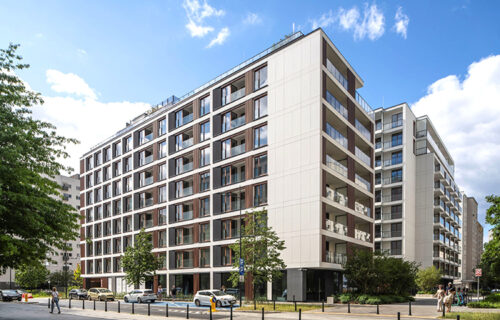
Photo: Chmielna Duo – BPI Real Estate Poland
Source: Dompress.pl