Wednesday, 14 October 2026
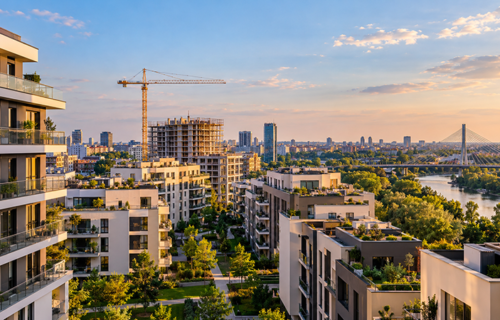
Romania’s residential construction market recorded a substantial recovery during the first half of 2026, following three consecutive years of declining housing completions. According to the National Institute of Statistics, 31,958 homes were completed between January and June, representing an increase of almost 30% compared with the corresponding period of 2025. The improvement follows a decade in which more than 636,000 homes were delivered nationwide, although recent research highlights considerable differences in construction activity between Romania’s major cities.
An analysis by Cushman & Wakefield Echinox shows that Romania completed 636,310 homes between 2016 and 2025, equivalent to approximately 32.9 units per 1,000 inhabitants. Among 21 European markets examined, Romania recorded a construction rate comparable with Germany at 33.6, Slovakia at 34.4 and Czechia at 31.5 homes per 1,000 residents. Poland recorded considerably stronger development at 55.2, followed by France at 52.8 and the Netherlands at 39. At the lower end, Hungary registered 18.2, Spain 16.4 and Portugal 15.7. These figures reflect the consultancy’s calculations and do not necessarily indicate whether housing supply meets demand.
Romania’s annual completions increased from 52,206 homes in 2016 to a peak of 73,338 in 2022, before declining to 70,957 in 2023, 60,978 in 2024 and 59,062 in 2025. The latest full-year figure was approximately 19.5% below the 2022 peak, although it remained 13% higher than in 2016. The recovery during the first half of 2026, when completions increased from 24,609 to 31,958 homes, indicates a change in the recent pattern, although six-month figures do not establish the full-year outcome.
The Bucharest–Ilfov region accounted for a substantial share of the improvement, with 10,773 homes completed during the first half of 2026, compared with 7,011 a year earlier. This represented approximately one-third of national deliveries. However, stronger completions do not necessarily indicate an equivalent increase in property sales or new development starts, as projects typically require several years to progress from planning to delivery.
The longer-term analysis reveals substantial differences between Romania’s principal cities. Bucharest recorded approximately 93,850 completed homes between 2016 and 2025, compared with 25,200 in Cluj-Napoca and 22,300 in Brașov. When adjusted for population, however, Brașov led the major cities examined with 94 homes per 1,000 inhabitants, followed by Cluj-Napoca at 88, Sibiu at 61.8 and Oradea at 58.1. Bucharest recorded 52.5 homes per 1,000 inhabitants, while Timișoara reached 50.1.
Other cities experienced considerably lower construction activity relative to population. Constanța recorded 43.2 completed homes per 1,000 inhabitants, followed by Iași at 38.8, Târgu Mureș at 36.1 and Craiova at 32.2. Ploiești registered just 8.1, while Brăila recorded 10.2, Baia Mare 11 and Buzău 11.5. The differences demonstrate how residential investment has been distributed unevenly across Romania, reflecting varying local economic and demographic conditions.
The slowdown following the previous construction peak was particularly pronounced in several major cities. Bucharest completed 9,361 homes in 2025, approximately 32% below its 2023 high of 13,834 units. Cluj-Napoca recorded 957 completions compared with 4,175 in 2019, while Brașov delivered 1,283 homes against a peak of 3,098 in 2020. Timișoara and Iași also experienced substantial reductions from earlier highs, demonstrating that the adjustment extended beyond the capital.
Vlad Săftoiu, Head of Research at Cushman & Wakefield Echinox, considers the figures evidence of increasingly different development conditions between Romania’s urban centres. He identifies infrastructure, accessibility, purchasing power and the suitability of residential projects for prospective buyers as important factors influencing future investment. Developers are expected to place greater emphasis on locations where economic activity and household incomes can support sustainable demand.
Despite the recovery in completions, indicators of future development remain mixed. Romania issued 15,939 residential building permits during the first six months of 2026, approximately 9.6% fewer than in the corresponding period of 2025. The difference between rising completions and declining permits suggests that current deliveries may reflect projects initiated under earlier market conditions, while the pipeline of future developments could face greater constraints.
Romania’s residential market therefore presents a more complex picture than the previous three-year decline suggests. Housing completions recovered strongly during the first half of 2026, but development remains concentrated in particular urban centres, with substantial differences in construction intensity between cities. For investors and developers, future opportunities will increasingly depend on infrastructure, financing conditions, local employment prospects and the ability to deliver homes at prices aligned with household purchasing power.