KCAP wins JTRE competition for iconic Bratislava skyscrapers

26 November 2024

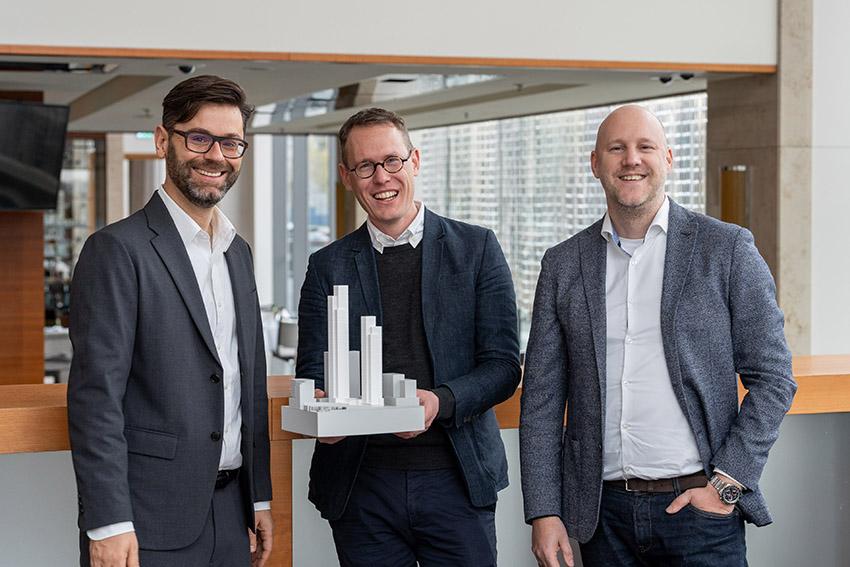
The Bratislava skyline is set to be transformed as renowned Dutch architectural studio KCAP emerges victorious in JTRE’s international urban-architectural competition for the Eurovea City Concept Design. KCAP’s innovative vision for two striking skyscrapers was selected by an expert jury, surpassing entries from globally acclaimed studios, including Delugan Meissl Associated Architects, Dominique Perrault Architecte, Gensler, and AE7 & GFI.

KCAP’s winning design features two slender towers, standing 260 meters and 184 meters tall, that reimagine traditional high-rise architecture. Instead of monolithic structures, the towers are envisioned as a cluster of elegant, tapering volumes with distinctive stepped crowns and panoramic windows, forming a dynamic addition to Bratislava’s downtown. The development will complement the existing Eurovea Tower (168m), creating a sophisticated vertical cluster that adheres to Bratislava’s Urban Study of Height Zoning and adds a contemporary vibrancy to the city’s silhouette.

The expert jury, chaired by Michal Sedláček, professor and former chief architect of Brno, praised KCAP’s design for its innovative approach, aesthetic harmony, and commitment to sustainability. The proposal integrates the towers seamlessly into Bratislava’s urban fabric while enhancing its visual identity and architectural prestige.

“The winning design stood out for its aesthetic and functional qualities, harmonizing with the existing urban environment while elevating Bratislava’s skyline with a contemporary touch. These skyscrapers will become iconic landmarks, signaling a progressive approach to urbanism and boosting the city’s appeal to investors and visitors alike,” Sedláček noted.

The KCAP-designed skyscrapers will feature over 1,000 residential units, making them two of the tallest residential buildings in the European Union. The towers will showcase warm metallic façades that subtly reflect light, adapting their appearance with changing weather and time of day.

Connected by glass base pavilions offering amenities and community spaces, the development emphasizes integration between architecture and nature. Inspired by the flowing forms of the nearby Danube River, the design incorporates a lush 7,300-square-meter green area, significantly expanding the planned open space in the Eurovea City district.

Sustainability is central to the project, with innovative systems that reduce concrete usage, optimize construction, and minimize carbon emissions. “With this project, we aim to set a new benchmark for high-rise living—blending architectural ambition with sustainable innovation,” said Jeroen Dirckx, KCAP Partner.

The competition attracted world-class architects, tasked with envisioning high-rises that would elevate Bratislava’s cityscape while integrating into a sustainable urban district. The jury included Bratislava’s Chief Architect Juraj Šujan, renowned architect Hadi Teherani, and JTRE’s Executive Director Pavel Pelikán.

Pelikán expressed satisfaction with the breadth of submissions: “We sought visionary designs from renowned architects experienced in high-rise projects. KCAP’s proposal not only meets these criteria but also redefines Bratislava’s urban profile with bold, sustainable landmarks.”

KCAP, based in Rotterdam, Zurich, and Paris, collaborated with British engineering firm Buro Happold to deliver the winning concept. Known for expertise in urban planning and architecture, KCAP brings together a global team of over 100 professionals focused on creating innovative solutions for growing cities.

The Bratislava skyscrapers promise to be transformative, establishing a new standard for high-rise design in Europe. As construction begins, the project is set to bolster Bratislava’s global architectural standing and further its reputation as a dynamic, forward-thinking European capital.
front page info
LATEST NEWS
14 August 2026 Skanska JV secures USD 1.9 billion Los Angeles light rail contract 14 August 2026 Poland’s Job Market Edges Higher as Construction and Logistics Hiring StrengthensPoland’s recruitment market continued to improve in July, although the latest data suggest that the recovery remains gradual rather than signalling a broad acceleration in hiring. The Barometr Ofert Pracy, which tracks changes in the number of employment advertisements published online, increased to 261.5 points in July 2026, compared with 261.1 points in June and 258.5 points a year earlier. The indicator has been rising since April, but the strength of the monthly increases has progressively weakened. The survey is prepared by the Department of Economics and Finance at the University of Information Technology and Management in Rzeszów together with the Bureau for Investments and Economic Cycles (BIEC). It is based on online job advertisements collected each month and adjusted to remove seasonal effects, providing an indication of changes in employers’ demand for new workers. BOP 8.2026.pdf The July results reveal increasingly different conditions between sectors. Recruitment in services is recovering, construction and engineering are showing stronger demand and logistics is improving, while vacancies for physical workers continue to decline. Construction recruitment reaches four-year high One of the clearest improvements is visible in construction. Among occupations requiring scientific or engineering qualifications, vacancies increased across almost every category in July, with IT the exception. Construction recorded a particularly strong result, with the number of advertised positions reaching its highest level in four years. BOP 8.2026.pdf Recruitment of engineers is also recovering. Following several years of declining vacancy numbers, demand has been gradually rebuilding and reached its highest level for two years following the latest increase. BOP 8.2026.pdf For the property and infrastructure sectors, the figures point towards stronger competition for technically qualified employees as construction activity requires additional engineering and specialist capacity. The improvement does not extend equally across the entire labour market. Vacancies for physical occupations declined again during July and have been following a clear downward trajectory since around the middle of 2024. BOP 8.2026.pdf This divergence suggests that employers’ recruitment requirements are becoming increasingly specialised rather than simply expanding across all categories of labour. Logistics hiring continues to recover Logistics is another area showing clearer signs of strengthening demand. The number of logistics vacancies has increased since April and reached its highest level since January 2024 in July. Recruitment in freight forwarding is also following an upward trend. BOP 8.2026.pdf The figures are relevant to Poland’s industrial and logistics property sector because employment demand provides another indication of operating activity among companies occupying warehouses, distribution centres and transport facilities. Services more broadly produced the largest increase in vacancies among the main occupational groups during July. Following more than a year of adjustment, recruitment in this part of the economy has been improving since the beginning of 2026, with July producing the highest number of advertisements since September 2024. BOP 8.2026.pdf Tourism recruitment also strengthened, reaching its highest level in more than 18 months, while education recorded a double-digit monthly percentage increase in vacancies, although demand in the sector remained substantially below the level recorded a year earlier. BOP 8.2026.pdf IT recovery remains fragile Technology presents a more complicated picture. Vacancies for both IT administration and programming declined in July, with the reduction somewhat greater among programmers. Nevertheless, the longer-term direction has improved modestly, with IT vacancies gradually increasing over approximately the past 18 months. BOP 8.2026.pdf The recovery remains far from complete. Demand for IT workers is still significantly below the levels recorded before the economic disruption associated with the pandemic, with the gap particularly pronounced for programmers. BOP 8.2026.pdf Meanwhile, within social-science and legal occupations, recruitment has been broadly stable since October 2025. July brought some improvement for call-centre employees, purchasing departments and lawyers, while vacancies declined for graphic designers, office workers and banking positions. BOP 8.2026.pdf Regional differences remain substantial The recovery is also uneven geographically. After seasonal employment was excluded, online vacancies increased in most Polish regions during July. The strongest monthly increases were recorded in Warmińsko-Mazurskie, Podkarpackie and Śląskie, while the largest decreases occurred in Wielkopolskie, Zachodniopomorskie and Dolnośląskie. BOP 8.2026.pdf At the same time, labour-market conditions are not improving across every measure. The seasonally adjusted registered unemployment rate increased by 0.1 percentage point in June to 6.1%, its highest level since May 2021, according to the report. BOP 8.2026.pdf The combination of slightly higher unemployment and gradually increasing vacancies points towards a labour market undergoing structural adjustment rather than a straightforward hiring boom. The report’s labour-market diagram on page three places July 2026 close to the boundary between improving qualifications and a stronger employment outlook, illustrating the relatively tentative nature of the current recovery. BOP 8.2026.pdf For Poland’s property sector, however, the composition of hiring may be more important than the headline movement in the index. Increasing demand for construction specialists, engineers, logistics workers and freight-forwarding employees coincides with sectors directly connected to development, infrastructure and industrial real estate. The July Barometr therefore points to a labour market moving forward slowly but becoming increasingly differentiated: employers are recruiting again in selected areas, while other occupations continue to face weaker demand. Construction and logistics currently stand out among the areas where that improvement is becoming most visible. 14 August 2026 NBI Analysis: Bucharest Strengthens Its Position in CEE 14 August 2026 How Transit-Oriented Development Has Shaped Japan’s Real Estate Success 14 August 2026 Croatia proposes 50% levy on exceptional 2026 corporate profit margins 14 August 2026 NEPI Rockcastle enters Spain with €252 million acquisition of MegaPark Barakaldo 14 August 2026 GN Group takes more than 30,000 sqm at Panattoni’s Kladno brownfield development



