Wednesday, 11 November 2026
Germany could introduce competitive auctions for commercial groundwater extraction rights in regions facing water shortages, according to a study published by the German Institute for Economic Research (DIW Berlin) on 11 November 2026. The proposal aims to improve the allocation of limited water resources as demand from industry, agriculture and emerging technologies increases.
The researchers estimate that approximately half of Germany’s districts and independent cities are already experiencing pressure on groundwater resources. Climate change, periods of prolonged drought and competing commercial requirements are placing additional demands on supplies, particularly in regions where groundwater reserves are under pressure.
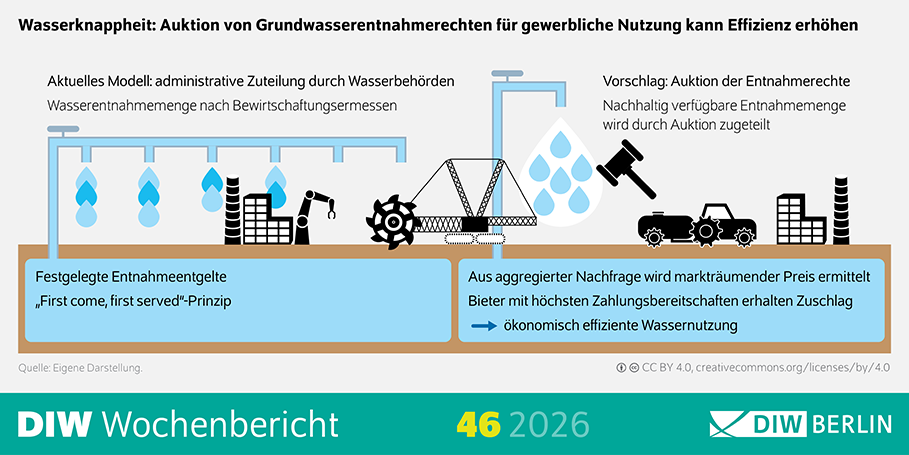
Germany currently regulates groundwater extraction through the Federal Water Resources Act and legislation administered by individual federal states. Commercial withdrawals generally require authorisation from the relevant water authority, although exemptions apply to certain activities. Authorities assess applications against environmental and water-management requirements and can impose restrictions on extraction volumes.
Water withdrawal charges also exist in many German federal states, although their structure and rates vary. The existing system relies primarily on administrative decisions rather than competitive bidding, with DIW Berlin identifying situations where earlier applicants may receive preferential access to available resources.
The researchers propose introducing auctions in regions where commercial demand exceeds the groundwater volume that can be sustainably extracted. Under this approach, water authorities would determine the quantity available for commercial use, after accounting for drinking water supplies and other priority requirements. Businesses would then submit bids for permission to withdraw specified volumes.
The available quantities could be reviewed annually to reflect changing groundwater conditions. According to the study, this would allow authorities to adjust commercial extraction levels during periods of reduced availability while using the auction process to establish a price reflecting regional demand.
DIW Berlin identifies data centre cooling, hydrogen production and agricultural irrigation as activities that could increase pressure on groundwater resources. Although industrial withdrawals from rivers and other surface waters have declined in recent years, the researchers report that groundwater extraction has not shown a comparable reduction.
For Germany’s industrial property market, the findings raise questions about how water availability could influence future development decisions. Manufacturing facilities, data centres and other water-intensive operations may need to consider regional supply constraints alongside electricity availability, transport infrastructure and construction costs when evaluating potential locations.
Data centre developments could be particularly affected where cooling systems require substantial water consumption. However, the implications would vary according to the technology used, the source of water and local environmental conditions. Facilities relying on alternative cooling arrangements or recycled water may face different requirements.
The proposed auctions would not necessarily replace existing water extraction charges. DIW Berlin suggests that both mechanisms could operate together, with charges addressing environmental and resource-related costs while auctions determine how limited commercial withdrawal volumes are distributed.
The researchers also acknowledge that implementation would depend on reliable information about groundwater availability and actual consumption. Accurate measurement would be necessary to establish sustainable extraction limits and assess whether the proposed allocation system was operating as intended.
The auction model remains a research recommendation and has not been introduced as German national policy. Existing extraction permissions, environmental safeguards and regional regulatory arrangements continue to apply. Any move towards competitive allocation would require further legal and administrative consideration, particularly regarding existing water rights and the treatment of different commercial users.
DIW Berlin recommends examining the approach initially in regions combining groundwater shortages with substantial industrial or agricultural demand. For property developers and investors, the study highlights the growing importance of assessing water availability when planning facilities whose operations depend on reliable access to natural resources.