Sunday, 20 September 2026
Germany’s industrial transformation has resulted in far fewer job losses than traditional employment statistics suggest, with many production-related roles moving into the services sector rather than disappearing altogether, according to a new study by the German Institute for Economic Research (DIW Berlin).
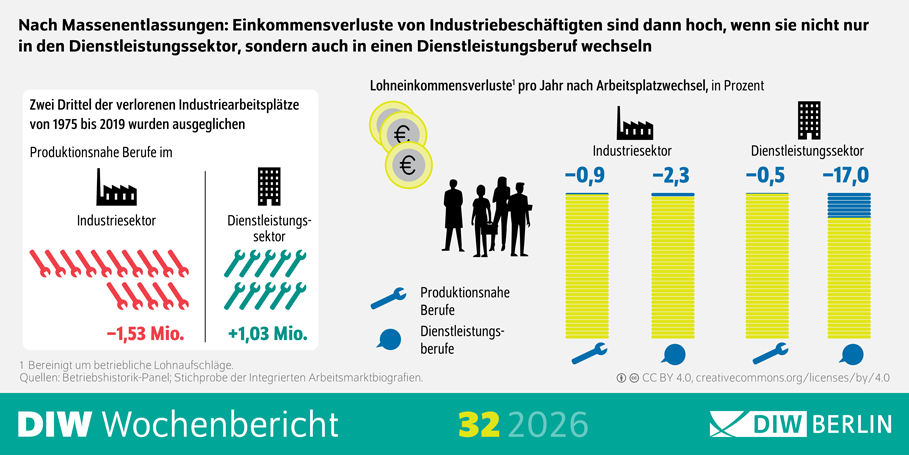
The research found that while around 1.5 million manufacturing jobs were lost between 1975 and 2019, more than one million comparable production-related positions were created in the service sector over the same period. As a result, approximately two-thirds of industrial jobs lost during the past four decades were effectively replaced by similar occupations outside manufacturing.
The findings suggest that the German labour market has undergone a structural shift rather than a simple decline in industrial employment, with workers increasingly applying manufacturing skills in logistics, maintenance, technical services and other production-related activities.
According to Thilo Kroeger, economist at DIW Berlin and co-author of the study, the most important factor for workers is not whether they remain employed in manufacturing but whether they are able to continue using their professional skills in a similar occupation.
The study argues that conventional industry employment statistics often overstate the decline in industrial work because they classify employees according to their employer’s sector rather than the work they actually perform. Using social security data from the Institute for Employment Research (IAB), the researchers analysed occupations rather than industries, focusing on workers affected by large-scale redundancies that were unrelated to individual performance.
Based on this occupational approach, the researchers estimate that net losses in production-related jobs amounted to around 500,000 positions, substantially below the 1.5 million decline suggested by sector-based employment figures.
The research also found that maintaining the same occupation is a key factor in preserving earnings. Workers who moved from manufacturing into service-sector employers while continuing to perform similar production-related roles experienced an average long-term wage decline of only 0.5%, after adjusting for company-specific pay differences.
By contrast, employees who changed both employer and occupation experienced significantly larger income reductions. Those leaving industrial occupations altogether for service-sector jobs earned on average around 17% less over the longer term.
The findings have important implications for labour market policy as Germany continues to adapt to structural changes affecting industries such as automotive manufacturing, mechanical engineering and metal processing.
Rather than focusing primarily on preserving employment within specific industries, the authors argue that policymakers should place greater emphasis on helping workers transfer their existing skills into comparable occupations across different sectors. They recommend expanding retraining and qualification programmes that build on existing technical expertise while supporting occupational mobility.
The study also suggests that employment agencies, employers and social partners should identify workers at risk of redundancy earlier and provide support before jobs disappear, helping employees transition into roles where their existing skills remain in demand.
The authors do not support a broad reduction in employment protection legislation. Instead, they argue that stable employment relationships encourage workers and employers to invest in skills development. While they see some scope for expanding fixed-term employment contracts, they recommend limiting such measures to newly created positions linked to transformation projects, with the expectation that successful projects would ultimately lead to permanent employment.
The study concludes that Germany’s industrial transition should be viewed less as a loss of productive employment and more as a redistribution of industrial skills across different sectors of the economy. For businesses facing ongoing technological and structural change, maintaining and redeploying occupational expertise may prove more important than preserving traditional industry boundaries.
Source: DIW Berlin