Wednesday, 25 November 2026
Europe could require substantial investment in hydrogen-based energy storage to maintain electricity supplies during prolonged periods of low wind and solar generation, according to a study by the German Institute for Economic Research (DIW Berlin).
Researchers Martin Kittel, Alexander Roth and Wolf-Peter Schill examined historical weather patterns between 1982 and 2019 and modelled the storage requirements of a future European electricity system powered entirely by renewable energy.
The longest period of reduced renewable generation identified in the 38-year dataset lasted 55 days during the winter of 1996–1997. Even during this exceptional event, potential renewable electricity generation averaged almost half its long-term level.
While shorter periods of reduced generation can be managed using battery storage, prolonged shortages require solutions capable of storing considerably larger quantities of energy. Combining wind and solar generation and expanding cross-border electricity transmission could also reduce the severity of supply shortages.
The DIW model estimates that a fully renewable European electricity system would require an average hydrogen-based storage capacity of approximately 170 terawatt-hours (TWh), equivalent to around 3% of assumed future annual electricity demand. Under the exceptional weather conditions recorded in 1996–1997, requirements would have increased to approximately 350 TWh, or around 7% of annual demand.
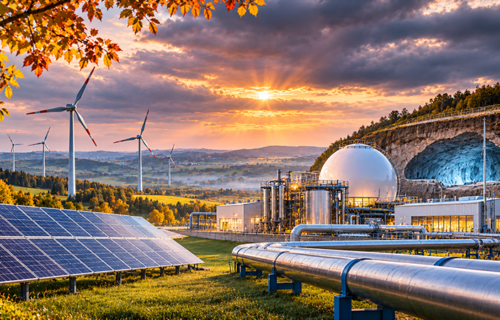
Hydrogen produced using renewable electricity could be stored in underground salt caverns and subsequently converted back into electricity when generation is insufficient. Electrolysis facilities, storage infrastructure and power generation plants could operate at separate locations connected through hydrogen pipelines.
“In a European comparison, northern Germany in particular has considerable potential for cavern storage, meaning Germany could play a key role in the expansion of long-term energy storage,” said Alexander Roth, co-author of the study.
European hydrogen storage projects currently under consideration represent more than 100 TWh of potential capacity, although their implementation remains uncertain. Very few underground hydrogen storage facilities are currently operational.
Planning and construction periods for cavern storage facilities are estimated at between five and 15 years, depending on whether existing natural gas storage facilities are converted or new infrastructure is developed.
The researchers argue that private investment alone may be insufficient to finance storage capacity intended for exceptional weather events, given the potentially infrequent utilisation of such facilities. Government support and mechanisms compensating operators for maintaining reserve capacity may therefore be necessary.
DIW recommends incorporating long-duration storage into Germany’s planned electricity capacity mechanism from 2032.
For infrastructure investors and industrial property developers, the findings underline the importance of long-term energy security, grid connectivity and investment in storage infrastructure. However, the projected storage requirements represent modelled scenarios for a fully renewable electricity system rather than forecasts of immediate European demand.
Source: DIW Berlin, study on prolonged periods of low renewable electricity generation and long-term energy storage.