Thursday, 19 November 2026
As Trenčín prepares for a new wave of residential development, questions surrounding housing demand, infrastructure investment, affordability and long-term urban planning are becoming increasingly important. CIJ.World speaks with Peter Klačman, CEO of VOD–EKO a.s., about the company’s 629-home Vážky development in Nozdrkovce, the challenges of transforming a brownfield site into a residential neighbourhood, and the outlook for the city’s housing market over the next five years.
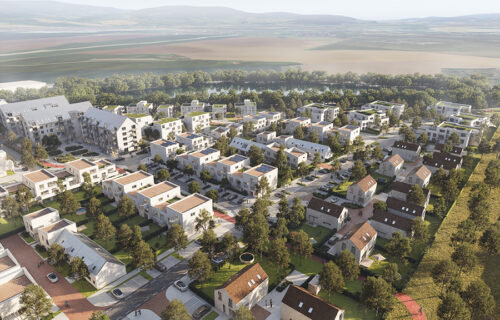
The Vážky project represents a significant investment in Trenčín’s residential market, combining apartments, family houses, retail premises, public spaces and transport infrastructure. With the first phase comprising 126 apartments and eight family houses, and initial handovers scheduled for December 2028, the development is intended to establish a new residential neighbourhood connected to the wider city.
In this interview, Klačman discusses the importance of matching construction activity to actual buyer demand, the financial and technical challenges of phased development, cooperation with the municipality, and the role of environmental resilience in creating sustainable residential communities.
CIJ.World: Trenčín is experiencing a growing pipeline of residential developments, including projects targeting different buyer segments. How do you assess the city’s capacity to absorb this new housing supply, and what has the initial sales experience at Vážky revealed about demand from local owner-occupiers, buyers relocating from surrounding municipalities and residential investors?
Peter Klačman: Trenčín has a substantial pipeline of new housing for a city of its size, and we are seeing the quality of new projects improve. We expect it will take time for the market to absorb the new supply and for sales to settle into a steadier pace, similar to what we see in more established markets. We remain optimistic about the city’s longer-term prospects. As a Trenčín-based company, VOD–EKO is also proud to be a main partner of Trenčín 2026, the European Capital of Culture.
Although the city’s registered population has declined over the past decade, more people moved into Trenčín than left in each year from 2023 to 2025. It is also important to recognise that the city serves a much wider population than its official resident figures suggest. People from surrounding municipalities travel into Trenčín every day for employment, education, healthcare and other services. This creates a broader potential housing market, while the volume of daily commuting contributes to congestion during peak periods.
At Vážky, we see an opportunity to offer families a quieter residential environment without sacrificing access to city services. For existing Trenčín residents, the development provides an alternative within the city, while households relocating from surrounding municipalities may benefit from shorter daily journeys. Planned public transport and cycling connections are an important part of this approach, reducing the need to rely exclusively on private cars.
Initial sales have progressed in line with our expectations. We are seeing interest across different age groups, with most purchasers intending to occupy their homes rather than acquire them primarily as investments.
CIJ.World: Vážky represents a substantial, multi-phase residential investment. How is VOD–EKO approaching the financing and capital allocation of the project, and to what extent will construction decisions depend on pre-sales, bank financing and changing development costs?
Peter Klačman: Vážky is a brownfield redevelopment on land that VOD–EKO has owned for decades. This provides an established foundation for the investment and allows us to approach the project with a long-term perspective.
We are using a conventional financing structure, which we have adapted together with our banking partner to accommodate the phased development of the site. The first phase comprises 126 apartments, eight family houses and retail space, alongside the access road and principal utility connections required to support the new neighbourhood.
Buyer demand will be the main factor determining the timing and scale of subsequent construction phases. The pace of pre-sales provides an indication of how quickly the market is absorbing new housing, while the types of properties buyers select help us refine the residential mix in later stages.
Before committing to additional construction, we also assess the availability of bank financing and updated building cost estimates. Our objective is to maintain a disciplined investment approach, ensuring that each phase reflects market conditions rather than expanding supply ahead of demonstrated demand.
CIJ.World: Transforming Nozdrkovce into a functioning residential neighbourhood will require considerable investment in transport connections, utilities and public infrastructure. What are the most significant technical or administrative challenges currently facing the development, and how are responsibilities and costs being coordinated between the developer and the municipality?
Peter Klačman: One of our principal priorities is upgrading the access road to Nozdrkovce, including the construction of a cycle path. We have signed a cooperation agreement with the City of Trenčín to coordinate and jointly finance these improvements.
Design and permitting are currently underway. A key challenge is ensuring that the road improvements progress in coordination with the first residential construction phase and the associated utility infrastructure. These investments are intended to benefit both existing Nozdrkovce residents and future households moving into Vážky, improving accessibility and road safety for the wider area.
The first phase also includes plans for a new bus stop and an extension of the municipal bus route. Additional cycling connections will link the neighbourhood to the existing network, including the Váh cycle route. Together, these improvements should provide residents with more practical alternatives for everyday travel.
Beyond transport infrastructure, the development involves significant investment in water supply and utility networks. Our plans include a new drinking water reservoir and a connection to the existing Nozdrkovce water main, creating a loop within the network. We also intend to upgrade sections of the existing utility infrastructure where necessary, introduce public lighting and establish new public spaces.
Coordinating these investments with the municipality is essential because the infrastructure must serve the long-term needs of the neighbourhood, rather than simply accommodate the first buildings completed.
CIJ.World: The project’s proximity to the Váh River and surrounding lakes is a defining feature, but it also raises questions about water management, climate resilience and long-term maintenance. What specific engineering and environmental measures are being incorporated to manage flood exposure, groundwater conditions and extreme rainfall, and how will these affect future residents’ operating costs?
Peter Klačman: Flood exposure and groundwater conditions were assessed from the earliest stages of the design process. Slovenský vodohospodársky podnik has mapped flood hazards along this section of the Váh, where river flows are managed through infrastructure including the Trenčín hydroelectric power station and the Biskupický Canal.
Vážky is situated behind an existing flood embankment. Based on the flood mapping used for the project, the site lies outside the area modelled to flood under the Q100 scenario, which represents a river flood with a one per cent annual probability of occurrence.
We have also considered how changes in river levels can influence local groundwater conditions, incorporating these factors into the neighbourhood’s drainage design.
Our environmental approach combines on-site rainwater retention with extensive planting along streets and within public parks. Green roofs will retain a proportion of rainfall where it falls and help reduce overheating within buildings. The drainage infrastructure will include an oil separator to treat runoff from paved surfaces before it reaches the lake.
Trees and other landscaping will provide shade and help moderate temperatures in outdoor public spaces. We believe that these measures will become increasingly important as cities adapt to periods of extreme heat and more intense rainfall.
Lake maintenance has been incorporated into the development strategy from the beginning. We are already working with specialists to maintain the lake’s ecological health, and we expect the water and surrounding greenery to contribute positively to the local microclimate.
The neighbourhood will also benefit from direct access to the Váh cycle route along the embankment, providing opportunities for outdoor recreation and sport.
Importantly, we do not expect the water management measures or lake maintenance to increase residents’ operating costs.
CIJ.World: Looking beyond the first construction phase, what milestones will determine the timing and scale of subsequent phases at Vážky, and how do you expect Trenčín’s residential property market to evolve over the next five years in terms of pricing, affordability and competition between developers?
Peter Klačman: The first residential handovers are planned for December 2028, and preparations for subsequent phases of the 629-home masterplan are already underway.
Our intention is to maintain a steady progression between phases, provided buyer demand supports continued development. Sales performance will determine when each new phase begins and how many homes are brought forward. We will also carefully sequence construction activities to use the time on site efficiently and minimise disruption for residents who have already moved into completed parts of the neighbourhood.
Nozdrkovce has historically experienced relatively limited new residential development. Vážky therefore presents an opportunity to establish a new neighbourhood in an area that has considerable potential.
We want each phase to contribute more than additional housing. The masterplan includes a central square with space for shops and everyday services, parks, walking routes and public areas around the lake. These facilities are intended to create opportunities for residents to meet, spend time outdoors and develop a sense of community.
We also want the neighbourhood to be accessible and attractive to people from other parts of Trenčín, rather than functioning as an isolated residential development.
Looking ahead five years, we expect buyers in Trenčín to benefit from a wider selection of new homes, while competition between developers will increasingly focus on both pricing and the quality of the residential environment.
Affordability will remain closely linked to household income growth and mortgage financing costs. Developers will need to understand what local families can realistically afford and respond with suitable housing options.
At Vážky, we believe our competitive advantage lies in combining homes within reach of families with well-designed streets, accessible public spaces and facilities that contribute to everyday quality of life. Our ambition is not simply to deliver residential buildings, but to create a neighbourhood that remains attractive and functional over the long term.
Source: © CIJ EUROPE