Wednesday, 23 September 2026
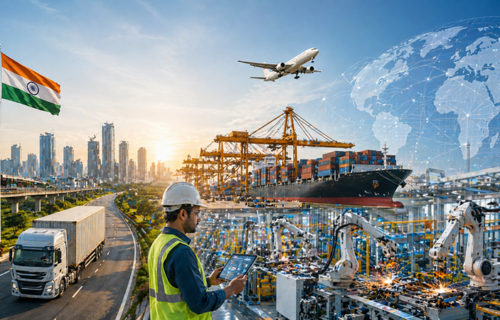
India is increasingly being positioned as a potential beneficiary of global supply chain diversification, as multinational companies reassess production strategies in response to geopolitical tensions, cost pressures and the need for resilience. While the country has historically transitioned from an agriculture-led to a services-driven economy, recent policy initiatives and investment trends suggest a renewed focus on manufacturing.
Global Supply Chain Reconfiguration
Over the past decade, and particularly following the COVID-19 pandemic and ongoing trade tensions between the United States and China, companies have accelerated efforts to diversify manufacturing bases. This “China+1” strategy has seen countries such as Vietnam, Thailand and Mexico attract significant investment.
India has emerged as a complementary destination within this shift, supported by its large domestic market, expanding middle class and demographic profile. According to analysis by the World Bank and UNCTAD, supply chain diversification is now driven as much by risk management as by cost efficiency, creating opportunities for multiple regional manufacturing hubs rather than a single dominant location.
Policy Support and Industrial Strategy
Government-led initiatives have played a central role in repositioning India’s manufacturing sector. The “Make in India” programme, launched in 2014, alongside Production Linked Incentive (PLI) schemes across key sectors, aims to boost domestic production and attract foreign investment.
According to the Ministry of Commerce and Industry India, PLI schemes have generated substantial investment commitments and increased production across sectors such as electronics, pharmaceuticals and automotive manufacturing. While headline figures cited by government sources point to large-scale investment and output gains, independent assessments suggest that the full impact is still evolving and varies significantly by sector.
Competitive Advantages
India’s structural advantages remain central to its manufacturing ambitions. These include a large and relatively young workforce, a growing consumer market and improving infrastructure. Foreign direct investment inflows into manufacturing have remained robust over the past decade, supported by regulatory reforms and sector-specific incentives.
Manufacturing activity indicators also point to steady expansion. Purchasing Managers’ Index (PMI) readings have generally remained in expansionary territory in recent periods, reflecting continued industrial activity despite global economic uncertainty.
Logistics efficiency has improved in recent years, although estimates vary. While some government sources suggest logistics costs are approaching single-digit levels as a share of GDP, external assessments, including those referenced by the World Bank, typically place India’s logistics costs higher than those in more established manufacturing economies.
Structural Challenges
Despite progress, several structural constraints continue to limit India’s ability to fully capitalise on global manufacturing shifts.
Infrastructure gaps remain a concern, particularly in terms of multimodal connectivity, port efficiency and energy reliability. Although large-scale investments are underway, execution timelines remain uneven across regions.
Labour productivity and skills development also present challenges. According to various studies, including those cited by the International Labour Organization, the proportion of the workforce with formal vocational training in India remains significantly lower than in developed economies.
Regulatory complexity and approval timelines continue to affect project execution, although reforms aimed at improving ease of doing business have led to gradual improvements. Comparisons with Southeast Asian economies such as Vietnam indicate that India still faces competition in terms of speed and predictability of approvals.
A Multi-Hub Manufacturing Future
While India is well-positioned to benefit from supply chain diversification, most analysts agree that it is unlikely to replace China as a single dominant manufacturing hub in the near term. Instead, the global manufacturing landscape is expected to evolve into a multi-hub system, with India playing an increasingly important role alongside other emerging economies.
The country’s ability to scale its manufacturing sector will depend on continued policy execution, infrastructure delivery and improvements in labour productivity. If these factors align, India could significantly expand its share of global manufacturing output over the medium to long term.
Source: CIJ.World India Research & Analysis Team