Tuesday, 10 November 2026
Electricity capacity, operating costs and the ability to accommodate new technology are becoming increasingly important factors in Europe’s industrial and logistics property market. Research from the Savills European Real Estate Logistics Census 2026 indicates that warehouse occupiers, developers and investors are placing greater emphasis on the technical capabilities of buildings and their suitability for changing operational requirements.
The survey found that 89% of occupiers expect their electricity requirements to increase over the next three years, while 26% report that their existing premises already lack sufficient power capacity. These findings suggest that access to electricity is becoming an important consideration in property selection, alongside rental costs, location and transport connections.
Financial pressures remain significant, particularly among retail businesses. Some 41% of respondents from the retail sector identified rent or increasing costs as obstacles to taking additional warehouse accommodation. For occupiers, the financial assessment of a property increasingly extends beyond the headline rent to include energy consumption, equipment requirements and the cost of adapting premises to operational needs.
The growing importance of electricity is also affecting development decisions. According to Savills, 77% of developers consider power availability an obstacle to bringing forward new projects, while 73% identify planning and approval procedures as a constraint. Construction costs were cited by 62% of respondents. Together, these factors influence the financial feasibility of developments and the time required to deliver new warehouse space.
In the Czech Republic, land acquisition costs and lengthy administrative procedures remain additional considerations. Ondřej Míček, Head of Industrial Agency at Savills, noted that developers must account for expenditure incurred during project preparation, often several years before rental income begins. These costs ultimately influence the rents required to make new developments financially viable.
The increasing use of technology is placing further demands on warehouse specifications. More than half of occupiers surveyed intend to increase investment in artificial intelligence, while 42% plan additional spending on warehouse automation. Such investments can require greater electricity capacity, changes to internal layouts and buildings capable of accommodating more complex storage and handling systems.
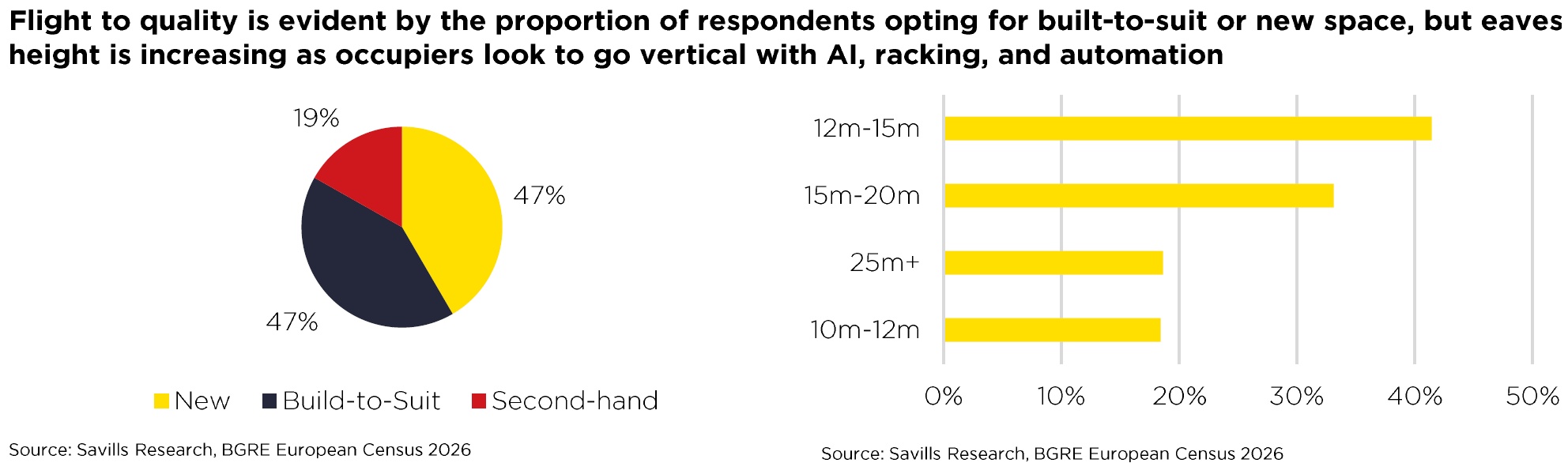
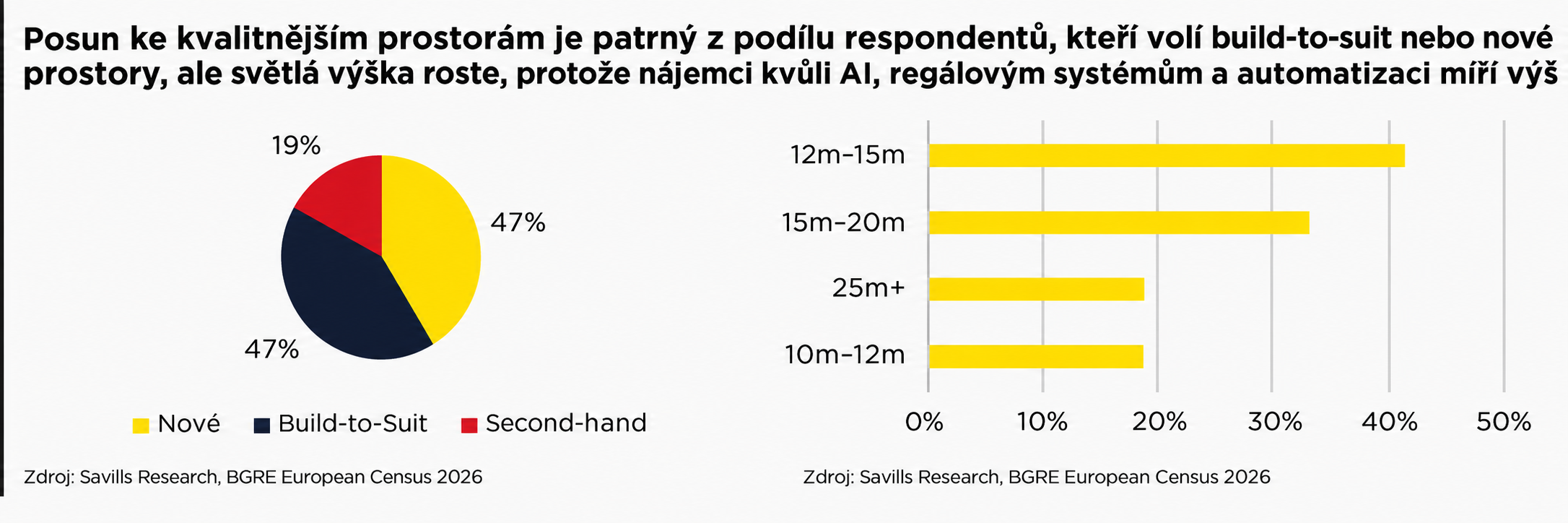
Building height is another consideration. The survey found that 42% of occupiers require warehouse heights of between 12 and 15 metres, while 33% seek heights of 15 to 20 metres. Taller buildings can accommodate higher-density storage and automated systems, although the suitability of these specifications depends on the activities carried out within the property.
For developers, providing greater height does not necessarily improve a building’s commercial prospects. Properties designed around highly specialised operational requirements may be more difficult to lease to alternative occupiers when an existing tenant leaves. This creates a need to balance technical specifications with the ability to accommodate different businesses over the building’s lifetime.
Míček observed that warehouses with clear heights of approximately 12 metres are now relatively common in the Czech Republic. However, developers do not necessarily use the maximum building height permitted under local planning rules, as future leasing flexibility can be more important than maximising the available internal volume.
The same considerations are influencing investment strategies. Savills found that 81% of investors surveyed are targeting prime logistics properties, compared with 73% in the previous year. The increased preference for this segment reflects attention to building quality, operational suitability and the potential costs of maintaining competitiveness.
Older logistics buildings may face additional challenges where electricity capacity, internal dimensions or technical infrastructure no longer meet occupier requirements. Properties that cannot be adapted economically could experience longer periods without tenants or require greater expenditure to remain commercially viable.
However, extensive redevelopment is not necessarily appropriate for every older property. Targeted improvements to electrical infrastructure, energy performance or internal facilities may provide a more economical means of extending a building’s useful life, depending on its location, condition and likely tenant demand.
The findings point to a change in how logistics properties are assessed across Europe. While location and rental levels remain central to leasing and investment decisions, electricity availability, automation readiness and the ability to accommodate future operational changes are becoming increasingly relevant to the financial performance of industrial buildings.
For the Czech market, where development costs and permitting procedures already affect the supply of new space, these requirements add another consideration for developers and property owners. Buildings capable of meeting changing occupier needs without substantial additional investment may be better positioned to retain tenants and maintain their competitiveness over time.