Tuesday, 20 October 2026
Poland’s continuing dispute over the Constitutional Tribunal has intensified following the appointment of Maciej Berek as a judge and President Karol Nawrocki’s refusal to receive his oath. The confrontation has renewed disagreements over the authority of parliament, the presidency and the judiciary, raising concerns about the stability and predictability of the country’s legal system.
Berek, a former government minister associated with Prime Minister Donald Tusk, was elected by the Sejm on 4 September 2026. The Presidential Chancellery subsequently questioned whether his professional experience met the statutory requirements for appointment. Berek disputed those objections. The disagreement followed an earlier confrontation in March, when the president declined to receive the oaths of four of six judges selected by parliament.
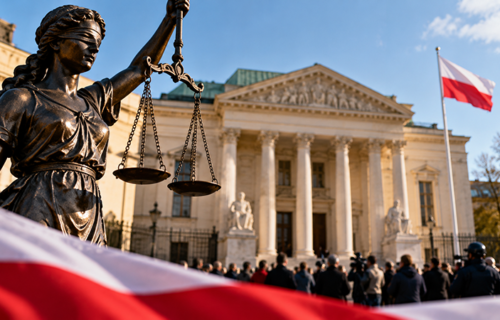
On 14 October, Berek took his oath during a parliamentary ceremony without the president present. The Presidential Chancellery challenged the procedure, while Constitutional Tribunal President Bogdan Święczkowski refused to admit him to judicial proceedings. Demonstrations outside the Tribunal’s headquarters further illustrated the political tensions surrounding the appointment.
The governing coalition argues that the president cannot prevent parliament’s chosen candidates from taking office by declining to receive their oaths. Presidential representatives maintain that judicial appointments must comply with statutory requirements, including those governing professional qualifications. The disagreement centres on whether the president’s participation is essential to the appointment process or whether alternative arrangements are permissible.
The Council of Europe’s Venice Commission addressed this question in October 2026, concluding that the president should receive the oath of a judge elected by parliament without independently reassessing the parliamentary decision. It also recognised that alternative procedures may be appropriate when presidential inaction prevents an elected judge from completing the normal process. Although influential, the Commission’s opinion is advisory and does not independently resolve every aspect of Berek’s appointment.
The dispute forms part of a broader constitutional conflict dating back to judicial appointments made during the previous Law and Justice administration. In 2021, the European Court of Human Rights identified irregularities involving the composition of Poland’s Constitutional Tribunal in the Xero Flor case. Prime Minister Donald Tusk’s government has committed itself to restoring judicial independence, but its approach has generated further disagreements about the constitutional limits of government authority.
Another unresolved issue concerns the publication of Constitutional Tribunal judgments. Since 2024, the government has withheld certain rulings because it considers the Tribunal’s composition legally defective. Critics argue that Article 190 of Poland’s Constitution requires the prompt publication of qualifying judgments and does not allow the executive to determine which decisions receive official recognition. Poland’s Commissioner for Human Rights and the Venice Commission have also raised concerns about withholding publication, while recognising that disputes over judicial appointments may require separate legal examination.
These overlapping disagreements have created a situation in which Poland’s principal constitutional institutions hold competing interpretations of their responsibilities. Parliament asserts its authority to appoint judges, the president challenges elements of the appointment process, and the Tribunal’s leadership controls participation in its proceedings. Meanwhile, the government disputes the authority of certain Tribunal rulings, leaving important questions about their legal consequences unresolved.
For businesses and investors, the principal concern is legal predictability. Constitutional decisions can influence taxation, property rights, commercial legislation and regulatory obligations. Uncertainty over judicial appointments and the status of Tribunal judgments may complicate assessments of legal risk, although there is no established evidence that the present dispute has directly reduced investment or commercial property activity.
Poland’s challenge now extends beyond the appointment of individual judges. Resolving the conflict will require procedures that address earlier judicial irregularities while respecting the constitutional responsibilities of each institution. Until a legally accepted framework emerges, the dispute will continue to raise questions about the effectiveness of constitutional oversight and the consistency of Poland’s legal environment.