Saturday, 10 October 2026
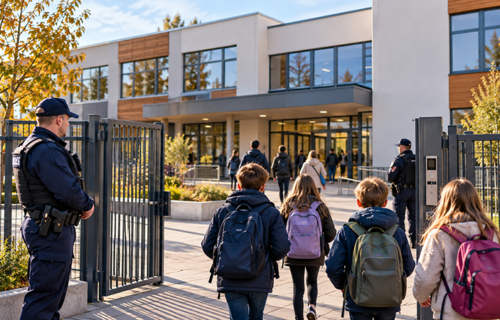
A nationwide security response following two violent attacks at schools in Poland has brought renewed attention to the operation and protection of educational properties. Police have carried out checks at more than 10,000 schools, while local authorities have introduced additional precautions and, in some areas, temporarily suspended classroom teaching. Beyond the immediate security concerns, the developments raise questions about how Poland’s educational buildings are managed and whether existing facilities can accommodate evolving safety requirements.
The measures follow incidents in Mazovia on 7 and 8 October. In Ostrołęka, a 19-year-old attacked people at a vocational school and in the surrounding area, leaving several injured. The following day, a 15-year-old former pupil attacked employees at a primary school in Leszczydół-Nowiny, near Wyszków. A 37-year-old member of staff died, while two colleagues were injured. The incidents prompted investigations and increased concern among parents, teachers and local authorities, particularly after warnings of further attacks began circulating online. Police have reported multiple arrests connected to threatening communications but have found no evidence of an organised nationwide campaign.
The response has differed across municipalities. Warsaw has maintained normal classroom activities while increasing police and municipal guard patrols around educational facilities. Schools have also been instructed to exercise greater control over access to their premises. Elsewhere in Mazovia, local administrations have adopted temporary closures or alternative teaching arrangements. In Wyszków municipality, primary schools and preschools suspended normal activities on 9 October, although supervision remained available for children requiring care. These decisions demonstrate the operational responsibilities facing municipalities and educational property managers when responding to unexpected security risks.
The situation highlights the particular challenges associated with managing educational buildings. Schools accommodate large numbers of children and employees throughout the day, with movement between classrooms, communal areas, sports facilities and outdoor spaces. Buildings must also provide access for parents, maintenance contractors and other authorised visitors. Unlike conventional office or commercial properties, educational facilities must combine effective supervision with an environment that supports learning, accessibility and freedom of movement. This creates practical considerations for building layouts, entrance arrangements and internal communication systems.
For municipalities responsible for public educational infrastructure, recent events may encourage closer examination of existing building arrangements. Older schools were frequently constructed before electronic access management and integrated security technology became widely available. Depending on the property, improvements could involve changes to reception areas, clearer separation between visitor and pupil circulation, upgraded communication equipment or better monitoring of entrances. However, the recent attacks have not established that deficiencies in building design contributed to the incidents, and there is no confirmed national programme requiring physical alterations to school properties.
Any future investment in educational building security would also have financial implications. Local authorities already face substantial expenditure on maintenance, heating systems, energy performance, accessibility and the renovation of ageing facilities. Introducing additional access-control equipment or monitoring technology would require expenditure on installation, electrical infrastructure, network connections and ongoing servicing. Such improvements would therefore need to be considered alongside existing municipal capital investment priorities, particularly where education budgets are already under pressure.
The potential implications extend to architects, engineers, construction companies and facility management providers involved in educational developments. Future school projects may place greater emphasis on the relationship between building configuration, supervision and emergency procedures. Entrances, reception areas and circulation routes can be designed to improve visibility and reduce uncontrolled movement without compromising accessibility or evacuation requirements. Nevertheless, building technology alone cannot address every security risk. Its effectiveness depends on appropriate operational procedures, trained personnel and cooperation between schools and emergency services.
The latest developments have also demonstrated the importance of communication infrastructure within educational institutions. As unverified warnings spread through social media, school administrators were required to communicate quickly with families and coordinate decisions with local authorities. Electronic school communication platforms have played a role in distributing instructions and explaining temporary changes to daily operations. For public building managers, the experience reinforces the value of reliable communication arrangements that can function during periods of uncertainty or disruption.
Although Poland has introduced extensive precautionary measures, there has been no confirmed announcement of new national construction regulations or dedicated funding for school security improvements arising from this week’s events. The immediate focus remains the protection of pupils and employees, while investigations continue. For the country’s educational property sector, the longer-term question is whether existing buildings and management procedures provide sufficient flexibility to respond to changing security demands. Any future modernisation measures will need to balance effective protection, operational practicality and the financial resources available to local authorities.