Tuesday, 15 September 2026
Russian attacks on transport infrastructure in western Ukraine have moved within kilometres of Poland, increasing security concerns along NATO’s eastern frontier and renewing debate over how Warsaw and its allies should respond without allowing military rhetoric to run ahead of events.
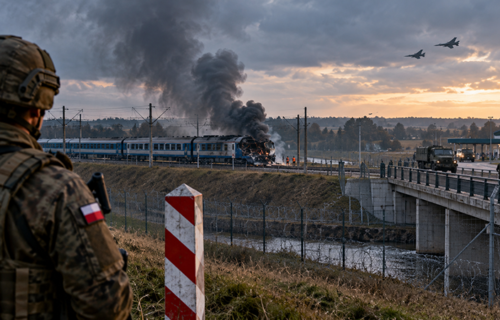
A Russian drone struck the locomotive of a passenger train at Yahodyn in western Ukraine on 13 September, around two kilometres from Polish territory. Passengers were evacuated and no casualties were reported. In a separate incident nearby, another Russian drone hit a truck close to Poland, temporarily disrupting operations at the Yahodyn-Dorohusk border crossing. Russia said its operations were directed against railway infrastructure involved in transporting military cargo from European countries.
The railway attack attracted additional attention because another train carrying former British Prime Minister Boris Johnson, former Swedish Prime Minister Carl Bildt and European security advisers had travelled through Yahodyn shortly beforehand. Ukraine’s state railway operator suggested that the diplomatic train could have been the intended target, although this has not been independently established. Former CIA director David Petraeus was aboard another train at the station when the drone struck.
The incidents underline the strategic importance of western Ukraine’s connections with Poland. Border crossings, railways and roads in the region provide important routes for humanitarian assistance and military equipment entering Ukraine from its Western partners. This makes transport infrastructure close to NATO territory increasingly exposed as Russia attempts to disrupt Ukraine’s supply network.
For Poland, the distinction between proximity and direct attack remains essential. The locomotive was struck inside Ukraine, not on Polish territory, and the incident was therefore not an attack against NATO. Nevertheless, repeated Russian military activity so close to the frontier increases the possibility of accidents, miscalculation and further escalation.
Polish Prime Minister Donald Tusk responded by bringing senior government and security officials together to assess the situation. Warsaw has become increasingly concerned that Russian military and hybrid activity could create more direct security problems for Poland as the war continues close to its borders.
Foreign Minister Radosław Sikorski has adopted a more assertive position. He has argued that NATO possesses a major advantage over Russia in air power and suggested that the alliance could defeat Russia relatively quickly in the event of a direct attack. He has also argued that European military capabilities would remain substantial even without full American involvement. These are strategic assessments rather than established predictions about how a future conflict would develop.
Europe has a much larger economic base than Russia and possesses sophisticated military technology, but economic scale and equipment numbers alone do not determine the ability to sustain a prolonged conflict. Ammunition production, logistics, air defence, intelligence, industrial capacity and political willingness would all become critical in a major confrontation.
For Poland, practical preparedness is therefore more important than predictions about how quickly Russia might be defeated. Investment in air and missile defence, surveillance, ammunition, military mobility and resilient transport and energy infrastructure strengthens deterrence while reducing the risks created by a war taking place immediately beyond the country’s eastern border.
Russia should neither be portrayed as an unstoppable military power nor treated as an opponent Europe could overcome without substantial costs. The more important objective is to ensure that Moscow sees any direct attack against NATO territory as carrying military, economic and political consequences far greater than any potential gain.
The strikes around Yahodyn demonstrate how physically close the war has moved to NATO territory. They do not mean that Russia and NATO are at war, but they reinforce the need for European governments to prepare for possible escalation without presenting such an outcome as inevitable.
For Poland in particular, credible deterrence will ultimately depend less on declarations about what NATO could do to Russia and more on demonstrating what Russia would encounter if it crossed the alliance’s border: prepared armed forces, protected infrastructure, adequate military supplies and allies capable of responding together.
Source: WEI