Sunday, 4 October 2026
India’s ambitious airport expansion programme is doing far more than improving air connectivity. It is reshaping the country’s real estate landscape by creating new commercial corridors, logistics hubs and urban growth centres around major aviation infrastructure.
Over the past decade, the government and private sector have invested heavily in expanding the aviation network to accommodate rising passenger numbers, strengthen regional connectivity and improve freight movement. As airports become larger and more sophisticated, the surrounding areas are attracting increasing interest from developers, investors and businesses seeking to benefit from improved accessibility.
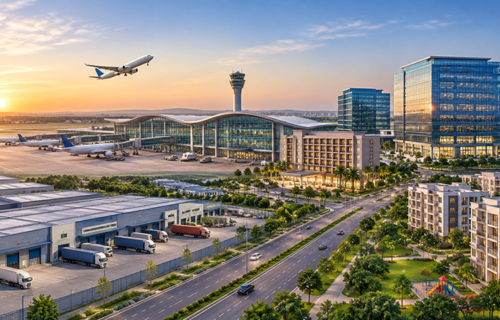
The result is the emergence of airport-led development, where aviation infrastructure acts as a catalyst for residential, commercial and industrial real estate.
A Rapidly Expanding Airport Network
India has significantly expanded its aviation infrastructure in recent years. The number of operational airports has more than doubled over the past decade, supported by the Regional Connectivity Scheme (UDAN), which has extended air services to many Tier II and Tier III cities.
Passenger traffic has also grown rapidly, driven by rising household incomes, increasing business travel and the expansion of domestic airlines. At the same time, both central and state governments continue to invest in airport modernisation through new terminals, runway expansions and greenfield airport developments.
Major projects such as Noida International Airport at Jewar, Navi Mumbai International Airport and expanding regional airports are expected to improve connectivity while easing congestion at existing metropolitan airports.
Alongside passenger infrastructure, airport operators are increasingly focusing on developing commercial facilities that generate revenue beyond aviation activities, creating entirely new business districts around airport campuses.
Better Connectivity Drives Land Values
One of the most immediate effects of airport development is the improvement in accessibility.
Areas that were previously considered peripheral often become attractive investment destinations once they gain faster access to domestic and international markets. Improved transport links encourage residential development, commercial projects and supporting infrastructure, contributing to higher land values over time.
This pattern has already been observed around several expanding airport regions, where infrastructure upgrades have accelerated urban development and attracted new private investment.
Growing Demand for Hospitality and Services
Rising passenger volumes generate demand well beyond airport terminals.
Hotels, serviced apartments, conference facilities, restaurants and retail developments often emerge to accommodate business travellers, tourists and airline staff. As airports evolve into major transport hubs, surrounding commercial activity becomes increasingly diversified, supporting long-term investment in hospitality and mixed-use developments.
Business parks and flexible office space are also becoming more common near major airports, particularly where companies require frequent domestic and international travel.
Logistics and Industrial Development
Airport expansion also strengthens India’s logistics sector.
Modern airports capable of handling larger cargo volumes create opportunities for warehousing, cold storage, freight terminals and distribution centres. Faster movement of goods is particularly valuable for industries handling pharmaceuticals, electronics, perishables and e-commerce fulfilment.
As supply chains become more sophisticated, logistics developers are increasingly targeting locations close to airports to improve delivery efficiency and reduce transportation times.
The combination of airports, highways and dedicated freight infrastructure is helping establish integrated logistics clusters across several regions.
Housing Demand Around Aviation Hubs
Airport development also creates significant employment opportunities.
Airlines, ground handling companies, maintenance services, hospitality businesses, logistics operators and retail outlets all require a growing workforce. This expansion increases demand for housing across a range of price segments, particularly in areas within convenient commuting distance of airport facilities.
As supporting social infrastructure such as schools, healthcare facilities and shopping centres develops alongside residential communities, many airport districts gradually evolve into self-contained urban centres rather than simply transport locations.
The Rise of Mixed-Use Airport Districts
Today’s airports generate a substantial proportion of their income from non-aviation activities, including retail, hospitality, entertainment, parking, office leasing and commercial real estate.
This shift has encouraged airport operators and developers to plan integrated mixed-use districts that combine business, residential and leisure facilities. Rather than functioning as isolated transport assets, airports are increasingly becoming anchors for wider urban development.
These airport cities, often referred to as “aerotropolis” developments in international markets, have the potential to transform surrounding regions into major economic hubs.
Looking Ahead
India’s airport expansion programme is likely to remain one of the country’s most significant infrastructure initiatives over the coming decade. Continued investment in regional connectivity, modern terminals and cargo capacity will strengthen both passenger travel and economic activity.
For the real estate sector, the opportunities extend well beyond airport boundaries. Improved connectivity, expanding logistics networks, growing employment and increasing commercial activity are creating new investment destinations across residential, industrial, hospitality and office property.
As India’s aviation network continues to expand, airport-led development is expected to play an increasingly important role in shaping the country’s next generation of urban growth corridors.
Source: © CIJ.World India Research & Analysis Team