Saturday, 19 September 2026
The European Central Bank has left its key interest rates unchanged following its latest monetary policy meeting, a move widely anticipated by market participants but one that underscores the growing uncertainty surrounding inflation and global economic stability.
Industry experts point to geopolitical tensions, particularly the ongoing conflict involving Iran and the potential disruption of key trade routes such as the Strait of Hormuz, as a central factor shaping the ECB’s cautious stance.
Prof. Dr. Felix Schindler, Head of Research & Strategy at HIH Invest, said the central bank’s decision to pause should not be interpreted as a definitive shift in direction. “Postponed is not cancelled,” he noted, highlighting that while inflation increases have so far been driven primarily by rising energy and commodity prices, underlying core inflation has yet to reflect these pressures. However, rising consumer inflation expectations remain a key concern.
Schindler added that a prolonged disruption to global trade could increase the likelihood of interest rate hikes later in the year, particularly if second-round inflationary effects begin to materialise. He also pointed out that capital markets have already adjusted, with higher rates largely priced into long-term real estate financing.
A similar assessment was offered by Prof. Dr. Steffen Sebastian of the IREBS Institut für Immobilienwirtschaft, who described the current macroeconomic environment as transitional. He warned that the global economy may be shifting from a period of slow growth and moderating inflation toward a phase characterised by heightened stagflation risks.
According to Sebastian, the duration of the conflict will be decisive. A short-lived disruption might have resulted in only temporary inflationary pressure, but a prolonged crisis could embed rising costs throughout supply chains, ultimately forcing central banks and capital markets to respond more aggressively. He also noted that ECB President Christine Lagarde had already signalled in April that further data would be required before any policy adjustment.
From a financing perspective, Francesco Fedele, CEO of BF.direkt AG, emphasised that markets are already anticipating additional rate increases this year. He pointed to a noticeable rise in the ten-year swap rate since the outbreak of the conflict, a key benchmark for real estate financing.
Fedele cautioned that even in a scenario where the ECB refrains from raising rates despite higher inflation, long-term borrowing costs could continue to increase as capital markets price in elevated inflation expectations. He added that expectations of rate cuts, which had been forecast prior to the conflict, are now likely to be delayed or may not materialise at all, signalling a longer-term shift away from the low-interest-rate environment that characterised previous years.
For lenders and investors, the ECB’s decision offers only temporary relief. Stefan Hoenen, Head of Commercial Real Estate at Hamburg Commercial Bank, described the move as a “pause” that provides short-term stability in financing costs and supports planning certainty for ongoing transactions.
However, he warned that this stability is fragile. “The pressure on pricing and yield expectations remains high,” Hoenen said, noting that elevated energy costs and inflation expectations continue to weigh on market sentiment. He suggested that the current pause should be viewed less as a signal of easing conditions and more as a prelude to potential tightening later in the year, with subdued market activity likely to persist.
Ulrich Creydt, Managing Director of Ypsilon Steuerberatungsgesellschaft, expressed some surprise at the ECB’s decision, citing a range of indicators that had pointed toward a possible rate increase, including rising inflation, supply chain disruptions and volatility in equity markets.
He suggested the central bank may be aiming to project confidence that geopolitical tensions have not yet translated into severe economic consequences for Europe. Nevertheless, Creydt warned that uncertainty remains high ahead of the ECB’s next policy meeting, with the possibility of a rate increase still firmly on the table. In the current environment, he advised borrowers to act decisively if favourable financing terms are available.
While the ECB’s decision provides a temporary pause for the real estate sector, the broader outlook remains closely tied to geopolitical developments and inflation dynamics. Market participants increasingly expect that monetary policy could tighten later in 2026 should external pressures persist.
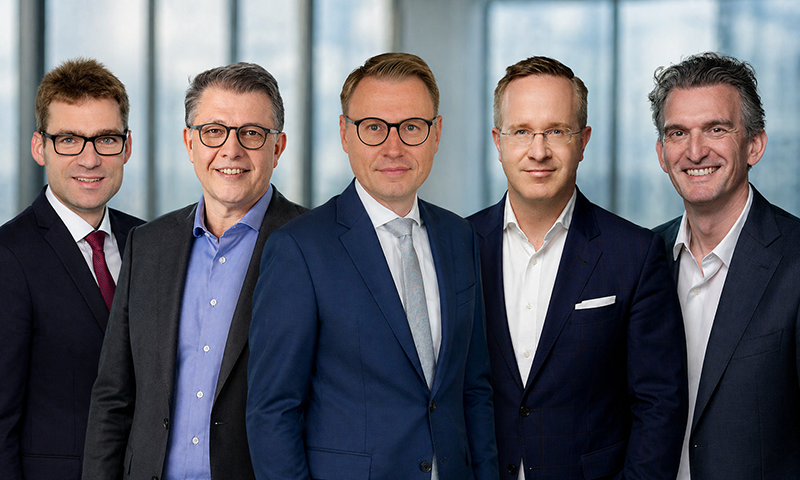
Photo: Left to right- Prof. Dr. Felix Schindler, Head of Research & Strategy at HIH Invest; Francesco Fedele, CEO of BF.direkt AG; Ulrich Creydt, Managing Director of Ypsilon Steuerberatungsgesellschaft; Stefan Hoenen, Head of Commercial Real Estate at Hamburg Commercial Bank and Prof. Dr. Steffen Sebastian of the IREBS Institut für Immobilienwirtschaft