Saturday, 19 September 2026
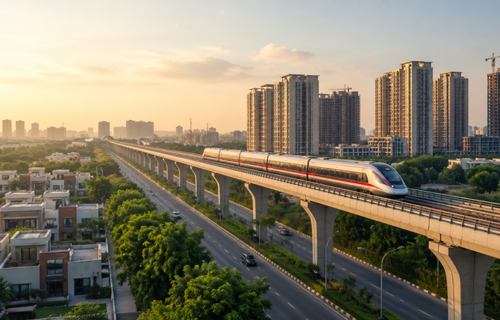
The rollout of the Delhi-Meerut Regional Rapid Transit System (RRTS), operated by National Capital Region Transport Corporation, marks a notable shift in how infrastructure is shaping urban expansion across India’s National Capital Region (NCR). While the full corridor is still being delivered in phases, the sections already in operation are beginning to alter both commuting patterns and real estate activity along the eastern axis of the region.
Designed to link Delhi with Meerut through a high-speed regional rail system, the corridor will ultimately span more than 80 kilometres, connecting key urban nodes including Ghaziabad and Muradnagar. Once fully operational, the line is expected to significantly reduce travel times between these cities, positioning them within a practical daily commuting range of the capital.
The project is supported by a mix of domestic and international financing, including institutions such as the Asian Development Bank, the Asian Infrastructure Investment Bank and the New Development Bank. It has been conceived as a regional mobility system rather than a metro network, with higher operating speeds and dedicated infrastructure intended to support inter-city movement.
As parts of the line have opened, early changes are visible in locations closest to operational stations. Areas such as Ghaziabad and nearby suburban clusters have seen increased residential interest, particularly from buyers seeking more affordable housing options within reach of Delhi. Improved accessibility has also begun to attract attention from developers, although activity remains uneven and concentrated in specific micro-markets.
The relationship between transport investment and property values is not new, but in this case the scale of the corridor is extending that effect beyond traditional city boundaries. That said, the extent of price growth varies widely depending on location, connectivity and the stage of infrastructure delivery. Increases reported in certain neighbourhoods reflect a combination of factors, including improved road links and broader expansion of the NCR, rather than the rail project alone.
At a planning level, the corridor aligns with wider efforts to concentrate development around transport hubs. Long-term strategies for Delhi and its surrounding region increasingly emphasise higher-density construction near major transit points, alongside a mix of residential, commercial and service functions. This approach is intended to reduce pressure on central areas while supporting more balanced urban growth.
Despite these early signals, the longer-term impact of the Delhi-Meerut RRTS will depend on the completion of the full route and its integration with existing transport systems. Commuter adoption, supporting infrastructure and the pace of development around stations will all play a role in determining how far the project reshapes the region.
For now, the corridor is contributing to a gradual shift in how people and businesses view locations beyond Delhi’s core. Whether this evolves into a more structural redistribution of demand across the NCR will become clearer as the network moves closer to full operation.
Source: CIJ.World India Research & Analysis Team