Sunday, 4 October 2026
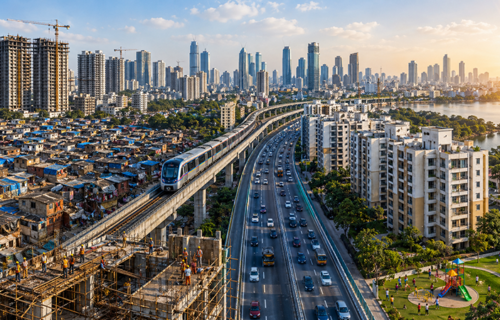
Rapid urbanisation continues to redefine the economic and social landscape of India, with major metropolitan regions expanding in both scale and complexity. Since the economic liberalisation reforms of 1991, cities such as Mumbai, Delhi, Bengaluru and Chennai have emerged as primary engines of growth, attracting investment, labour and infrastructure development.
According to the World Bank, India’s urban population is projected to expand significantly in the coming decades, with estimates suggesting that cities could house close to 50 percent of the population by 2050. This transition would make India one of the largest contributors to global urban growth.
Urban Expansion and Demographic Shifts
India’s urban population currently accounts for roughly 35-37 percent of the total population, depending on methodology and projections from institutions such as the United Nations. Over the next 25 years, the country is expected to add hundreds of millions of urban residents, driven by both migration and natural population growth.
Government analysis, including findings referenced in the Economic Survey of India, points to a clear pattern of outward expansion in major metropolitan regions. Growth is increasingly concentrated in peri-urban and suburban corridors, particularly along transport infrastructure, reflecting both affordability constraints in core areas and improvements in connectivity.
Housing Demand and Structural Shortages
Urbanisation continues to place significant pressure on housing supply. Estimates from government-backed assessments indicate an urban housing shortage of approximately 18–20 million units, with the deficit heavily concentrated in economically weaker sections (EWS) and lower-income groups.
Affordability remains a key challenge, particularly in high-cost cities. In markets such as Mumbai, price-to-income ratios are among the highest globally, limiting access to formal housing. Regulatory constraints, including floor space index (FSI) limits and complex approval processes, have historically restricted supply, although gradual reforms are underway.
Large-scale programmes such as Pradhan Mantri Awas Yojana aim to address these gaps, but delivery has been uneven relative to demand.
Infrastructure Pressures and Investment Needs
Urban infrastructure continues to lag behind population growth in many cities. Challenges related to transport congestion, waste management and access to basic services remain persistent.
Cities such as Bengaluru have become emblematic of infrastructure strain, with congestion resulting in measurable economic losses. Studies cited by NITI Aayog highlight the significant productivity impact of traffic delays in major urban centres.
At the same time, investment in mass transit systems has accelerated. India’s metro rail network has expanded rapidly, now spanning over 1,000 kilometres across multiple cities. Projects such as the Delhi-Meerut Regional Rapid Transit System (RRTS) are expected to further improve regional connectivity, although private vehicle usage continues to dominate urban mobility patterns.
Living Standards: Gains and Trade-offs
Urbanisation has contributed substantially to economic growth. Estimates from institutions including Asian Development Bank indicate that cities generate more than 60 percent of India’s GDP, a share expected to increase over time.
However, improvements in income and access to services are offset by rising concerns around quality of life. Air pollution, congestion and limited access to affordable housing continue to affect living conditions in major metropolitan areas.
India is also home to one of the world’s largest informal housing populations, reflecting structural gaps in housing delivery and urban planning. While estimates vary, the scale of informal settlements remains a critical policy challenge.
A Structural Transition with Long-Term Implications
India’s urban transition represents a structural shift that will define its economic trajectory over the coming decades. While cities are expected to remain central to growth, the sustainability of this expansion will depend on coordinated reforms in housing policy, infrastructure investment and urban governance.
Improving affordability, increasing density through planning reforms and strengthening transport linkages with secondary cities will be essential to managing future growth. Without such measures, the gap between economic output and living standards is likely to persist.
Source: CIJ.World India Research & Analysis Team