Friday, 16 October 2026
Yareal Polska has relocated its headquarters to a newly designed 750 sqm office within the LIXA business complex in Warsaw, demonstrating how established office developments can accommodate changing workplace requirements without companies having to move to different locations. The developer has transferred its operations to the second floor of LIXA C, while the premises it previously occupied in LIXA B have already attracted another tenant.
The relocation represents an internal move within the five-building campus near Rondo Daszyńskiego, one of Warsaw’s principal commercial districts. Rather than expanding into a separate property, the company has reorganised its accommodation around a new interior layout intended to provide greater flexibility for employees and improve the experience of visiting clients.
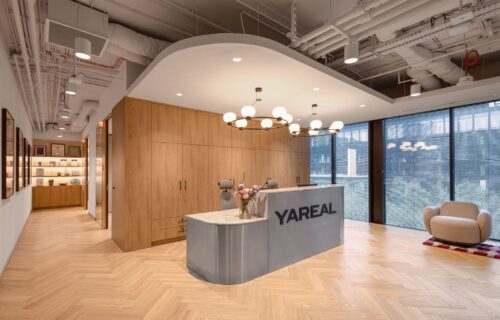
The Design Group was responsible for the architectural interiors, with Katarzyna Oleksińska managing the project on behalf of Yareal. The design combines traditional office facilities with features commonly found in residential properties, including natural materials, softer lighting and a less formal arrangement of working areas. The objective was to create an environment suited to different professional activities while maintaining the standards expected of a corporate headquarters.
The office is organised into separate areas for external meetings and internal operations. Reception and visitor spaces feature timber flooring, marble finishes and oak detailing, while the main employee areas combine shared workstations with enclosed rooms and smaller spaces for individual work. Planting, subdued colours and carefully arranged lighting are used throughout the premises to create a consistent interior environment.
Digital systems have been incorporated to support everyday operations, including mobile access to the office and electronic management of meeting room availability. The technology is intended to simplify how employees use the space rather than introduce unnecessary complexity. This reflects an approach to workplace planning in which building functionality and employee requirements take priority over highly visible technological installations.
The move also has implications for the management of the wider LIXA development. The previous office space in LIXA B was leased again shortly after becoming available, indicating continued interest in accommodation within the complex. For property owners, retaining an existing occupier within a development while securing a replacement tenant for vacated premises can help maintain rental income and reduce the disruption associated with tenant relocations.
LIXA was developed by Yareal in several stages and comprises five buildings with approximately 77,000 sqm of office space. The architectural design was prepared by HRA Architekci, with the campus incorporating commercial services, restaurants and landscaped public areas. Yareal currently owns the LIXA C and LIXA E buildings, maintaining a direct investment interest in part of the completed development.
More than 5,500 sqm of outdoor space is distributed across the campus, including landscaped courtyards and terraces. These areas provide connections between the buildings and contribute to the wider pedestrian environment. The new headquarters overlooks one of the courtyards, integrating the office with the surrounding outdoor facilities.
The development also incorporates recognised environmental and building performance standards. Properties within LIXA have obtained certifications including BREEAM Excellent, WiredScore Platinum, WELL Health-Safety, ActiveScore and AirRated. These assessments address different aspects of building performance, ranging from environmental efficiency and digital infrastructure to indoor conditions and facilities supporting active transport.
The relocation highlights the importance of adaptable office accommodation in Warsaw’s established business districts. Companies increasingly evaluate premises according to how effectively they support daily operations, employee preferences and long-term organisational requirements. For developers and landlords, the ability to offer different workplace configurations within the same complex can support tenant retention while creating opportunities to lease space released through internal relocations.