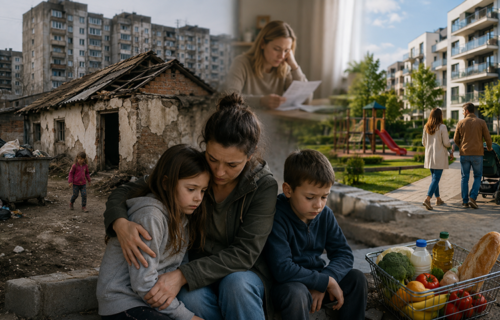
Monday, 21 September 2026
The share of people facing poverty or social exclusion in Slovakia declined in 2025 after several years of deterioration linked to the pandemic period, inflation and rising living costs. However, significant differences between regions and household types remain, according to new data published by Statistical Office of the Slovak Republic.
The survey found that 16.7% of Slovakia’s population experienced at least one form of poverty or social exclusion during 2025, representing more than 895,000 people. Compared with the previous year, the number of affected residents fell by almost 85,000, marking the first notable improvement after four consecutive years of worsening indicators.
The study examines three main areas linked to social vulnerability: insufficient income, inability to afford essential goods and services, and very low participation in the labour market.
The number of people affected by all three dimensions simultaneously also decreased. According to the survey, around 77,000 residents were exposed to the most severe form of social exclusion, down significantly from the previous year.
Although national figures improved overall, regional disparities remained pronounced. The lowest levels of poverty risk were recorded in the Bratislava, Žilina and Trnava regions, where fewer than one in ten residents were affected. Conditions were considerably more difficult in eastern and central parts of the country, particularly in the Prešov, Banská Bystrica and Košice regions.
Prešov Region recorded the highest level of vulnerability, with almost 30% of residents affected by at least one poverty-related factor. In Banská Bystrica Region, more than a quarter of the population faced similar challenges.
The report noted that six out of Slovakia’s eight regions recorded year-on-year improvements. Bratislava Region saw the sharpest decline in the share of affected residents, while Žilina Region also posted a significant reduction.
Household composition continued to play a major role in determining financial vulnerability. Single-parent households remained the group most exposed to poverty risk, with around half of all people living in these households affected. Conditions also worsened among families with three or more dependent children, where more than one third of residents faced financial hardship.
Among households without children, women under the age of 65 living alone were identified as the group most exposed to economic pressure.
Low income remained the most common form of poverty in Slovakia. In 2025, approximately 652,000 residents lived below the nationally defined poverty threshold. For a single-person household, the threshold corresponded to an annual income of less than €7,794, or roughly €650 per month.
The report also examined material deprivation, which measures the inability of households to afford common living expenses and activities. Around 7% of the population experienced serious material and social deprivation during 2025.
The most common financial difficulties included the inability to afford a one-week holiday away from home, problems covering unexpected expenses and delays in replacing worn-out furniture.
A separate indicator focused on households with very low work intensity showed that around 3.1% of the population lived in homes where working-age adults were employed only minimally during the year.
The Statistical Office stated that updated methodology introduced for the latest survey incorporated additional administrative data from the Social Insurance Agency in order to improve the quality and accuracy of income measurements while maintaining comparability with previous years.