Saturday, 4 April 2026
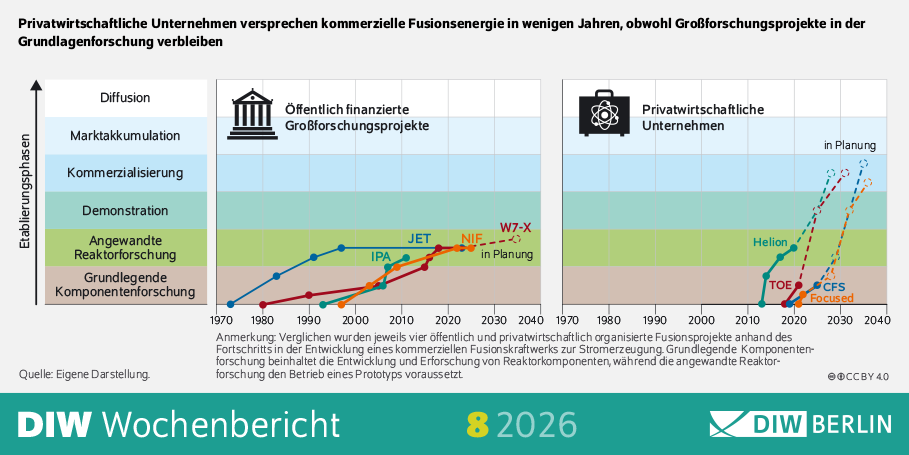
A new study by the German Institute for Economic Research (DIW Berlin) concludes that nuclear fusion remains distant from practical use in the energy sector despite decades of public investment. The report argues that while large publicly funded research institutions continue to pursue long-term ambitions of building fusion power plants, private companies are increasingly concentrating on specialised technologies with nearer-term commercial applications.
According to the authors, many private firms are directing their efforts toward components such as advanced magnets, laser systems and related industrial technologies that can be applied in areas including medicine and manufacturing. These developments, the study notes, often have clearer short, and medium-term business potential than the construction of full-scale fusion reactors.
“Nuclear fusion is not an energy issue, but rather an innovation policy issue,” said Christian von Hirschhausen, DIW Fellow in the Energy, Transport and Environment Department and one of the study’s authors. “Most private companies are not working on the realisation of a fusion power plant, but on the commercialisation of niche products.”
The research compares several private-sector companies with major publicly funded projects using a newly developed evaluation framework. The analysis shows a widening gap between public programmes, which often project timelines extending beyond mid-century, and private initiatives that operate on shorter innovation cycles. The authors suggest that this divergence warrants a reassessment of how public funds are allocated.
“German research policy should not be geared towards the goal of building the world’s first fusion power plant, but should instead promote the innovative strength of private companies,” said Charlotte Dering of the Technical University of Berlin, a co-author of the study. Alexander Wimmers, another contributor, added that “public funds should be targeted at technologies with short-term potential for use, regardless of the energy use of nuclear fusion.”
The study proposes the introduction of regular independent monitoring of fusion research to evaluate the effectiveness and risks of continued public financing. Such a mechanism, the authors argue, would provide a more objective basis for long-term funding decisions.
Claudia Kemfert, head of DIW Berlin’s Energy, Transport and Environment Department, said the findings indicate that “nuclear fusion has been announced for ‘in a few years’ for decades, but is not expected to contribute to energy supply or the energy transition in the foreseeable future. The sector has long been an innovation-driven field of technology whose economic prospects are based more on specialised niche products than on a functioning power plant, and thus primarily on competition for research funding.”
Source: DIW Berlin