Tuesday, 17 November 2026
The residential property market in Łódź recorded stronger sales activity during the third quarter of 2026, while asking prices remained relatively unchanged. The combination of improving demand and a substantial selection of available flats distinguishes the city from more expensive Polish housing markets, particularly Warsaw, where higher-priced properties have a greater influence on overall price levels. According to Otodom Analytics, approximately 13,100 new flats were sold across Poland’s seven largest residential markets between July and September 2026, an increase of 25% compared with the corresponding period in 2025. Developers introduced around 11,000 flats during the quarter, representing a 16% decline from the previous three months. In Łódź, more than 420 flats were sold in July alone, while 290 new units entered the market across 16 developments.
Despite the improvement in transactions, there has been little evidence of significant upward pressure on residential property prices in Łódź. Data from BIG DATA RynekPierwotny.pl show that average asking prices reached approximately PLN 11,500 per sqm in September, remaining broadly unchanged from August. The median stood at PLN 11,200 per sqm, indicating a relatively narrow difference between the city’s two main price indicators. Warsaw presents a different pricing structure, with average asking prices exceeding PLN 19,900 per sqm in September and the median reaching PLN 17,500 per sqm. The wider difference suggests that expensive properties have a more pronounced effect on Warsaw’s overall market figures than they do in Łódź.
The availability of housing remains an important factor in the city’s pricing conditions. In August 2026, approximately 6,100 new flats in Łódź were listed at prices not exceeding PLN 12,000 per sqm, representing a 7% increase from the previous year. Over the same period, the average asking price of available properties increased by approximately 1%, indicating that a substantial selection of lower-priced housing has coincided with limited overall price growth. Differences are more noticeable at district level. Figures published by RynekPierwotny.pl for October indicate that average asking prices in Śródmieście reached approximately PLN 13,200 per sqm, around 15% above the citywide average. The difference reflects the higher prices associated with central locations, although it does not establish that individual properties offer better construction standards or facilities.
These conditions are influencing how developers approach more expensive residential projects. With a substantial selection of flats available at lower prices, developments seeking higher selling prices face the challenge of demonstrating differences in construction quality, building design, internal layouts and facilities. Location remains important, but it is only one of several factors affecting the value of individual properties.
Tomasz Świeboda, President of REAL Development, believes that the competitive position of higher-priced residential schemes increasingly depends on features that distinguish them from conventional developments. He explains: “With average prices remaining stable and a wide selection of flats still available in lower price brackets, location alone is not enough to justify a higher price. The competitive advantage of a development increasingly depends on features that buyers will not find in a standard project, from architecture and materials to the quality of communal areas and how the building fits into its surroundings.”
His comments reflect the challenge facing developers seeking to establish a higher-priced segment in a market where buyers retain access to a substantial number of more affordable alternatives. JLL’s approach to classifying higher-end residential developments similarly considers a combination of characteristics rather than price alone. Architectural design, materials, functional arrangements and communal facilities are assessed alongside location when distinguishing higher-specification properties from conventional residential schemes.
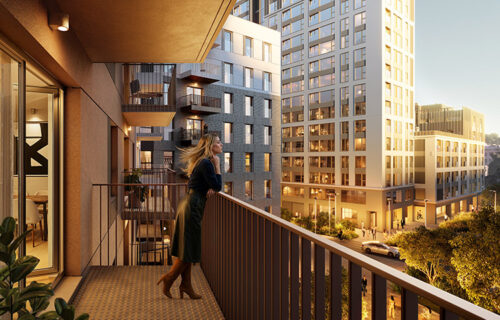
An example of new residential construction in central Łódź is Piano Forte, a project being developed by REAL Development between Jaracza and Uniwersytecka streets. The development is located on the former site of the Łódź gasworks and forms part of the continuing conversion of previously industrial land into residential and commercial uses. The first phase is planned to comprise 200 flats and 16 commercial units, while the wider development includes proposals for a publicly accessible square, a courtyard and a new street. These elements are intended to introduce additional pedestrian connections and public space within a part of Śródmieście undergoing redevelopment.
The interior design of the building’s communal areas has been developed in collaboration with Polish fashion designer Gosia Baczyńska. Her involvement covers the arrangement of shared spaces and the selection of finishes and materials, including ceramic products supplied by Ceramika Paradyż. Discussing the collaboration, Świeboda says: “We want to create solutions that retain their aesthetic and practical value for decades to come. We believe this is how the higher-end residential market in Łódź should develop, through considered design decisions rather than copying popular approaches from other cities.”
The collaboration represents one approach being adopted by developers seeking to distinguish residential buildings through their interior design. However, the extent to which such features influence sales performance or achievable prices will depend on buyer demand and the additional costs associated with their implementation.
The redevelopment of the former gasworks site also reflects a wider pattern of urban change in Łódź, where former industrial and infrastructure properties continue to be adapted for new purposes. Such projects can increase residential supply in established urban areas while introducing additional services and public spaces. Their wider contribution depends on how successfully they connect with surrounding streets, existing buildings and local infrastructure. For developers, the redevelopment of central sites also involves balancing construction costs, design requirements and the purchasing power of prospective residents.
The available market data suggest that Łódź remains considerably less expensive than Warsaw, even in its central districts. At the same time, stronger property sales and continued investment in redevelopment indicate that the city’s residential market is becoming more varied. Whether higher-priced developments can establish a larger share of the Łódź market will depend on actual transaction prices, household purchasing power and buyers’ willingness to pay for differences in building specifications. For now, relatively stable asking prices and a broad selection of available flats continue to shape competition among residential developers.