Friday, 27 November 2026
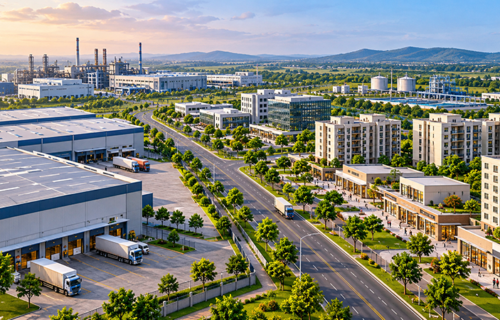
India’s industrial expansion is reshaping the property market as manufacturing corridors develop into larger employment centres incorporating warehouses, worker accommodation and commercial facilities. The shift is widening the role of developers and investors beyond conventional factory premises, particularly in locations where industrial activity is becoming established. Government information published in December 2025 identified more than 4,500 industrial parks covering approximately 770,000 hectares, with around 135,000 hectares available for industrial use. The National Industrial Corridor Development Corporation (NICDC) is also involved in 20 industrial park and smart-city projects, reflecting the scale of India’s manufacturing development programme.
Gujarat’s Dholera Special Investment Region illustrates the approach. The planned region covers approximately 920 sq km, including an initial development area of around 22.5 sq km. Government updates in 2025 indicated that essential infrastructure in the first development area was approaching completion, establishing a foundation for industrial operations and subsequent property development. Maharashtra’s Shendra-Bidkin Industrial Area, also known as Aurangabad Industrial City or AURIC, is further advanced in manufacturing activity. NICDC reported in August 2025 that 65 industrial units were operational and another 64 companies were undertaking construction. The concentration of businesses provides a basis for logistics facilities, employee accommodation and services connected to manufacturing operations.
The Integrated Industrial Township Greater Noida in Uttar Pradesh represents another stage of development. Covering approximately 747 acres, the project benefits from access to major transport networks. NICDC reported four operational companies and one under construction in August 2025, illustrating how industrial occupation can progress more gradually than infrastructure delivery. Together, these projects demonstrate the different stages of India’s industrial township programme, from large-scale infrastructure construction to locations with established manufacturing operations.
Logistics is a major component of this expansion. Colliers reported that industrial and warehousing leasing across eight Indian cities reached 36.9 million sq ft in 2025, increasing 16% year on year, with third-party logistics operators accounting for approximately 32% of transactions. Its February 2026 research also identified 30 cities with significant industrial and logistics potential and projected that annual demand for Grade A space across eight principal markets could exceed 50 million sq ft by 2030. The findings indicate the potential for further development of warehouses, distribution centres and specialised logistics facilities serving manufacturing clusters and freight corridors.
Worker accommodation is another area receiving greater attention. NITI Aayog’s December 2024 research identified regulatory and financial obstacles to affordable rental housing near manufacturing facilities. The Union Budget 2024–25 subsequently proposed dormitory-style accommodation through public-private partnerships supported by viability gap funding. Such facilities can address housing shortages in industrial locations where employees face lengthy commutes. Separate residential markets may also develop for engineers, skilled workers and management staff, particularly where permanent employment supports family housing and neighbourhood services.
Commercial uses generally follow the establishment of manufacturing operations. Offices, training centres, shops and healthcare facilities can serve businesses and their employees, although their scale depends on local employment and the services already available in surrounding towns. India’s Industrial Park Rating System 3.0, introduced in September 2025, reflects greater attention to infrastructure quality, freight connectivity, environmental performance and operational services. The framework allows industrial locations to be assessed against a broader range of characteristics than the availability of factory land alone.
The development of larger manufacturing districts also involves cooperation between public authorities and private developers. Governments may provide land and major transport connections, while private companies deliver industrial buildings, warehouses, accommodation and commercial property through leases, development agreements or public-private partnerships. These property types typically develop at different stages, allowing projects to expand in phases as industrial occupation increases and helping align construction with the requirements of manufacturers, logistics operators and employees.
As India’s manufacturing corridors mature, the development of logistics, residential and commercial assets will become an increasingly visible part of industrial growth. Dholera, AURIC and Greater Noida illustrate how the pace of industrial occupation influences the surrounding property market. For developers and institutional investors, the opportunity lies in identifying locations where established manufacturing activity can support a wider range of income-producing assets, extending the economic value of industrial development beyond factory premises.
Source: © CIJ.World India Research & Analysis Team