Wednesday, 28 October 2026
Romania’s new Territorial Planning, Urbanism and Construction Code (CATUC), which entered into force on 25 August 2026, introduces a simplified administrative procedure for certain small residential developments in rural areas. The legislation, adopted through Law No. 169/2026, allows qualifying single-family houses with a developed floor area of up to 150 sqm to proceed through a notification process rather than the conventional building-permit procedure. The changes could make smaller residential projects easier to develop, although eligibility remains subject to planning, architectural and technical requirements.
Under Article 294 of the legislation, the simplified procedure applies to individual houses situated within the designated built-up boundaries of rural settlements. Eligible properties must not exceed 150 sqm of developed floor area and must generally be limited to a ground-floor configuration or a semi-basement and ground floor. The development must also meet requirements concerning land ownership, site access, local planning regulations and restrictions affecting protected areas. Consequently, the procedure does not automatically apply to every small house or holiday property, regardless of its location or intended use.
The new framework does not eliminate the requirement for professional design or technical documentation. Property owners must submit the prescribed notification and supporting documents, including a simplified technical execution project prepared by qualified professionals. Articles 295 and 296 establish the administrative process through which local authorities assess compliance and determine whether a project can proceed under the simplified arrangements. The legislation provides for a 15-working-day response period under specified conditions, followed by an additional statutory period before construction can begin. Projects that fail to meet the relevant requirements remain subject to the conventional approval process.
The regulatory changes are particularly relevant to Romania’s rural holiday-home market. According to figures attributed to the 2021 Population and Housing Census, the country had 178,226 holiday homes, of which 141,654, approximately 79.5%, were located in rural communities. The largest concentrations were recorded in Prahova, with 16,006 properties, followed by Buzău with 14,080, Argeș with 13,121, Cluj with 10,127 and Dâmbovița with 7,928. These locations include established mountain and recreational destinations where demand for smaller residential properties may support development activity. The detailed census figures remain subject to confirmation against the original statistical tables.
Interest in holiday properties has also increased, according to research published by Romanian property platform Storia. Its April 2026 analysis recorded a 141% annual increase in holiday-home-related search activity within the relevant section of the platform. Although this indicates growing attention from prospective buyers, the figure measures online searches rather than completed transactions or new construction. Independent property consultancy Colliers has separately estimated Romania’s holiday-home stock at approximately 180,000 properties, broadly consistent with the scale indicated by the census figures.
For prospective buyers and smaller residential developers, the distinction between land situated within a settlement’s approved development boundary and land outside that area remains particularly important. A rural location alone does not establish eligibility for the notification procedure. Local planning restrictions, road access, utility connections, ground conditions and environmental protections can influence whether a project is permitted and how much it will cost to complete. The new legislation therefore increases the importance of assessing a plot’s development potential before completing a purchase.
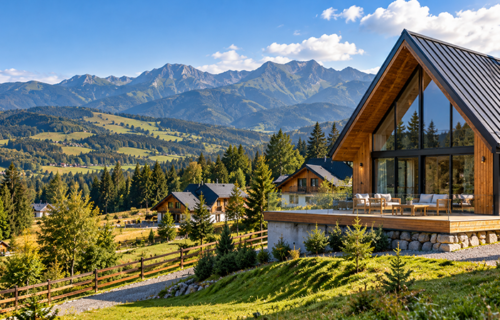
The changes may also influence demand for compact houses, standardised residential designs and prefabricated construction, particularly in locations associated with weekend and seasonal accommodation. However, the architectural form of a building, including an A-frame or modular design, does not independently determine eligibility for simplified approval. The legislation concerns qualifying single-family dwellings and should not be interpreted as providing a general exemption for guesthouses, holiday parks or other commercial tourist accommodation. Developers considering rental properties must establish how the intended use is classified under the applicable regulations.
Although the notification procedure could reduce administrative complexity, the financial requirements of rural residential construction remain substantial. Land preparation, foundations, structural works, utility installations, professional design, interior finishes and landscaping can account for a significant proportion of the total investment. Limited infrastructure in some rural locations may further increase development costs, particularly where connections to electricity, water, wastewater systems or public roads require additional expenditure. Simplified administrative requirements do not necessarily translate into lower construction costs.
For Romania’s residential property market, CATUC represents a potentially important adjustment to the development framework for smaller rural homes. Its practical impact will depend on how consistently local authorities implement the notification procedure, the availability of suitable development land and the ability of buyers to finance construction. While the legislation could support individual housing projects and create opportunities for smaller contractors and residential developers, it is too early to determine whether it will generate measurable increases in construction activity, land transactions or property values. The coming months will provide an initial indication of whether the administrative changes translate into greater development activity across Romania’s rural communities.