Thursday, 15 October 2026
Germany could face a substantial decline in retirement income relative to average earnings if future pension increases were linked exclusively to inflation rather than wage growth, according to research published by the German Institute for Economic Research (DIW Berlin) on 14 October 2026. The study examines how alternative pension adjustment mechanisms could affect public finances, household income and financial security in old age. Its findings are particularly relevant as Germany considers how to finance retirement benefits for an ageing population while maintaining manageable contribution requirements for employees and employers.
Under the existing German pension system, adjustments are largely influenced by wage developments, allowing retirees to benefit indirectly from rising earnings across the economy. Moving towards increases based solely on consumer prices would change this relationship. Although pension payments could retain their purchasing power against general inflation, they would gradually fall behind average wages if earnings increased more quickly than prices. The researchers estimate that under a comprehensive inflation-based system, the pension level could decline from approximately 48% today to 32% by 2070.
The study considers several approaches rather than a single reform proposal. One option would apply inflation adjustments to both accumulated pension entitlements and payments made after retirement. Another would preserve the existing method of calculating entitlements but limit subsequent increases to inflation. The second approach would have a smaller financial impact, potentially reducing the projected pension contribution rate by approximately 1.5 percentage points while lowering the average pension level by around three percentage points compared with the current framework.
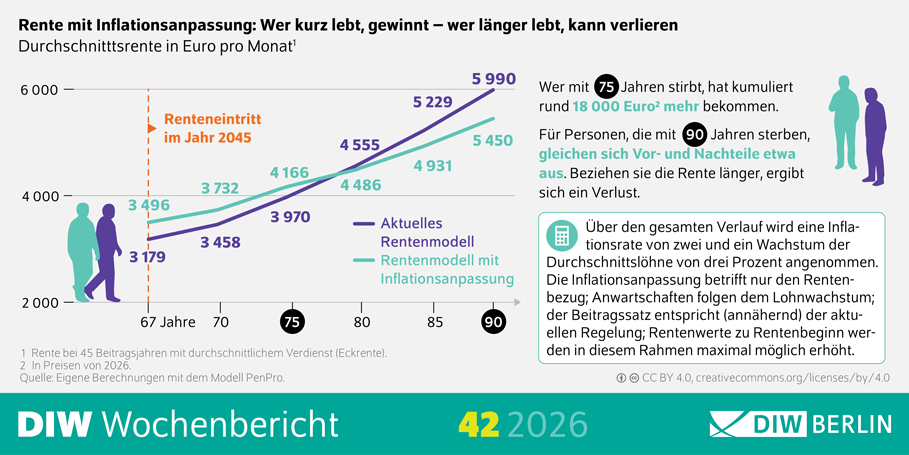
A third approach would provide retirees with higher payments at the beginning of retirement, followed by smaller annual increases linked to inflation. This could benefit individuals who receive pensions for relatively short periods, as they would collect more income during their early retirement years. However, the advantage would gradually disappear for people living longer, potentially leaving those reaching advanced old age with lower monthly payments than under the existing system.
To illustrate the difference, researchers modelled the retirement income of a hypothetical employee who begins receiving a pension in 2045 after 45 years of contributions at average earnings. Under the existing arrangement, monthly payments would rise from €3,179 at age 67 to €5,990 at age 90. Under the alternative system offering a higher initial pension, payments would begin at €3,496 but reach only €5,450 by age 90. These projections assume annual inflation of 2% and average wage growth of 3%, making the eventual outcome dependent on future economic conditions.
The financial consequences would also vary between population groups. Individuals with shorter life expectancy could benefit from receiving more income immediately after retirement, while those living into their late eighties or nineties could experience a growing disadvantage. Women may be particularly exposed because they generally live longer and often receive lower pension payments. The researchers therefore question whether changing the entire pension adjustment system would be an effective way to support financially vulnerable retirees.
The findings also raise wider questions about housing affordability among Germany’s older population. Pension income plays an important role in determining whether retired households can meet rental payments, property maintenance costs, utilities and other essential expenses. If retirement income grows more slowly than earnings, pensioners could face increasing difficulties in housing markets where accommodation costs rise faster than general inflation. The consequences would vary according to homeownership, rental arrangements, household savings and access to additional support.
Rather than introducing a broad change to inflation-based pension increases, the researchers favour strengthening financial assistance for people receiving smaller pensions. Possible measures include improving existing pension supplements and extending allowances available to low-income retirees. The study suggests that targeted support could address retirement income inequalities without reducing future pension growth for those who live longer. For Germany’s housing market, the broader consideration is how pension policy and demographic change may influence residential affordability and demand over the coming decades.