Tuesday, 20 October 2026
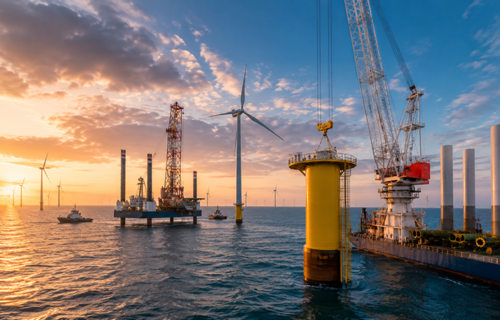
Construction of the Bałtyk 2 and Bałtyk 3 offshore wind farms has passed another major milestone, with foundations now installed for all 100 planned wind turbines together with the supporting structures for the projects’ two offshore substations.
Developed jointly by Polenergia and Equinor, the two Baltic Sea projects will have combined generating capacity of 1.44 GW. Their progress is also becoming increasingly relevant to Poland’s onshore investment landscape as offshore construction creates requirements for ports, industrial facilities, logistics infrastructure and permanent servicing operations.
The recently completed installation campaign covered 100 monopiles and transition pieces for the turbines as well as two jacket structures that will support the offshore substations. At the busiest point of the operation, approximately 35 vessels were involved around the construction sites.
The turbines planned for the projects will each have capacity of 14.4 MW and reach approximately 260 metres in height. Installing equipment on this scale requires specialised vessels and extensive coordination between offshore construction and the ports and logistics facilities supplying the projects.
Attention will now increasingly shift towards the remaining electrical infrastructure and turbine installation. Work is continuing on export cables and preparations for the network connecting individual turbines, while the offshore substations themselves still have to be installed on their supporting structures.
Turbine installation is scheduled for 2027. Bałtyk 2 and Bałtyk 3 are also expected to begin generating their first electricity during that year, with full commissioning targeted for 2028.
For the property and infrastructure markets, the projects demonstrate how Poland’s offshore wind programme is creating investment requirements far beyond the turbines themselves. Large offshore developments need areas for handling and storing components, specialised port infrastructure, technical facilities, transport connections and bases capable of supporting vessels and maintenance teams.
Łeba is emerging as an important part of this network. An operations and maintenance base there will support Bałtyk 2 and Bałtyk 3, giving the coastal location a role that will extend beyond the construction period. Once the wind farms are operating, servicing the turbines and offshore infrastructure will require technicians, vessels, equipment storage and supporting facilities over the projects’ operating lives.
This longer-term requirement distinguishes operations bases from temporary construction facilities. Offshore wind can consequently generate sustained demand for certain types of coastal property and infrastructure rather than producing activity only while turbines are being installed.
The development of further offshore capacity could also increase the strategic importance of industrial land around Poland’s Baltic ports. Sites capable of accommodating large components, storage, assembly, manufacturing or marine-support activities may become increasingly relevant as the offshore supply chain expands.
Not every coastal location will benefit equally. Port capacity, water depth, available industrial land, road and rail accessibility and proximity to offshore development areas will all influence where supply-chain businesses establish operations.
Grid infrastructure represents another substantial component of the investment programme. Electricity generated offshore must be transmitted to land and integrated into Poland’s power system, requiring subsea and onshore cables, substations and connections with the national transmission network.
For developers and industrial investors, this creates a wider investment map around offshore energy. Opportunities can potentially extend from port-related industrial property and warehouses to manufacturing, component handling, technical facilities and long-term maintenance infrastructure.
The completion of the turbine foundations at Bałtyk 2 and Bałtyk 3 therefore represents more than progress on two individual energy projects. It demonstrates that Poland’s offshore wind programme is moving deeper into physical delivery, with increasingly visible consequences for the country’s ports, logistics networks, industrial locations and coastal infrastructure.
With turbine installation and first electricity expected in 2027 and full commissioning planned for 2028, the next stage will show how quickly the offshore construction programme translates into a broader industrial ecosystem along Poland’s Baltic coast.